
Scientists trap light in a layer 1,000x thinner than hair
- Date:
- April 5, 2026
- Source:
- University of Warsaw, Faculty of Physics
- Summary:
- Researchers have created a nanoscale structure that traps infrared light in a layer just 40 nanometers thick—over 1,000 times thinner than a human hair. By using a unique material with exceptional light-bending properties, they can confine and intensify light far beyond previous limits. This setup also dramatically boosts light conversion effects, turning infrared into visible blue light. The advance could pave the way for smaller, faster photonic technologies.
- Share:
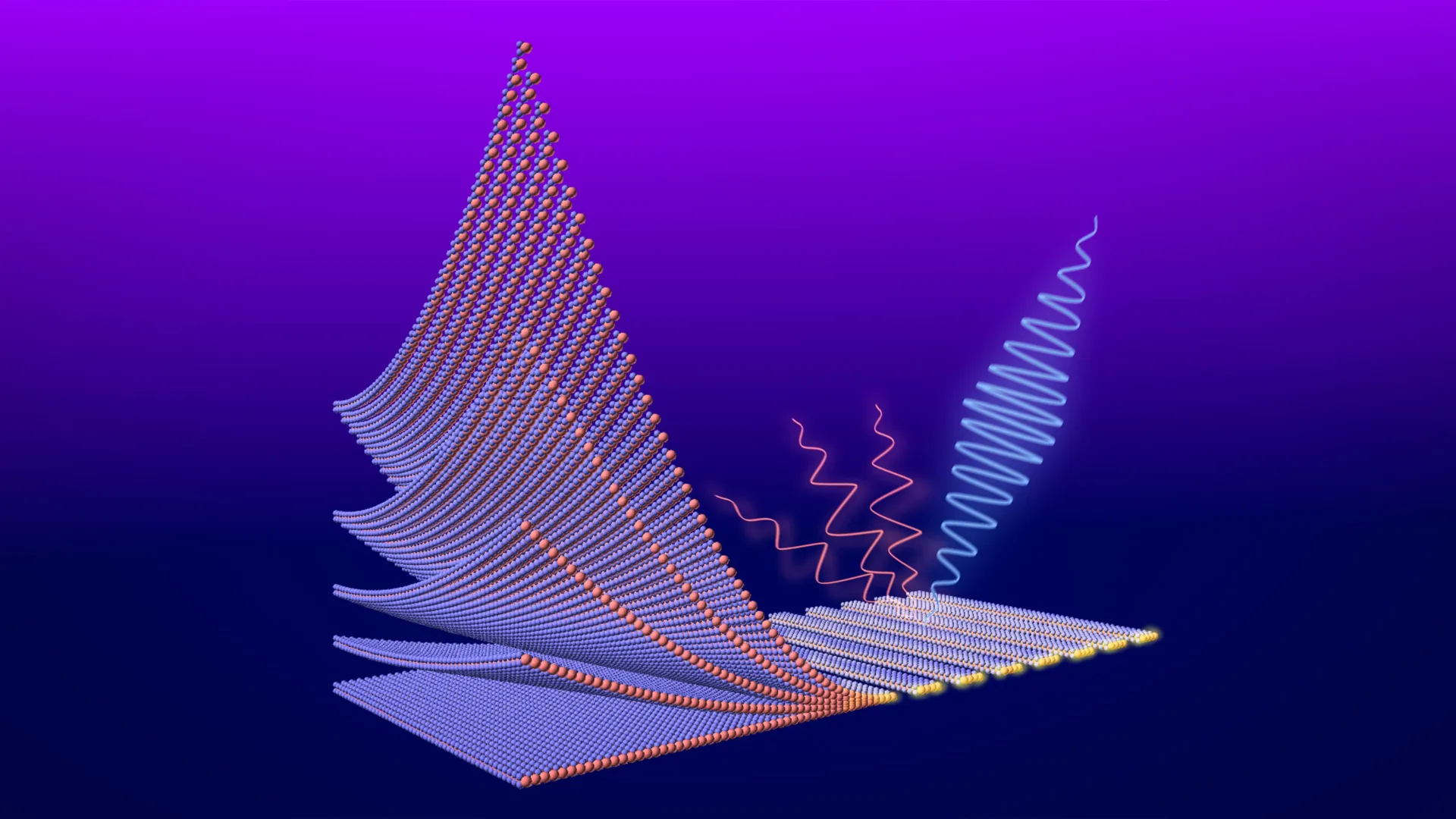
Researchers from the Faculty of Physics at the University of Warsaw, working with teams from the Łódź University of Technology, the Warsaw University of Technology, and the Polish Academy of Sciences, have created a structure capable of trapping infrared light in a layer just 40 nanometers thick. Their approach relies on a design known as a subwavelength grating made from a specialized material called molybdenum diselenide (MoSe2). The findings were reported in the journal ACS Nano.
Manipulating light at extremely small scales is key to advancing modern technology. As traditional electronics begin to reach their limits, photonics offers an alternative by using light instead of electrons to carry information. Because photons move faster and do not have mass like electrons, devices based on light could become both quicker and smaller, opening the door to more powerful and compact technologies.
The Challenge of Light's Wavelength
Light behaves both as a particle and as a wave, and this wave nature introduces a limitation. Each type of light has a wavelength, which determines how small a structure can be while still controlling it effectively. Visible light has wavelengths of several hundred nanometers, while infrared light extends to a micrometer or more. This raises an important question: can light be confined in structures smaller than its own wavelength?
The research team demonstrated that this is indeed possible. By engineering a subwavelength grating, they were able to trap infrared light within a layer only 40 nanometers thick. This structure consists of closely spaced parallel strips that interact with light similarly to a prism. When these strips are positioned closer together than the wavelength of light, the grating can act like a near-perfect mirror while also holding the light inside a very small volume.
Why Molybdenum Diselenide Works So Well
Earlier versions of such gratings, made from materials like silicon or gallium compounds, required thicknesses of several hundred nanometers to function effectively. Reducing their size caused them to lose their ability to confine light. The key difference in this new approach is the use of molybdenum diselenide, which has a much higher refractive index. In simple terms, light slows down more inside this material than in others. While light slows by about 1.5 times in glass and roughly 3.5 times in silicon or gallium arsenide, it slows by about 4.5 times in MoSe2. This strong slowing effect allows the structure to shrink dramatically while still trapping light efficiently, resulting in a layer more than a thousand times thinner than a human hair.
Turning Infrared Light Into Blue Light
MoSe2 also brings additional advantages. Like graphene, it forms layered structures, but unlike graphene, it is a semiconductor. It also exhibits nonlinear optical behavior, including a process known as third harmonic generation. In this process, three infrared photons combine into one photon with a higher frequency, effectively converting infrared light into visible blue light. Because the grating strongly concentrates infrared light, this conversion becomes much more efficient. The researchers found that the effect is more than 1,500 times stronger compared to a flat layer of the same material.
Another major advance lies in how the material was produced. Previously, thin layers of MoSe2 were created using exfoliation -- a method similar to peeling layers off a crystal with adhesive tape. While simple, this technique is inconsistent and limited to very small areas, typically around ten square micrometers, which is not suitable for real-world devices.
To overcome this, the team used molecular beam epitaxy (MBE), a well-established method for growing semiconductor layers. This approach allowed them to produce large, uniform MoSe2 films spanning several square inches. Despite this large size, the layer maintained a thickness of just 40 nanometers, giving it an extreme aspect ratio. For comparison, the thickness-to-size ratio of this layer is about one to a million, while a typical A4 sheet of paper has a ratio closer to 1:2000.
Toward Practical Photonic Applications
These results suggest that molybdenum diselenide produced in this way could significantly change how light is controlled in future technologies. Structures no longer need to be thick to manipulate light effectively. Instead, extremely thin layers can perform the same function, and in some cases even better. Because the production method is scalable, the path toward real-world applications, such as photonic integrated circuits, is becoming increasingly realistic.
Funding and Support
The research was funded by the National Science Centre under projects OPUS 2020/39/B/ST7/03502 and 2021/41/B/ST3/04183, with European Union funds under ERC-ADVANCED grant No. 101053716, the Foundation for Polish Science under project ENG.02.01-IP.05-T004/23, and by the University of Warsaw under the Excellence Initiative - Research University (IDUB) New Ideas in Priority Research Areas II No. 501-D111-20-2004310 titled "Ultrathin subwavelength gratings based on dichalcogenides."
Story Source:
Materials provided by University of Warsaw, Faculty of Physics. Note: Content may be edited for style and length.
Journal Reference:
- Emilia Pruszyńska-Karbownik, Tomasz Fąs, Katarzyna Brańko, Dmitriy Yavorskiy, Bartłomiej Stonio, Rafał Bożek, Piotr Karbownik, Jerzy Wróbel, Tomasz Czyszanowski, Tomasz Stefaniuk, Wojciech Pacuski, Jan Suffczyński. Optical Bound States in the Continuum in Subwavelength Gratings Made of an Epitaxial van der Waals Material. ACS Nano, 2026; 20 (9): 7426 DOI: 10.1021/acsnano.5c12870
Cite This Page: