
Earth may have been seeding Venus with life for billions of years
- Date:
- June 25, 2026
- Source:
- Universe Today
- Summary:
- A new study suggests Earth may have been sending tiny hitchhikers to Venus for billions of years. Researchers found that asteroid impacts could launch microbes into space, where some might survive the journey and end up suspended in Venus' clouds. If future missions detect life there, there's a surprising chance it didn't originate on Venus at all—it may have come from Earth.
- Share:
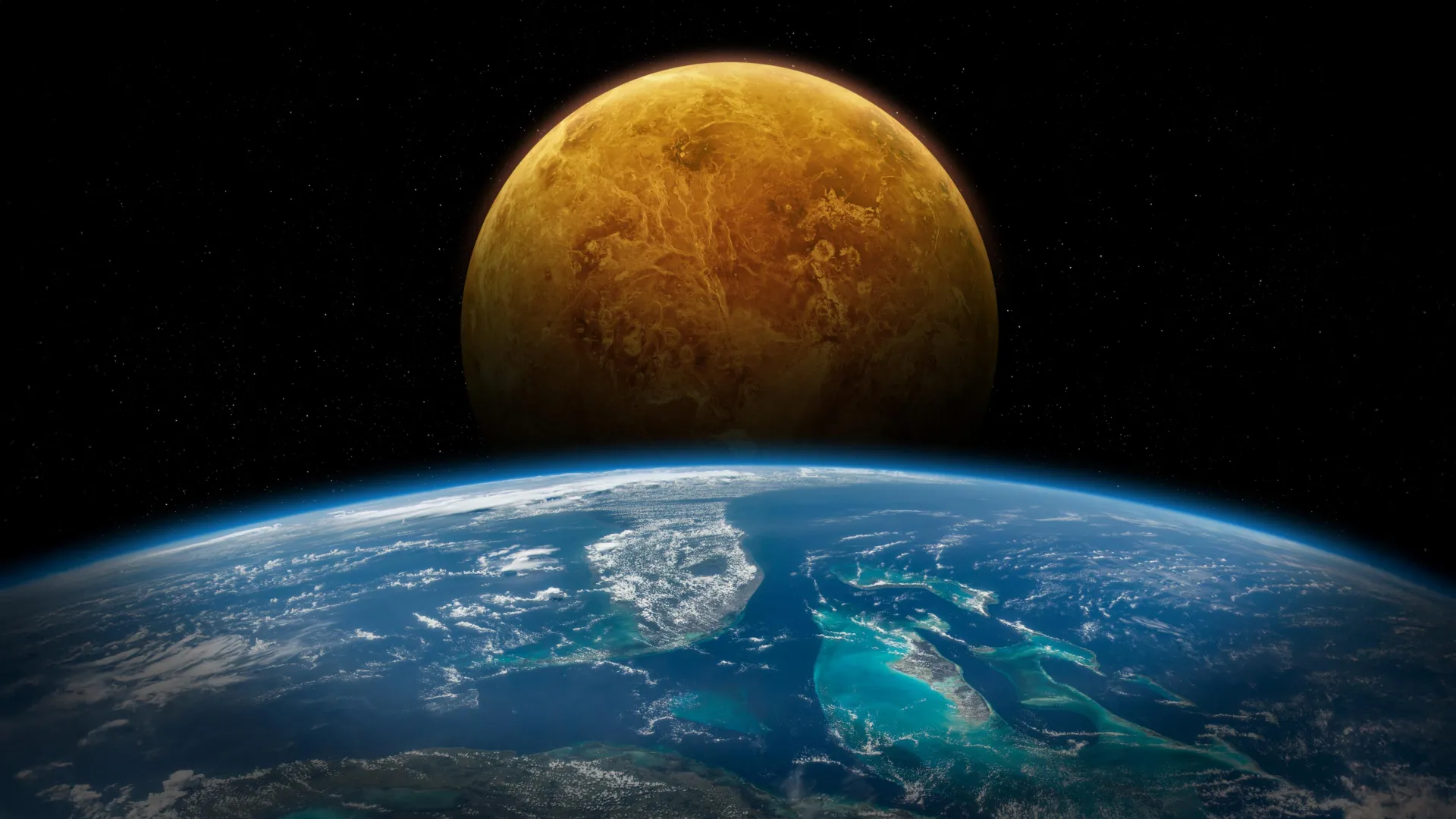
The theory of panspermia proposes that life, or the ingredients needed for it, can spread throughout the cosmos aboard asteroids, comets, and other rocky objects. When life develops on a planet, powerful impacts can blast material from its surface into space, potentially carrying microscopic organisms or organic compounds to other worlds. Scientists have long debated whether this kind of transfer may have occurred between Earth and Mars (in both directions). More recently, renewed interest in the possibility of microbial life within Venus' thick cloud layers has expanded that discussion to include Earth, Venus, and Mars.
A recent study presented at the 2026 Lunar and Planetary Science Conference (LPSC) takes a closer look at that possibility. Researchers from The Johns Hopkins University Applied Physics Laboratory (JHUAPL) and Sandia National Laboratories used the "Venus Life Equation" (VLE), a framework developed by Noam Izenberg et al. in 2021, to estimate how material from Earth could introduce life into Venus' atmosphere. Their modeling suggests that life delivered from Earth could potentially survive in Venus' clouds for at least a few days per century.
The Venus Life Equation
Like the famous Drake Equation, the VLE estimates the probability of life by combining several contributing factors. Each factor is multiplied together to produce an overall estimate of the likelihood that life exists.
*### L = O x R x C*
In this equation, L represents the likelihood of Extant Life (0 to 1, where 0 is no chance and 1 is certainty). O stands for origination (the chance life began and became established on Venus), R represents Robustness (the ability of a biosphere to survive and adapt to changing conditions), and C refers to Continuity (The chance that habitable conditions persisted until today). Before applying this framework, the researchers first examined whether organic material could survive the journey from one planet to another, regardless of where it originally formed.
Surviving the Journey to Venus
Material blasted into space by an impact must endure enormous challenges. In addition to the violent shock of ejection, it is exposed to intense heat, the vacuum of space, radiation, and extreme temperature swings. Previous computer simulations and analyses of meteorites found on Earth have shown that organic material can survive both ejection from a planet and the trip through interplanetary space. Once it reaches Venus, however, that material would also need to remain suspended within or above the planet's cloud layers in order to survive.
To investigate this, the team modeled how fireball meteorites (bolides) behave as they enter Venus' atmosphere, including their ablation, explosion, and breakup into smaller fragments capable of remaining in the clouds. They relied on the "pancake model," a widely used semi-analytic approach that describes how a bolide fragments while passing through an atmosphere. After the bolide explodes in the atmosphere (an "airburst"), aerodynamic drag spreads the fragments outward into a flattened "pancake" of material that the researchers describe as "cells."
Billions of Potential Transfers
Using the pancake model together with values derived from earlier studies, the researchers estimated how many bolides from Earth or Mars could have reached Venus' clouds. Their calculations suggest that hundreds of billions of cells may have been delivered from Earth to Venus, with hundreds of billions potentially remaining viable. Their preferred estimate indicates that about 100 cells become dispersed throughout Venus' clouds each Earth year. Over the past 1 billion years, roughly 20 billion cells may have been transferred from Earth.
The researchers emphasize that their model does not capture every aspect of how bolides interact with Venus' atmosphere. They also note that every parameter in the VLE carries significant uncertainty, much like the Drake Equation. Even so, their findings support the possibility that panspermia between Earth and Venus could occur. If a future astrobiology mission discovers life in Venus' clouds, one possible explanation is that it originally came from Earth.
Story Source:
Materials provided by Universe Today. Original written by Matthew Williams. Note: Content may be edited for style and length.
Cite This Page: