
Scientists found a way to explain bird flocks that “defy” Newton’s third law
- Date:
- June 16, 2026
- Source:
- Technische Universität Dresden
- Summary:
- Physicists have solved a long-standing problem involving systems that appear to violate Newton’s third law, such as bird flocks and bacterial swarms. By adding carefully designed “imaginary partners” to their models, they can now simulate these complex systems with unprecedented accuracy.
- Share:
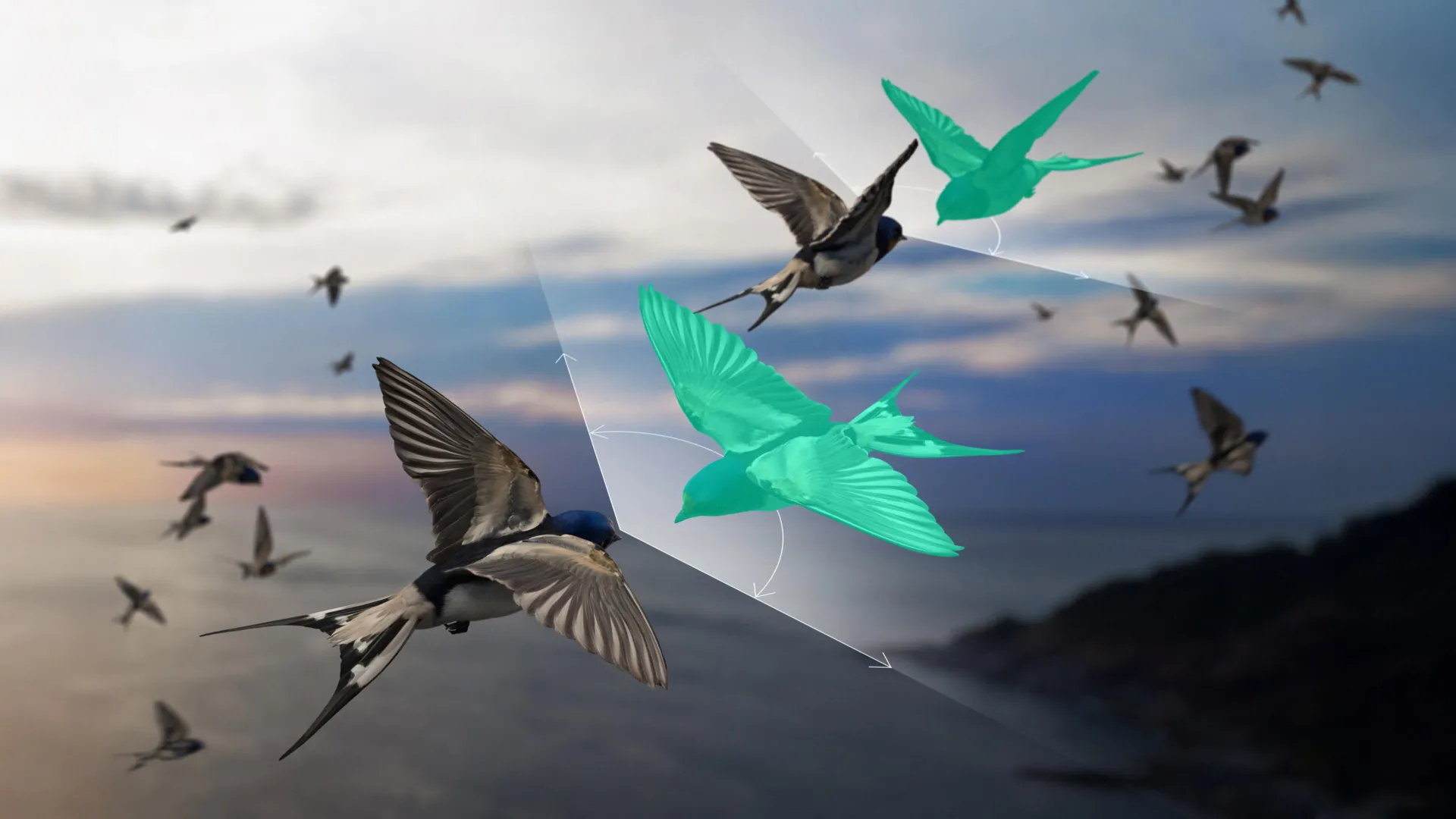
Birds can see a large portion of the world around them, but when they fly in flocks, they pay attention only to birds beside them or ahead of them. They do not align their movements with birds behind them. That behavior appears to conflict with Newton's third law, the famous action and reaction principle often summarized as "for every action, there is an equal and opposite reaction."
This principle is easy to see in everyday life. When we run, our feet push against the ground and the ground pushes back with an equal force. The same idea explains how cars move, how people row boats, and why a balloon shoots forward when air escapes from its opening. For more than 300 years, Newton's third law has been one of the foundations of classical physics.
"Whatever we normally teach our students in theoretical mechanics, it ultimately rests on the action-reaction principle," explains research group leader Marín Bukov.
Bird flocks are not the only systems that appear to fall outside this rule. Bacterial swarms, crowds of people, and even groups of cells in living tissue behave similarly. In these systems, individual components respond to only part of their environment rather than everything around them. As a result, the interaction works in one direction, meaning that action and reaction are no longer balanced.
Physicists refer to these as non-reciprocal interactions. Traditional theories were designed for reciprocal interactions, where action and reaction are equal. Because of that limitation, scientists have struggled to accurately simulate non-reciprocal systems. Better simulations are important for understanding biological processes, crowd behavior, and the collective motion of animals.
Researchers in Dresden, working with physicist Roderich Moessner, have now developed a solution to this longstanding problem. Moessner is a Principal Investigator of the Würzburg-Dresden Cluster of Excellence ctd.qmat -- Complexity, Topology and Dynamics in Quantum Matter -- and director of the Max Planck Institute for the Physics of Complex Systems in Dresden.
A New Way to Model Non-Reciprocal Systems
"The research team has developed and proven a theory that makes much of what we teach our students applicable to non-reciprocal systems as well. These systems, where Newton's third law does not apply, can now finally be described exactly and simulated precisely -- even using established methods. This is exactly the kind of tool that has been missing in recent years," says Bukov.
The researchers achieved this by extending the traditional action-reaction framework. Their approach allows non-reciprocal systems to be studied using many of the same tools already employed for ordinary reciprocal systems. The key is the introduction of additional artificial variables.
Physicists typically describe natural systems using mathematical variables that correspond to real properties, such as a bird's position and speed, a fish's location within a school, or a car's position in traffic.
"The trick behind the new theory is that it constructs a partner for each component of the system -- a fictitious partner that doesn't exist in nature. The original non-reciprocal interactions are replaced by reciprocal interactions with these auxiliary degrees of freedom," explains Bukov's colleague Ricard Alert, a biophysicist.
The Case of the Imaginary Bird
What does this idea look like in practice?
"To simulate the birds' movements precisely, we describe the dynamic system 'flock of birds' using established methods -- as if it were a reciprocal system, even though it is not. The elegant solution is to artificially place a fictitious bird in front of each real bird, aligned in exactly the opposite direction," says Alert.
These imaginary partners do not represent actual birds. Instead, they are mathematical tools that allow researchers to transform one-way interactions into a form that can be analyzed using existing methods.
New Possibilities for Physics Research
Using auxiliary degrees of freedom is not a new concept in physics. What is new is how they can now be applied to systems with non-reciprocal interactions.
This approach allows scientists to take advantage of the well-established framework of many-body physics while also producing much more accurate simulations of complex systems. Just as importantly, it provides a deeper understanding of the underlying physics. That kind of understanding often lays the groundwork for future discoveries.
"In Würzburg and Dresden, we study quantum matter whose particles interact under certain conditions in ways that give rise to new phenomena such as magnetism or lossless current transport. The exciting question now is whether these exceptions to Newton's law lead to entirely new forms of collective quantum behavior. We still know very little about this -- and that is precisely what makes this so fascinating," says Moessner.
The team's findings were published in the journal Nature Physics.
Story Source:
Materials provided by Technische Universität Dresden. Note: Content may be edited for style and length.
Journal Reference:
- Yu-Bo Shi, Roderich Moessner, Ricard Alert, Marin Bukov. Hamiltonian description of non-reciprocal interactions. Nature Physics, 2026; DOI: 10.1038/s41567-026-03317-0
Cite This Page: