
Atom-sized gates could transform DNA sequencing and neuromorphic computing
Scientists have built atom-scale “gates” that mimic living ion channels—opening the door to next-generation sensing and brain-inspired tech.
- Date:
- February 19, 2026
- Source:
- The University of Osaka
- Summary:
- Scientists have taken a major step toward mimicking nature’s tiniest gateways by creating ultra-small pores that rival the dimensions of biological ion channels—just a few atoms wide. The breakthrough opens new possibilities for single-molecule sensing, neuromorphic computing, and studying how matter behaves in spaces barely larger than atoms.
- Share:
Ion channels are tiny openings that control the movement of charged particles in living organisms. These narrow pathways are essential for many biological functions. In some cases, their tightest sections measure only a few angstroms across, roughly the width of individual atoms. Reproducing structures this small with precision and consistency remains one of the toughest challenges in nanotechnology.
Researchers at The University of Osaka have now taken a major step toward that goal. Writing in Nature Communications, the team describes how they used a miniature electrochemical reactor to produce pores that approach subnanometer dimensions.
Mimicking Nature's Electrical Gateways
Inside cells, ions travel through specialized protein channels embedded in the cell membrane. This ion movement generates electrical signals, including the nerve impulses responsible for muscle contraction. The channels are built from proteins and contain extremely narrow regions at the angstrom scale. When exposed to external signals, these proteins change shape, which allows the channels to open or close.
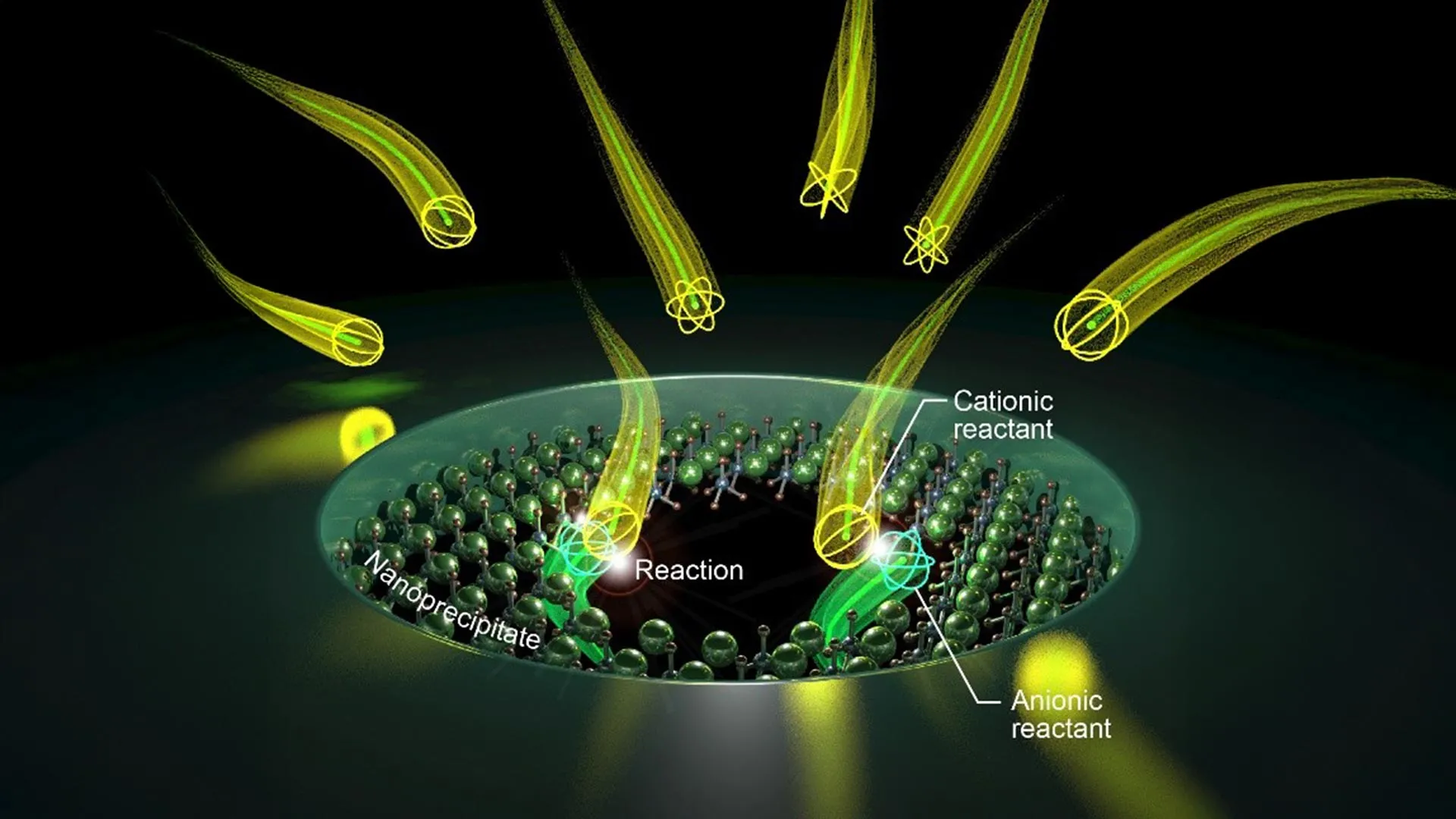
Drawing inspiration from this natural system, the researchers designed a solid-state version capable of forming pores nearly as small as biological ion channels. They began by creating a nanopore in a silicon nitride membrane. That nanopore then acted as a tiny reaction chamber for building even smaller pores within it.
When the team applied a negative voltage across the membrane, it triggered a chemical reaction inside the nanopore. This reaction produced a solid precipitate that gradually expanded until it completely blocked the opening. Reversing the voltage caused the precipitate to dissolve, restoring conductive pathways through the pore.
"We were able to repeat this opening and closing process hundreds of times over several hours," explains lead author Makusu Tsutsui. "This demonstrates that the reaction scheme is robust and controllable."
Electrical Spikes Reveal Subnanometer Pores
To better understand what was happening inside the membrane, the researchers monitored the ion current passing through it. They observed sharp spikes in the current, similar to patterns seen in biological ion channels. Further analysis indicated that these signals were most consistent with the formation of numerous subnanometer pores within the original nanopore.
The team also discovered that they could fine-tune how the pores behaved. By adjusting the chemical composition and pH of the reactant solutions, they altered both the size and properties of the ultrasmall openings.
"We were able to vary the behavior and effective size of the ultrasmall pores by changing the composition and pH of the reactant solutions," reports Tomoji Kawai, senior author. "This enabled selective transport of ions of different effective sizes through the membrane by tuning the ultrasmall pore sizes."
Applications in DNA Sequencing and Neuromorphic Computing
This chemically driven approach makes it possible to generate multiple ultrasmall pores inside a single nanopore. The technique offers a new way to study how ions and fluids move through extremely confined spaces at scales comparable to living systems.
Beyond fundamental research, the technology could support emerging fields such as single-molecule sensing (e.g., using nanopores to sequence DNA), neuromorphic computing (using electrical spikes to mimic the behavior of biological neurons), and nanoreactors (creating unique reaction conditions through confinement).
Story Source:
Materials provided by The University of Osaka. Note: Content may be edited for style and length.
Journal Reference:
- Makusu Tsutsui, Wei-Lun Hsu, Denis Garoli, Ali Douaki, Yuki Komoto, Hirofumi Daiguji, Tomoji Kawai. Chemistry-driven autonomous nanopore membranes. Nature Communications, 2026; 17 (1) DOI: 10.1038/s41467-026-68800-x
Cite This Page: