
Ancient DNA solves 5,500 year old burial mystery in Sweden
- Date:
- February 19, 2026
- Source:
- Uppsala University
- Summary:
- Ancient DNA from a Stone Age burial site in Sweden shows that families 5,500 years ago were more complex than expected. Many individuals buried together were not immediate family, but second- or third-degree relatives. One grave held a young woman alongside two children who were siblings—yet she wasn’t their mother. The discoveries hint at tight-knit communities where extended kin mattered deeply.
- Share:
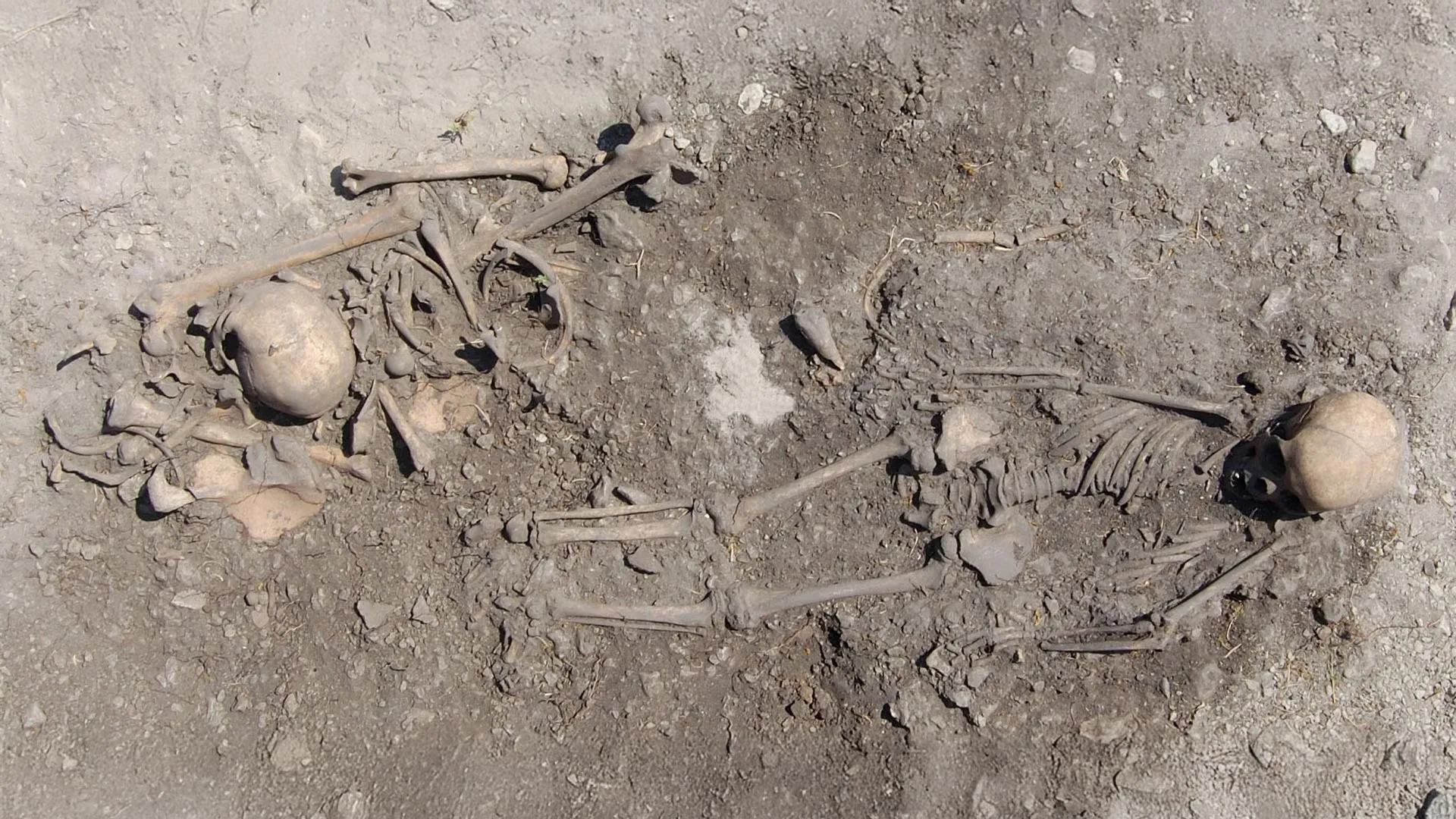
A young woman was laid to rest with two small children at her side. For years, it might have seemed natural to assume they were her own. But DNA testing tells a different story. The children were closely related to each other, yet the woman was not their mother.
In another nearby grave, two children were buried together. They were not brother and sister. Genetic evidence suggests they were more distantly related, likely cousins.
These discoveries come from a new study by researchers at Uppsala University, who analyzed four shared graves from a 5,500-year-old hunter-gatherer community at Ajvide on the island of Gotland. The DNA results indicate that people at the site understood their family connections well and that extended relatives held meaningful roles in their society.
Ajvide Burial Ground and Stone Age Hunter-Gatherers
Ajvide is one of Scandinavia's most significant Stone Age archaeological sites, known for its well-preserved graves and abundant artifacts. About 5,500 years ago, hunter-gatherers lived there, surviving mainly on seal hunting and fishing. Although farming had already spread across much of Europe, northern groups like those at Ajvide continued their traditional way of life and remained genetically distinct from nearby farming populations.
The burial ground contains 85 known graves. Eight of them hold more than one individual. Researchers focused on four of these shared burials, extracting and analyzing DNA from the remains to determine how the individuals were related.
"Surprisingly enough, the analysis showed that many of those who were buried together were second- or third-degree relatives, rather than first-degree relatives -- in other words, parent and child or siblings -- as is often assumed. This suggests that these people had a good knowledge of their family lineages and that relationships beyond the immediate family played an important role," says archaeogeneticist Helena Malmström, who was responsible for the design of the study.
Burials With Children and Extended Relatives
At least one child was present in most of the graves examined.
In one burial, the remains of a 20-year-old woman were found lying on her back. A four-year-old child rested on one side of her, and a one-and-a-half-year-old on the other. DNA testing revealed that the children, a boy and a girl, were full siblings. However, the woman was not their mother. She was most likely their father's sister or possibly their half-sister.
In a second grave, researchers identified a young girl buried alongside an adult man whose remains appear to have been moved there from another location. Genetic analysis showed that the man was her father.
A third grave contained two children, a boy and a girl. Their shared DNA indicated a third-degree relationship, meaning they were probably cousins.
In the fourth burial, a girl and a young woman were found together. They were also third-degree relatives, suggesting a connection such as great-aunt and niece or cousins.
Insights Into Stone Age Social Organization
Because well-preserved hunter-gatherer graves are rare, large-scale studies of family relationships in these communities are uncommon.
"As it is unusual for these kinds of hunter-gatherer graves to be preserved, studies of kinship in archaeological hunter-gatherer cultures are scarce and typically limited in scale," says population geneticist Tiina Mattila, who had lead responsibility for the genetic analyses.
"The analyses provide insight into social organisation in the Stone Age," says Paul Wallin, Professor of Archaeology and an expert on the Ajvide burial ground.
This project marks the first pilot study to explore family connections among Scandinavian Neolithic hunter-gatherers using archaeogenetic methods. Researchers plan to expand their work by studying more than 70 additional individuals from the burial site. Their goal is to better understand social structures, life histories and burial customs in these ancient communities.
Facts: How sex and kinship were determined
Scientists determined biological sex and family relationships by examining DNA taken from teeth and bones belonging to the ten individuals. The sex of children cannot be reliably identified from skeletons alone. Instead, researchers looked at chromosomes to see whether an individual had two X chromosomes (girl) or one X and one Y chromosome (boy).
To establish relatedness, scientists measured how much DNA individuals shared. First-degree relatives, such as parents and children or full siblings, share half of their DNA. Second-degree relatives, including grandparents and grandchildren or half-siblings, share one quarter. Third-degree relatives, such as cousins or great-grandparents and great-grandchildren, share one eighth.
Story Source:
Materials provided by Uppsala University. Note: Content may be edited for style and length.
Journal Reference:
- Tiina Maria Mattila, Magdalena Fraser, Julian Koelman, Maja Krzewińska, Marieke Ivarsson-Aalders, Anders Götherström, Mattias Jakobsson, Jan Storå, Torsten Günther, Paul Wallin, Helena Malmström. Genetic relatedness mattered in the co-burial ritual of Neolithic hunter–gatherers. Proceedings of the Royal Society B: Biological Sciences, 2026; 293 (2065) DOI: 10.1098/rspb.2025.0813
Cite This Page: