
Tiny 3D-printed light cages could unlock the quantum internet
- Date:
- January 6, 2026
- Source:
- Light Publishing Center, Changchun Institute of Optics, Fine Mechanics And Physics, CAS
- Summary:
- A new chip-based quantum memory uses nanoprinted “light cages” to trap light inside atomic vapor, enabling fast, reliable storage of quantum information. The structures can be fabricated with extreme precision and filled with atoms in days instead of months. Multiple memories can operate side by side on a single chip, all performing nearly identically. The result is a powerful, scalable building block for future quantum communication and computing.
- Share:
Storing quantum information is essential for the future of both quantum computing and a global quantum internet. Today's quantum communication systems struggle with signal loss over long distances, which limits how far quantum information can travel. Quantum memories help solve this problem by making quantum repeaters possible, allowing information to hop across a network through entanglement swapping rather than fading away.
A new study published in Light: Science & Applications reports a major advance in this area. Researchers from the Humboldt-Universität zu Berlin, the Leibniz Institute of Photonic Technology, and the University of Stuttgart have introduced a new type of quantum memory built from 3D-nanoprinted structures known as "light cages" filled with atomic vapor. By bringing both light and atoms together on a single chip, the team has created a platform designed for scalability and seamless integration into quantum photonic systems.
What Makes Light Cages Different
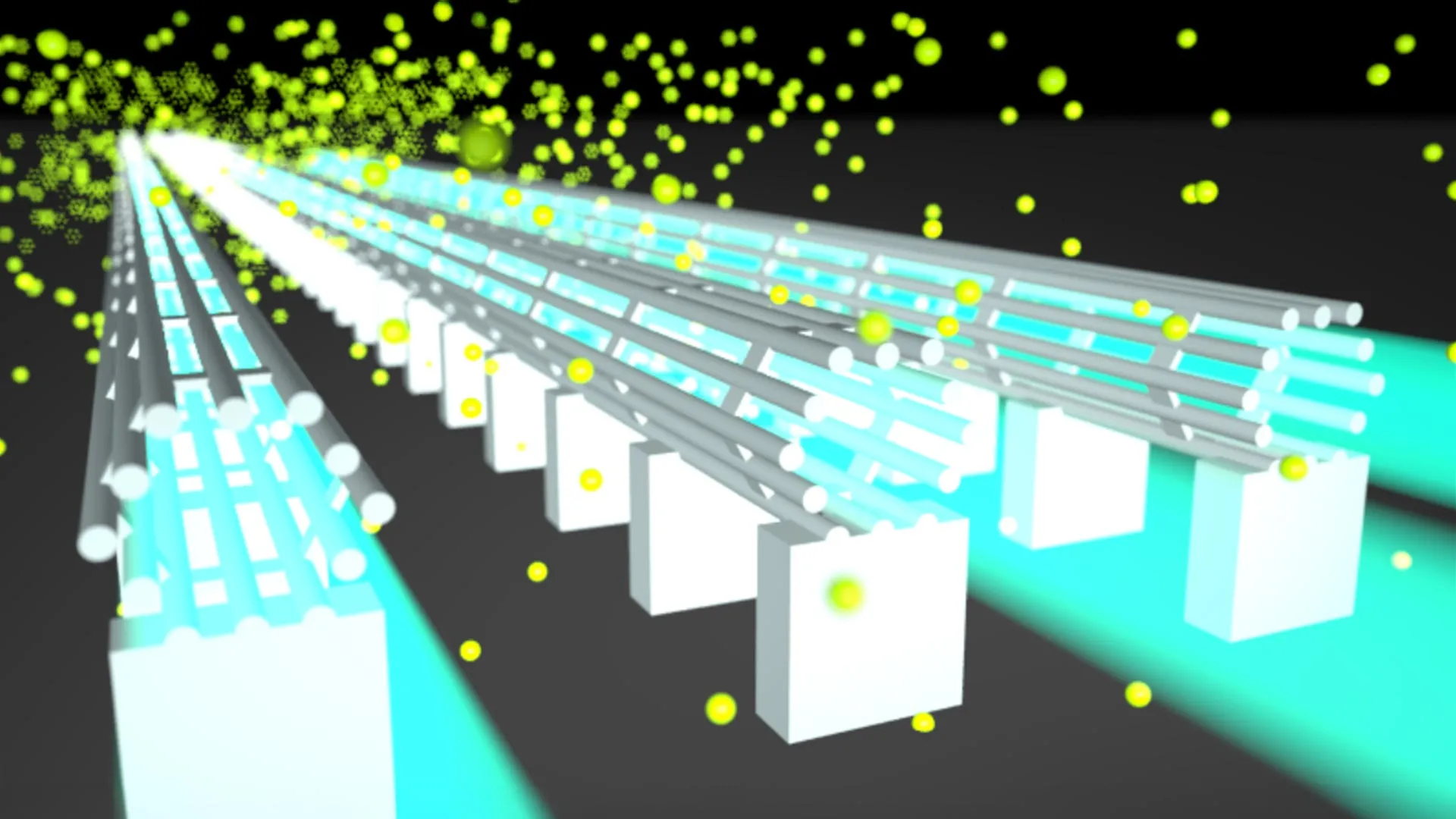
Light cages are hollow-core waveguides engineered to tightly guide light while still allowing access to the space inside. This design offers a key advantage over conventional hollow-core fibers, which can take months to fill with atomic vapor. In contrast, the open structure of light cages lets cesium atoms diffuse into the core much more quickly, cutting the filling process down to just a few days without sacrificing optical performance.
The structures are fabricated using two-photon polymerization lithography with commercial 3D printing systems. This approach allows researchers to directly print intricate hollow-core waveguides onto silicon chips with extremely high precision. To protect the devices from chemical reactions with cesium, the waveguides are coated with a protective layer. Tests showed no signs of degradation even after five years of operation, highlighting the system's long-term stability.
"We created a guiding structure that allows quick diffusion of gases and fluids inside its core, with the versatility and reproducibility provided by the 3D-nanoprinting process. This enables true scalability of this platform, not only for intra-chip fabrication of the waveguides but also inter-chip, for producing multiple chips with the same performance," explained the research team.
Turning Light Into Stored Quantum Information
Inside the light cages, incoming light pulses are efficiently converted into collective excitations of the surrounding atoms. After a chosen storage time, a control laser reverses this process and releases the stored light exactly when needed. In a key demonstration, the researchers successfully stored very weak light pulses containing only a few photons for several hundred nanoseconds. They believe this approach can eventually be extended to store single photons for many milliseconds.
Another major milestone was the integration of multiple light cage memories on a single chip placed inside a cesium vapor cell. Measurements showed that different light cages with the same design delivered nearly identical storage performance across two separate devices on the same chip. This level of consistency is essential for building scalable quantum systems.
The strong reproducibility comes from the precision of the 3D-nanoprinting process. Variations within a single chip were kept below 2 nanometers, while differences between chips remained under 15 nanometers. Such tight control is critical for spatial multiplexing, a technique that could dramatically increase the number of quantum memories operating together on one device.
Implications for Quantum Networks and Computing
Light cage quantum memories address several long-standing challenges in quantum technology. In quantum repeater networks, they could synchronize multiple single photons at the same time, greatly boosting the efficiency of long-distance quantum communication. In photonic quantum computing, the memories provide controlled delays that are needed for feed-forward operations in measurement-based quantum computing systems.
The platform also stands out for its practicality. Unlike many competing technologies, it operates slightly above room temperature and does not require cryogenic cooling or complex atom-trapping setups. This makes the system easier to deploy while also offering higher bandwidth per memory mode. The ability to produce many identical quantum memories on a single chip opens a clear path toward large-scale quantum photonic integration.
Thanks to its flexible fabrication process, the technology can potentially be combined with direct fiber coupling and existing photonic components. These advantages position light cage quantum memories as a strong candidate for future quantum communication infrastructure.
A Scalable Path Forward
The development of light cage quantum memories marks a significant step in quantum photonic research. By merging advanced 3D-nanoprinting with core principles of quantum optics, the researchers have created a compact, scalable system that could speed the arrival of practical quantum networks and more powerful quantum computers.
Story Source:
Materials provided by Light Publishing Center, Changchun Institute of Optics, Fine Mechanics And Physics, CAS. Note: Content may be edited for style and length.
Journal Reference:
- Esteban Gómez-López, Dominik Ritter, Jisoo Kim, Harald Kübler, Markus A. Schmidt, Oliver Benson. Light storage in light cages: a scalable platform for multiplexed quantum memories. Light: Science, 2026; 15 (1) DOI: 10.1038/s41377-025-02085-5
Cite This Page: