
T. rex took 40 years to reach full size, study finds
New research suggests T. rex grew slowly for 40 years—and some “T. rex” fossils may not be T. rex at all.
- Date:
- March 5, 2026
- Source:
- PeerJ
- Summary:
- Tyrannosaurus rex may have taken far longer to grow up than scientists once thought. By analyzing growth rings in fossilized leg bones from 17 tyrannosaur specimens and using new statistical methods, researchers found that the famous predator likely took about 40 years to reach its full size—around eight tons—rather than the previously estimated 25 years.
- Share:
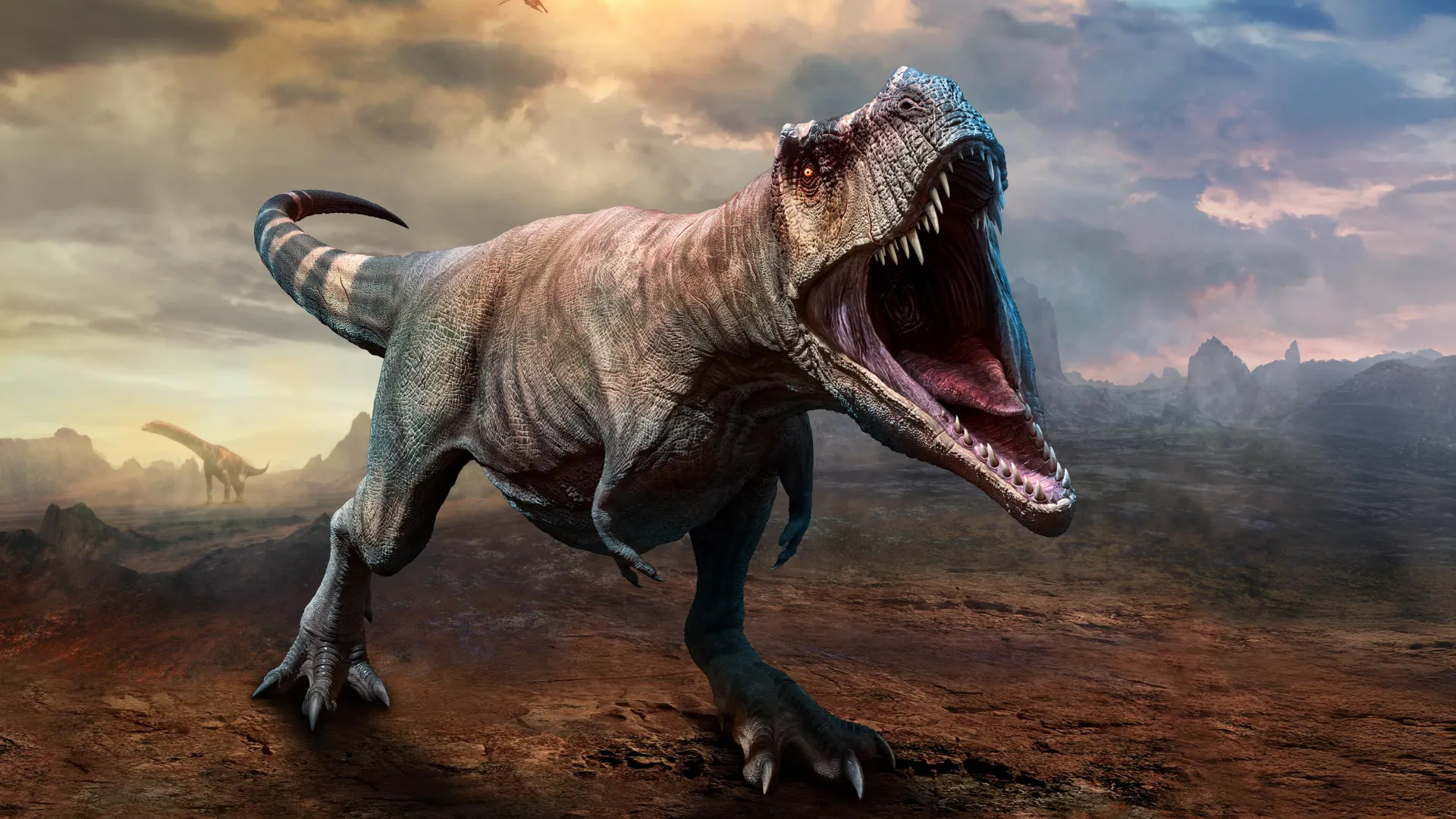
For many years, paleontologists have studied annual growth rings preserved inside the fossilized leg bones of Tyrannosaurus rex. Much like the rings inside a tree trunk, these marks help scientists estimate how old the dinosaurs were when they died and how quickly they grew. Earlier research suggested that T. rex reached its full size by about age 25.
A new and far more comprehensive analysis now challenges that timeline. By examining 17 tyrannosaur specimens ranging from young juveniles to enormous adults, researchers determined that the famous predator likely continued growing for around 40 years before reaching its maximum weight of roughly eight tons.
The study, published in the journal PeerJ, represents the most detailed reconstruction of the life history of T. rex so far. Researchers combined advanced statistical modeling with microscopic examination of bone slices. Using a specialized lighting technique, they were able to detect previously overlooked growth rings. These hidden markers allowed the team to build a more complete picture of tyrannosaur growth patterns. The findings also hint that some fossils previously classified as T. rex could actually belong to different species or represent other biological differences.
Reconstructing the Life History of Tyrannosaurus Rex
"This is the largest data set ever assembled for Tyrannosaurus rex," says Holly Woodward, a professor of anatomy at Oklahoma State University who led the research effort. "Examining the growth rings preserved in the fossilized bones allowed us to reconstruct the animals' year-by-year growth histories."
However, the fossil record does not preserve the entire lifespan of an individual animal. Unlike the full sequence of rings visible in a tree trunk, a cross section of T. rex bone typically captures only the final 10 to 20 years of the dinosaur's life.
To fill those gaps, the researchers developed a new analytical method. By combining growth information from multiple specimens of different ages, they created a composite growth curve for the species.
"We came up with a new statistical approach that stitches together growth records from different specimens to estimate the growth trajectory of T. rex across all stages of life in greater detail than any previous study," explains Nathan Myhrvold, a mathematician and paleobiologist at Intellectual Ventures who led the statistical analysis. "The composite growth curve provides a much more realistic view of how Tyrannosaurus grew and how much they varied in size."
A Longer Growth Period for the King of Dinosaurs
The results suggest that Tyrannosaurus did not rapidly reach adulthood. Instead, the dinosaurs appear to have grown gradually over several decades.
Rather than maturing quickly, T. rex experienced a prolonged growth phase lasting roughly four decades. According to the researchers, this extended development may have played an important ecological role.
"A four-decade growth phase may have allowed younger tyrannosaurs to fill a variety of ecological roles within their environments," says coauthor Jack Horner of Chapman University. "That could be one factor that allowed them to dominate the end of the Cretaceous Period as apex carnivores."
Could Some Famous Fossils Belong to Other Species
Although Tyrannosaurus rex is the best known species in this group of dinosaurs, scientists continue to debate whether some fossils assigned to T. rex actually belong to closely related species.
Some researchers have proposed that certain smaller fossils represent a distinct species called Nanotyrannus rather than young Tyrannosaurus individuals. Others have suggested that even the largest specimens might belong to two or three separate species.
These ideas remain controversial within the scientific community.
To explore the issue further, the new study examined 17 specimens within what researchers describe as the "Tyrannosaurus rex species complex." This term acknowledges the possibility that the fossils may represent multiple related species or subspecies.
One notable result involves two well known fossils nicknamed "Jane" and "Petey." Their growth patterns differ significantly from those of the other specimens in the dataset. While growth data alone cannot prove that they represent separate species, the difference raises intriguing questions. A separate recent analysis by Zanno and Napoli reached a similar conclusion using different techniques, identifying Jane and Petey as belonging to two distinct species of Nanotyrannus.
New Imaging Technique Reveals Hidden Growth Rings
Another key finding involves the discovery of a previously unrecognized type of growth ring in dinosaur bone. Woodward, Myhrvold, and Horner found that circularly polarized and cross-polarized light can reveal growth features that are difficult to detect with standard methods.
This approach helps clarify puzzling growth patterns seen in some specimens. The researchers supported the finding with strong statistical evidence, suggesting that traditional techniques for counting dinosaur growth rings may sometimes overlook important details.
"Interpreting multiple closely spaced growth marks is tricky," Myhrvold says. "We found strong evidence that the protocols typically used in growth studies may need to be revised."
A Clearer Picture of Tyrannosaurus Life
More than a century after Tyrannosaurus rex was first discovered, the species continues to surprise scientists. By combining a larger fossil sample, new analytical tools, and improved imaging methods, the research offers a clearer understanding of how these iconic predators grew and developed.
The results provide a more complete portrait of Tyrannosaurus rex as a living animal, tracing its journey from young dinosaur to one of the largest land predators in Earth's history.
Story Source:
Materials provided by PeerJ. Note: Content may be edited for style and length.
Journal Reference:
- Holly N. Woodward, Nathan P. Myhrvold, John R. Horner. Prolonged growth and extended subadult development in the Tyrannosaurus rex species complex revealed by expanded histological sampling and statistical modeling. PeerJ, 2026; 14: e20469 DOI: 10.7717/peerj.20469
Cite This Page: