
This rare bone finally settles the Nanotyrannus mystery
Nanotyrannus emerges as a true species, revealing a more crowded and competitive world of tyrannosaurs.
- Date:
- December 9, 2025
- Source:
- Natural History Museum of Los Angeles County
- Summary:
- Scientists have confirmed that Nanotyrannus was a mature species, not a young T. rex. A microscopic look at its hyoid bone provided the key evidence, matching growth signals seen in known T. rex specimens. This discovery suggests a richer, more competitive tyrannosaur ecosystem than previously believed. It also highlights how museum fossils and cutting-edge analysis can rewrite prehistoric history.
- Share:
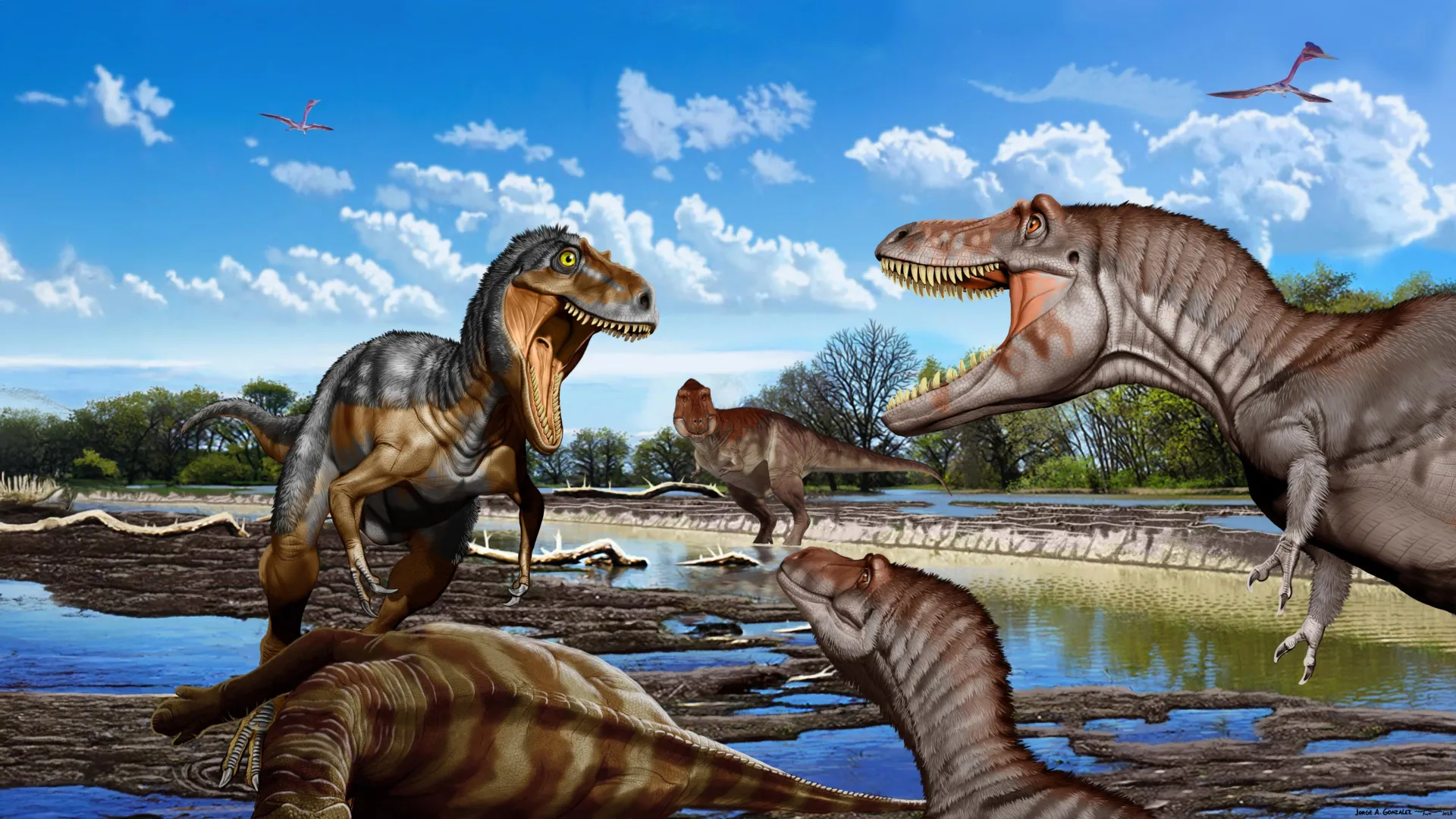
For many years, paleontologists have debated whether the single skull used to define the species Nanotyrannus represented a true species or simply a young Tyrannosaurus rex. A new study in Science has now resolved this question. The research shows that Nanotyrannus was nearly fully grown and not a juvenile T. rex, while also offering new clues about how large tyrannosaur species achieved rapid growth.
A collaborative team that included Dinosaur Institute Postdoctoral Fellow Dr. Zach Morris studied the disputed Nanotyrannus holotype -- the specimen originally used to identify the species -- with a close focus on its throat bone. By investigating the microscopic details of this bone and comparing them with those of modern birds, crocodilians, and other dinosaurs -- including specimens from the Dino Hall's T. rex growth series -- the group confirmed that Nanotyrannus was a mature and separate predator. Although smaller than an adult T. rex, it was still a full-grown animal that lived in a far more diverse Late Cretaceous ecosystem than previously thought. Measuring under half the size of an adult T. rex, Nanotyrannus likely competed with young T. rex individuals for the same prey.
"The identity of the holotype specimen was the key piece in this debate. Discovering that this small skull was actually fully grown shows definitively that it is different from Tyrannosaurus rex," said Dr. Christopher Griffin, lead author and Assistant Professor of Geosciences at Princeton University.
How Bone Structure Reveals Age and Growth
Just as tree rings can indicate a tree's age, thin slices taken from dinosaur bones can reveal how old an animal was and how quickly it grew. Scientists study microscopic tissue patterns within these bone samples to determine maturity. Long bones such as ribs or femora are typically used, but they are not always preserved. In the case of Nanotyrannus, most of the holotype consists of skull material filled with sinuses and other irregular features that make it unsuitable for this type of study. The hyoid, however -- the throat bone that supports the tongue -- offered a rare opportunity to assess maturity in a skull-dominated specimen.
"When we started this project, it was unclear whether the hyoid preserved a record of a dinosaur's growth. To be honest, we mostly accepted the hypothesis that Nanotyrannus was a juvenile T. rex, so we expected the microscopic bone structure or histology of the holotype would show this animal was still growing quickly," said co-author Dr. Morris. "What we did not expect was to see it was nearing maturity with clear evidence of the cessation of growth!"
Testing the Throat Bone as a New Tool for Dinosaur Aging
Because no one had previously proven that hyoid bones could reliably preserve growth information, the researchers needed to verify the method before applying it to Nanotyrannus. To do so, Dr. Griffin assembled a team to create a broad comparative dataset of hyoid samples from living lizards, crocodiles, birds, and extinct dinosaurs. "To show that hyoid microstructure would work to test maturity status in Nanotyrannus, we first had to compile strong support for this method across many groups of living reptiles and extinct dinosaurs," said Dr. Griffin.
Dr. Morris led the work on the juvenile and sub-adult specimens known as "Thomas" from NHM's rare T. rex growth series. "The growth series in our Dino Hall was critical to demonstrating that the hyoid in Tyrannosaurus showed the same kind of growth record as long bones," Morris explained. "Having a growth series that had already been histologically analyzed meant that we could compare the growth record in the hyoid and the growth record in the long bones and see that they show consistent signals even in these uniquely giant predators." This comparison allowed the researchers to set clear benchmarks for distinguishing growth differences between T. rex and Nanotyrannus.
"Our teenage Tyrannosaurus looks immature in both its limbs and its hyoid, while Thomas looks like a more mature, but still not quite adult animal. Amusingly enough, Thomas is not nearly as mature as the Nanotyrannus holotype, despite being much larger," added Morris.
Balancing Conservation, Discovery, and Scientific Accuracy
The findings emphasize how important it is for paleontologists to understand the maturity of holotype specimens. Without this knowledge, scientists risk mistaking growth-related changes for evolutionary ones. "So many techniques in modern paleontology require some degree of destructive analysis, and as a Curator, I'm always trying to strike a balance between conservation and discovery. We preserved the anatomical data by 3D scanning and molding and casting the hyoid, and there is still more of it for future analyses," said senior author Dr. Caitlin Colleary of the Cleveland Museum of Natural History (and incidentally, a former undergraduate volunteer in the NHM Dinosaur Institute). "In this instance, it was totally worth it because we gained so much more than we lost."
The new evidence also reshapes the view of Late Cretaceous North America. Instead of T. rex ruling alone before the end-Cretaceous mass extinction, the region appears to have hosted multiple tyrannosaur species at the same time. "It is remarkable that our study matches findings from other independent lines of evidence, including an analysis published last month, demonstrating that multiple species of tyrannosaurs lived alongside one another. It shows that we need to re-evaluate what we think these ecosystems looked like," said Dr. Morris.
Expanding Knowledge Through Museum Collections and Collaborative Research
Dr. Morris serves as the first Dinosaur Institute Postdoctoral Fellow, focusing on how developmental processes shape evolutionary changes and how skull anatomy shifts over time in the fossil record. "I am fascinated by the ways in which changes during development give rise to the skeletal features which distinguish dinosaurs, birds, crocodylians, and other vertebrates," said Morris. "This project was an exciting collaboration to study developmental patterns in the fossil record directly."
"Zach's expertise in dinosaur growth and development, coupled with his histological skills, was a huge asset to this project. It's another example of our NHMLAC Post-Docs conducting novel, ground-breaking research," said Dr. Nate Smith, Gretchen Augustyn Director & Curator of the Dinosaur Institute. "This study also highlights the incredible potential of unique museum collections like our T. rex growth series, which not only inform the public but also provide rich ground for new scientific discoveries."
Story Source:
Materials provided by Natural History Museum of Los Angeles County. Note: Content may be edited for style and length.
Journal Reference:
- Christopher T. Griffin, Jeb Bugos, Ashley W. Poust, Zachary S. Morris, Riley S. Sombathy, Michael D. D’Emic, Patrick M. O’Connor, Holger Petermann, Matteo Fabbri, Caitlin Colleary. A diminutive tyrannosaur lived alongside Tyrannosaurus rex. Science, 2025; DOI: 10.1126/science.adx8706
Cite This Page: