
Astronomers find a ghost galaxy made of dark matter
- Date:
- January 9, 2026
- Source:
- European Space Agency (ESA)
- Summary:
- Hubble has revealed a strange cosmic object called Cloud-9, a dark matter–dominated cloud with no stars at all. Scientists believe it is a “failed galaxy,” a leftover building block from the early Universe that never lit up. Its discovery confirms long-standing theories about starless galaxies. Cloud-9 offers a rare glimpse into the dark side of cosmic evolution.
- Share:
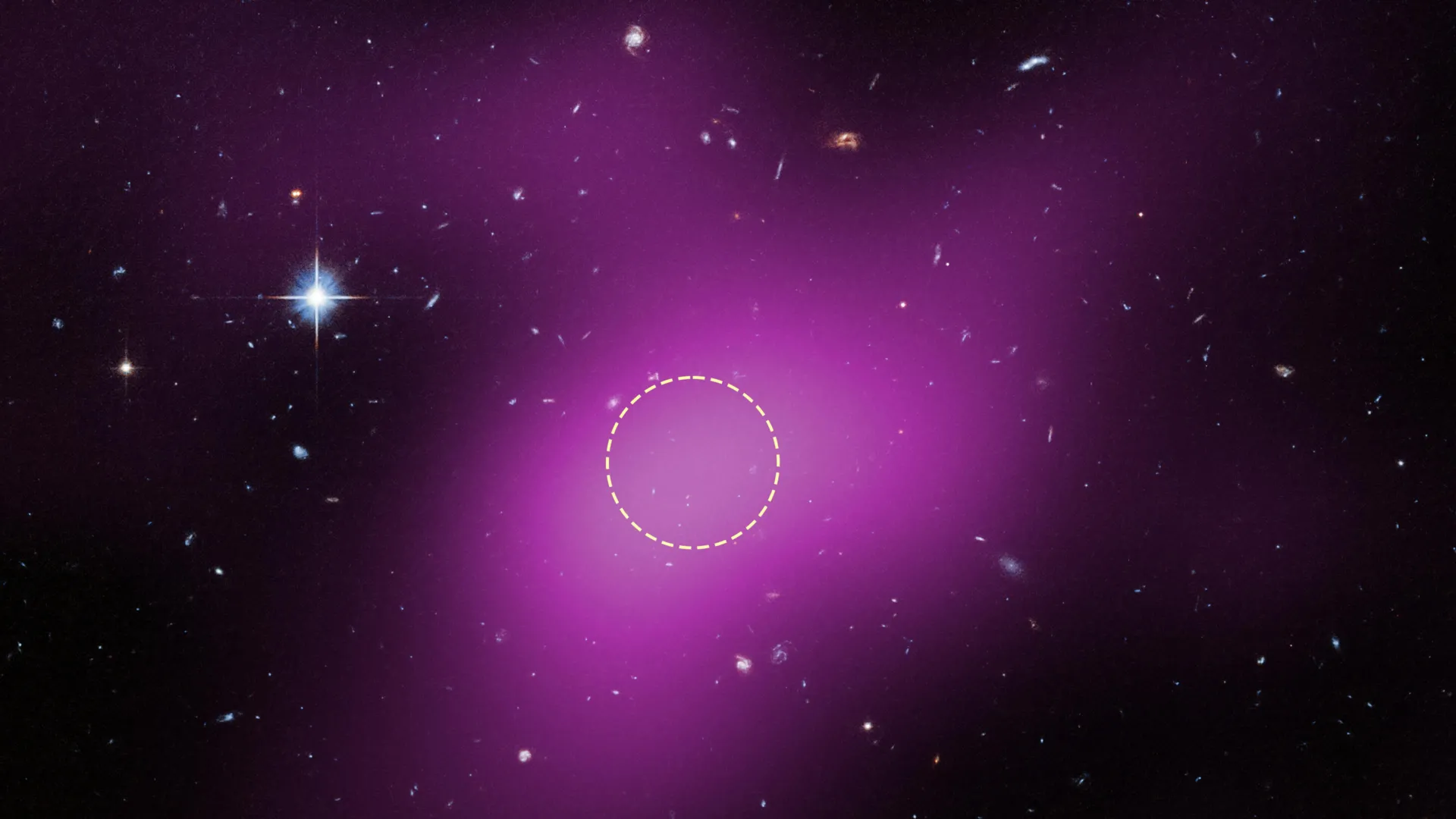
Astronomers working with the Hubble Space Telescope have identified an entirely new type of cosmic object. It is a cloud rich in gas and dominated by dark matter, yet it contains no stars. Scientists consider it a relic left behind from the earliest stages of galaxy formation. The object, known as "Cloud-9," is the first confirmed example of its kind ever observed in the Universe.
"This is a tale of a failed galaxy," said the program's principal investigator, Alejandro Benitez-Llambay of the Milano-Bicocca University in Milan, Italy. "In science, we usually learn more from the failures than from the successes. In this case, seeing no stars is what proves the theory right. It tells us that we have found in the local Universe a primordial building block of a galaxy that hasn't formed."
A Rare Glimpse of the Dark Universe
"This cloud is a window into the dark Universe," explained team member Andrew Fox of AURA/STScI for the European Space Agency. "We know from theory that most of the mass in the Universe is expected to be dark matter, but it's difficult to detect this dark material because it doesn't emit light. Cloud-9 gives us a rare look at a dark-matter-dominated cloud."
Cloud-9 belongs to a category known as Reionization-Limited H I Clouds, or "RELHICs." The term "H I" refers to neutral hydrogen, while "RELHIC" describes a hydrogen cloud formed in the early Universe that never progressed to form stars. Scientists had predicted the existence of such objects for years, but direct confirmation remained elusive. Only after observing Cloud-9 with Hubble were researchers able to verify that it truly contains no stars.
Ruling Out a Hidden Dwarf Galaxy
"Before we used Hubble, you could argue that this is a faint dwarf galaxy that we could not see with ground-based telescopes. They just didn't go deep enough in sensitivity to uncover stars," explained lead author Gagandeep Anand of the Space Telescope Science Institute (STScI), Baltimore, USA. "But with Hubble's Advanced Camera for Surveys, we're able to nail down that there's nothing there."
The discovery itself caught researchers off guard. "Among our galactic neighbors, there might be a few abandoned houses out there," said STScI's Rachael Beaton, who is also on the research team.
RELHICs are believed to be dark matter structures that never gathered enough gas to trigger star formation. Because of this, they preserve conditions from the early Universe. Cloud-9 points to the likely existence of many other small, dark matter-dominated objects, often described as failed galaxies. Studying them offers new insight into parts of the Universe that remain difficult to observe because most telescopes focus on bright stars and galaxies.
Measuring an Invisible Giant
Hydrogen clouds near the Milky Way have been studied for decades, but most are far larger and more irregular in shape than Cloud-9. By contrast, Cloud-9 is smaller, denser, and nearly spherical, giving it a distinctly different appearance from other known gas clouds.
At its center, Cloud-9 contains neutral hydrogen spanning roughly 4900 light-years. The hydrogen gas alone has a mass about 1 million times that of the Sun. If the gas pressure is indeed balanced by the gravitational pull of the surrounding dark matter, then dark matter must account for most of the object's mass. Based on this balance, Cloud-9 is estimated to contain roughly 5 billion solar masses.
Why Starless Objects Matter
Cloud-9 highlights how much of the Universe exists beyond stars. Observing starlight alone does not reveal the full picture. By examining gas and dark matter together, scientists can better understand systems that would otherwise remain hidden.
Finding failed galaxies like Cloud-9 is difficult because nearby bright objects often overpower their faint signals. These systems are also sensitive to environmental effects such as ram-pressure stripping, which can remove gas as they move through intergalactic space. These challenges help explain why such objects appear to be rare.
Discovery Through Radio Telescopes
Cloud-9 was first detected three years ago during a radio survey conducted with the Five-hundred-meter Aperture Spherical Telescope (FAST) in Guizhou, China. The discovery was later confirmed using the Green Bank Telescope and the Very Large Array in the United States. The name "Cloud-9" carries no cultural meaning in China and was assigned simply because it was the ninth gas cloud identified near the outer regions of the spiral galaxy Messier 94 (M94).
The cloud lies close to M94 and appears to be physically connected to the galaxy. High-resolution radio observations reveal slight distortions in the gas, which may be evidence of interaction between Cloud-9 and its larger neighbor.
A Galaxy That Might Still Form
Whether Cloud-9 will eventually become a galaxy depends on whether it gains additional mass. If it had been much larger, gravity would have caused it to collapse and form stars long ago. If it were much smaller, its gas might have dispersed and become ionized, leaving little behind. Instead, it exists in a narrow range that allows it to persist as a RELHIC.
This discovery advances understanding of how galaxies form, how the early Universe evolved, and how dark matter behaves. Because Cloud-9 contains no stars, it allows scientists to study the properties of dark matter clouds without interference from starlight. As future surveys improve, researchers expect to uncover more of these rare relics, offering deeper insight into the Universe's hidden structure and the physics of dark matter.
Story Source:
Materials provided by European Space Agency (ESA). Note: Content may be edited for style and length.
Journal Reference:
- Gagandeep S. Anand, Alejandro Benítez-Llambay, Rachael Beaton, Andrew J. Fox, Julio F. Navarro, Elena D’Onghia. The First RELHIC? Cloud-9 is a Starless Gas Cloud*. The Astrophysical Journal Letters, 2025; 993 (2): L55 DOI: 10.3847/2041-8213/ae1584
Cite This Page: