
How manipulating gravitational waves could reveal gravity’s quantum secrets
Scientists may be on the verge of not just detecting gravitational waves—but gently reshaping them to probe the quantum secrets of gravity itself.
- Date:
- January 2, 2026
- Source:
- Helmholtz-Zentrum Dresden-Rossendorf
- Summary:
- A physicist has proposed a bold experiment that could allow gravitational waves to be manipulated using laser light. By transferring minute amounts of energy between light and gravity, the interaction would leave behind faint but detectable fingerprints. The setup resembles advanced gravitational-wave detectors like LIGO, but pushes them further into quantum territory. Success could hint at the long-sought quantum nature of gravity.
- Share:
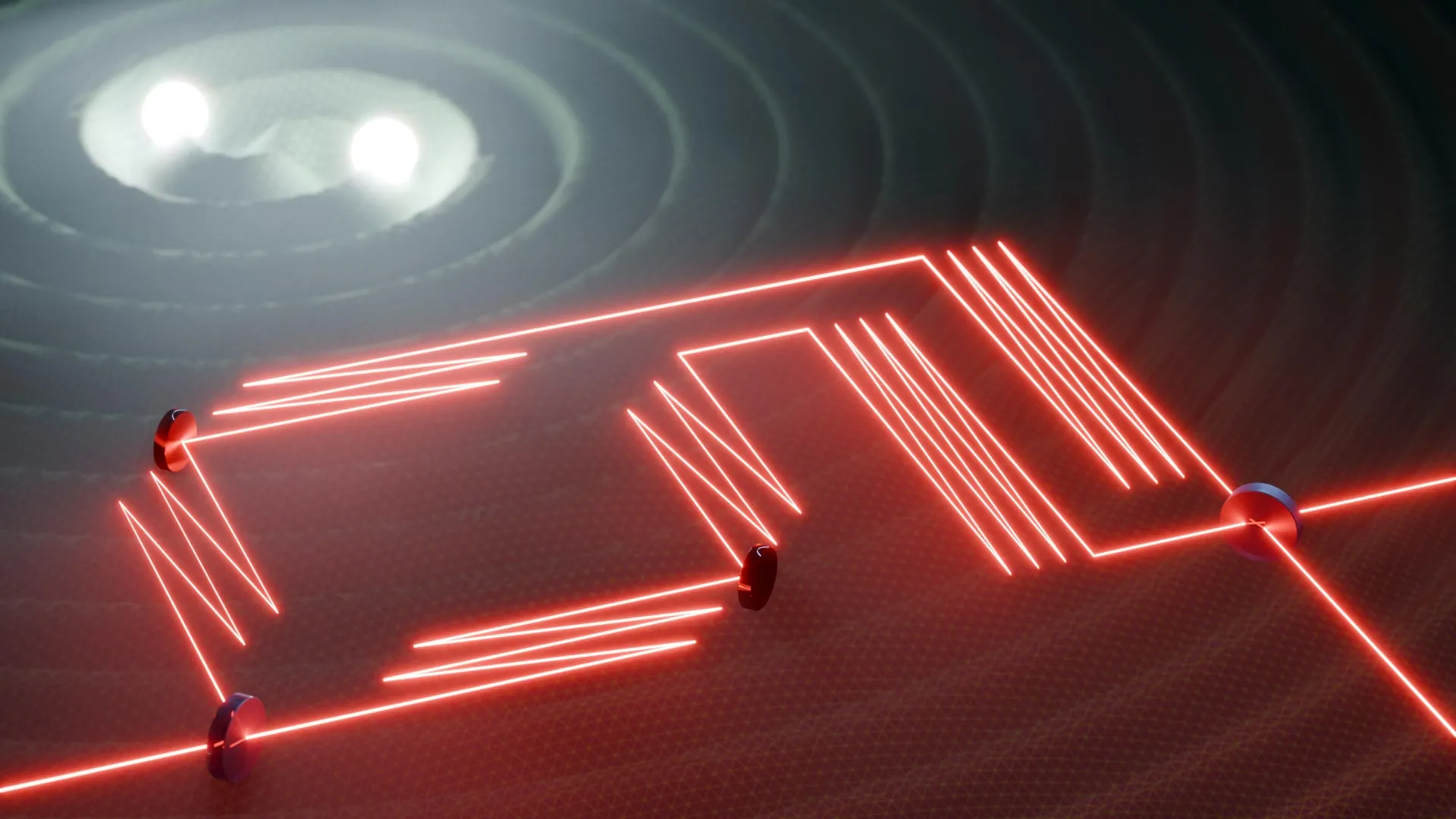
When massive objects such as black holes merge or neutron stars collide, they can send gravitational waves rippling through the universe. These waves travel at the speed of light and cause extremely small distortions in space-time. Albert Einstein predicted their existence more than a century ago, but scientists did not directly observe them until 2015. Now, Prof. Ralf Schützhold, a theoretical physicist at the Helmholtz-Zentrum Dresden-Rossendorf (HZDR), has proposed taking the science further. He has outlined an experiment that would not only detect gravitational waves but also actively influence them. The concept, published in the journal Physical Review Letters, could also help scientists explore the long-suspected quantum nature of gravity.
"Gravity affects everything, including light," says Schützhold. This means that when light waves encounter gravitational waves, the two can interact. His proposal focuses on shifting tiny amounts of energy from a beam of light into a passing gravitational wave. As this happens, the light loses a small amount of energy, while the gravitational wave gains exactly the same amount. That energy corresponds to one or more gravitons, the theoretical particles believed to carry the force of gravity, although they have never been directly observed. "It would make the gravitational wave a tiny bit more intensive," explains the physicist. At the same time, the light wave experiences a barely detectable change in its frequency.
Reversing the Energy Flow
"The process can work the other way around, too," Schützhold continues. In this scenario, the gravitational wave gives up a packet of energy to the light wave. In principle, both directions of this exchange could be measured, meaning scientists could observe the stimulated absorption and emission of gravitons. Doing so would require an enormous experimental setup. Schützhold estimates that laser pulses in the visible or near-infrared spectral range would need to bounce between two mirrors up to a million times. With a physical setup about a kilometer long, this repeated reflection would create an effective optical path of roughly one million kilometers. That scale should be large enough to detect the tiny energy transfers that occur when light interacts with a gravitational wave.
Detecting an Almost Imperceptible Signal
The frequency change in the light caused by absorbing or releasing the energy of one or more gravitons would be extraordinarily small. Still, Schützhold argues that a carefully designed interferometer could reveal it. In such a device, two light waves would undergo slightly different frequency changes depending on whether they gain or lose energy. After traveling the long optical path, the waves would recombine and form an interference pattern. By analyzing that pattern, researchers could determine how the light's frequency shifted and confirm that energy was exchanged with the gravitational wave.
Lessons From LIGO and Future Possibilities
"It can take several decades from initial idea to experiment," says Schützhold. However, he notes that the proposal shares similarities with existing technology, particularly the LIGO Observatory -- acronym for the Laser Interferometer Gravitational-Wave Observatory -- which is already used to detect gravitational waves. LIGO consists of two L-shaped vacuum tubes about four kilometers long. A beam splitter sends a laser beam down both arms, where passing gravitational waves slightly stretch and compress space-time. These distortions change the arm lengths by just a few attometers (10-18 meters), enough to alter the light's interference pattern and produce a measurable signal.
An interferometer designed around Schützhold's concept could go beyond detection and allow scientists to manipulate gravitational waves for the first time through the stimulated absorption and emission of gravitons. He also suggests that using light pulses with entangled photons, meaning they are quantum mechanically linked, could greatly improve the instrument's sensitivity. "Then we could even draw inferences about the quantum state of the gravitational field itself," says Schützhold. Although this would not directly prove the existence of gravitons, it would provide strong supporting evidence. If the expected interference effects failed to appear, current theories based on gravitons would be called into question. For that reason, it is not surprising that Schützhold's proposal has attracted significant attention from the physics community.
Story Source:
Materials provided by Helmholtz-Zentrum Dresden-Rossendorf. Note: Content may be edited for style and length.
Journal Reference:
- Ralf Schützhold. Stimulated Emission or Absorption of Gravitons by Light. Physical Review Letters, 2025; 135 (17) DOI: 10.1103/xd97-c6d7
Cite This Page: