
UCLA scientists turn cord blood into powerful cancer-fighting T cells
A new off-the-shelf T-cell therapy made from cord blood stem cells controlled solid tumors in mice while promising faster, cheaper, and potentially safer cancer treatment.
- Date:
- September 10, 2026
- Source:
- University of California - Los Angeles Health Sciences
- Summary:
- UCLA researchers developed ready-made cancer-fighting T cells from cord blood stem cells that can attack solid tumors through two separate detection systems. In mice, a single dose controlled cancer and extended survival while avoiding a dangerous complication associated with donor-derived T-cell therapies.
- Share:
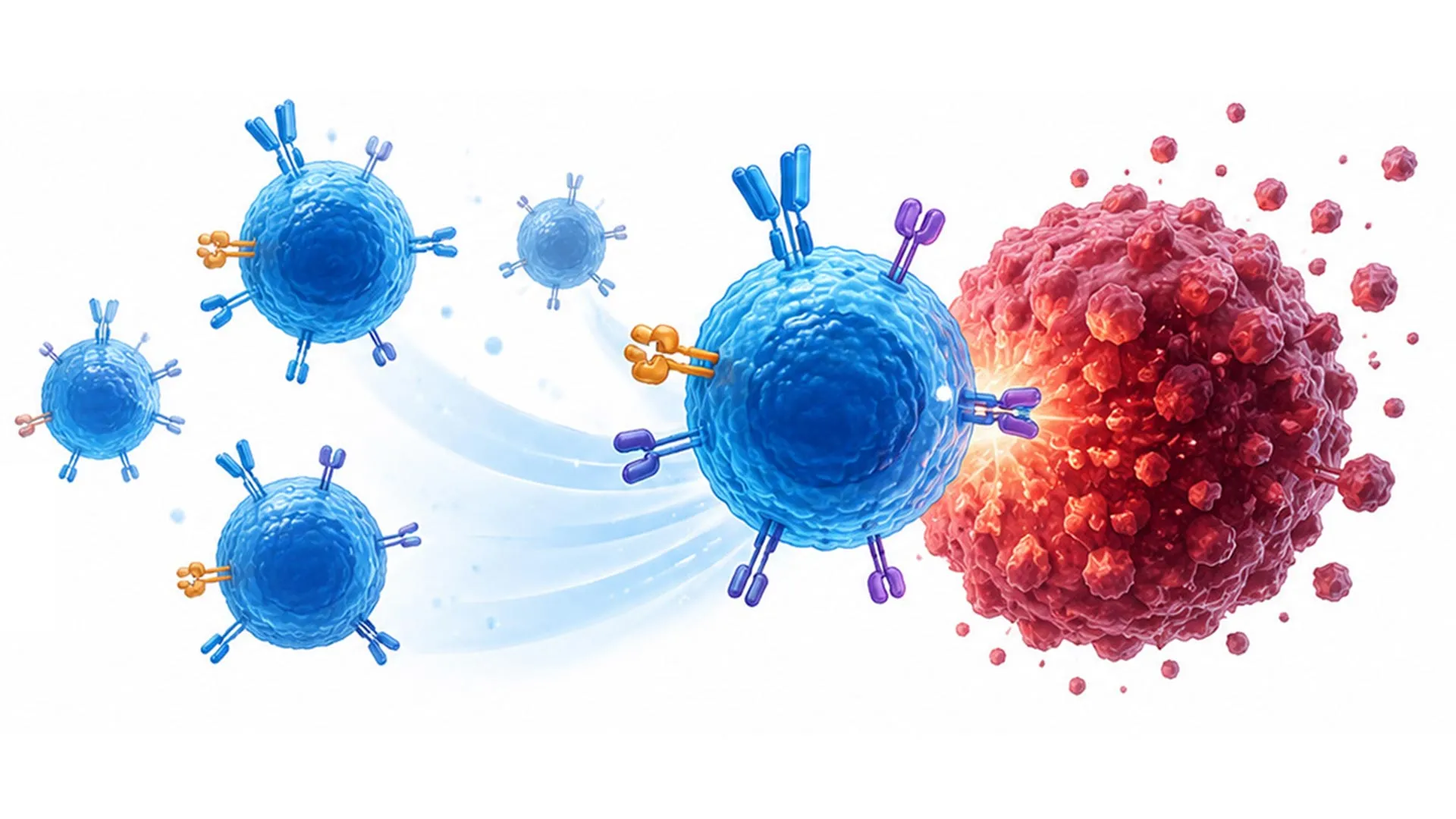
T cell receptor therapy, known as TCR therapy, is a form of cancer treatment that genetically modifies immune cells called T cells so they can recognize and attack cancer with high precision.
The approach resembles CAR T-cell therapy, but there is an important difference. CAR T-cell therapy can recognize proteins that naturally sit on the outside of cancer cells. TCR therapy can go deeper. It can detect small pieces of proteins that originate inside a cancer cell and are then transported to the cell surface, where they act like identifying tags.
That expanded reach could be especially important for treating solid tumors. Many of the molecular changes that make these cells cancerous are found inside the cell rather than on its exterior, putting them beyond the reach of many existing immune therapies.
A Major Bottleneck in T Cell Therapy
Despite its potential, TCR therapy faces a major practical obstacle. Current approaches generally require a personalized treatment made from each patient's own T cells. Producing those cells can take weeks, and the cost can climb well into six figures.
Scientists have investigated another possibility: using T cells from healthy donors to create treatments ahead of time that could be stored and given to many different patients. But donor cells introduce another danger. They can cause graft-versus-host disease, a potentially serious condition in which the transplanted immune cells mistakenly attack the patient's healthy tissue.
Researchers at UCLA say they have developed a strategy that could address both problems at the same time.
In a study published in Cell Reports Medicine, the scientists describe a scalable method for making consistent batches of cancer-targeting T cells from blood stem cells obtained from donated cord blood. The cells are engineered to recognize a protein that appears in many types of solid tumors.
When tested in mouse models of ovarian cancer and melanoma, a single dose of the engineered cells, known as AlloESO-T cells, controlled tumor growth and helped the animals survive longer without producing dangerous side effects.
"This platform brings us closer to a future where the product is already made, frozen and ready to go as soon as the patient needs," said co-senior author Lili Yang, a professor of microbiology, immunology and molecular genetics and a member of the UCLA Broad Stem Cell Research Center and the UCLA Health Jonsson Comprehensive Cancer Center.
Building the T Cells From an Earlier Stage
Instead of beginning with mature T cells taken from a donor, the UCLA team started earlier in the immune cell development process.
They used blood stem cells from cord blood. These immature cells can eventually develop into every major type of blood and immune cell. The researchers inserted a gene for a receptor that recognizes NY-ESO-1, a protein found in many solid tumors.
Pieces of NY-ESO-1 are transported from inside tumor cells to their outer surface, where they can be recognized by T cells. After engineering the stem cells, the researchers guided them to develop into mature T cells in the laboratory.
Adding the cancer-targeting receptor at such an early stage has an important advantage. As the engineered stem cells mature, they do not develop the random collection of natural T cell receptors normally found on donor T cells.
That could reduce the risk that the resulting cells will recognize and attack healthy tissues. Conventional therapies made from mature donor T cells require additional gene editing to silence their existing receptors because some of those receptors could react against the patient.
"Stem cells are undifferentiated -- they're not yet mature T cells with a fixed receptor already in place," said co-first author Yichen (John) Zhu, a graduate student in the UCLA Broad Stem Cell Research Center Training Program. "When we differentiate our engineered stem cells into T cells, essentially all of the resulting cells carry the same receptor and go after the same tumor target."
Giving T Cells a Backup Way to Find Cancer
One of the biggest challenges in treating solid tumors is their diversity. Cancer cells within the same tumor can differ considerably from one another, and some can stop displaying the molecular marker that a treatment was designed to recognize.
This phenomenon, known as antigen escape, can allow cancer cells to survive even when a targeted treatment initially works.
The UCLA team designed the AlloESO-T cells with another way to detect cancer. Along with the engineered receptor targeting NY-ESO-1, the cells carry natural killer cell receptors that can recognize stress signals displayed by many tumor cells.
That additional detection system means the cells may still be able to recognize and kill a tumor cell even if it stops displaying NY-ESO-1.
"Solid tumors are very diverse," Zhu said. "Some tumor cells lose or hide the antigen a therapy is designed to find -- what we call antigen escape. When that happens, a therapy built around a single target loses its grip. Our stem cell-derived cells still have a second mechanism to kill those tumor cells."
Laboratory experiments with human melanoma, ovarian and prostate cancer cells supported that idea. The natural killer receptors allowed the engineered T cells to destroy cancer cells that could not be eliminated through the NY-ESO-1 targeting pathway alone.
That second mechanism could potentially close off one of the escape routes that limits therapies aimed at only a single cancer marker.
A Single Dose Controlled Tumors in Mice
The researchers next tested the cells in mouse models of ovarian cancer.
A single treatment with AlloESO-T cells produced lasting tumor control and extended survival. By comparison, mice receiving engineered T cells made from mature donor cells experienced only partial tumor control and developed graft-versus-host disease.
Similar results emerged in a melanoma model. The AlloESO-T cells slowed tumor growth and delayed the cancer's return, while the conventionally engineered comparison cells provided only temporary control.
The researchers also found major differences in how the two types of cells behaved after treatment.
Following one infusion, the AlloESO-T cells increased in number by roughly 100-fold. They traveled into the tumors, expanded where they were needed, and remained active for weeks while mostly avoiding healthy organs.
The conventionally engineered donor T cells behaved differently. Those cells accumulated in the liver and lungs and produced the type of toxicity the new strategy is intended to prevent.
Trillions of Cells From Cord Blood
Beyond tumor control, one of the most significant potential advantages of the platform is manufacturing.
Personalized T cell treatments require cells to be collected and processed separately for individual patients. Starting with stem cells could allow researchers to produce therapeutic cells on a much larger scale.
Because cord blood stem cells can generate enormous numbers of immune cells, a relatively small starting supply could potentially be turned into thousands of treatment doses.
"From a small number of cord blood stem cells, we can generate trillions of therapeutic cells -- enough for thousands of doses -- within about six weeks," said co-senior author Yanruide (Charlie) Li, a postdoctoral scholar in the Yang lab. "At an estimated $5,000 per dose, this approach would be far more accessible than today's therapies."
That estimated cost would be dramatically lower than today's personalized T cell treatments, which can cost hundreds of thousands of dollars.
A Platform That Could Target Many Solid Tumors
The researchers see AlloESO-T as more than a treatment built around a single cancer protein.
Many solid tumors lack suitable proteins on their outer surface for conventional immune therapies to recognize. TCR-based treatments offer another route because their receptors can identify protein fragments that originate inside tumor cells and are later displayed on the cell surface.
That ability could open the door to targeting cancers that have remained difficult to reach with existing cell therapies.
"We're not just presenting one therapy for one target. We want to share the platform itself," Li said. "As long as a receptor for a given cancer antigen has been validated, we can build it into this system and generate T cells specific to that target."
The AlloESO-T system also builds on manufacturing work already completed by Yang's laboratory for its CAR-NKT platform, a separate off-the-shelf immunotherapy strategy.
The researchers have already partnered with the UCLA Health Center for Advanced Biotherapies to manufacture clinical-grade cells for that program. They expect to use the same manufacturing relationship to help scale up AlloESO-T, potentially allowing the technology to move toward clinical testing more quickly than if the production process had to be developed from the beginning.
Human Trials Are Still Needed
The therapeutic cells described in the research have so far been evaluated only in preclinical experiments. They have not been tested in humans through clinical trials and have not been approved by the FDA as safe or effective for human use.
Additional authors include Jiaji Yu, Yu Jeong Kim, Yanxin Tian, Zhe Li, Yuning Chen, Zibai Lyu, Enbo Zhu, Annabel S. Zhao, Nathan Ma, Catherine Zhang, Adam Kramer, Matthew Wilson, Ryan Hon, Yu-Chen Wang, Siyu Lin, Xinyuan Shen, Zoe Hahn, Yuchong Zhang and Aijun Wang.
The research was supported by the California Institute for Regenerative Medicine, the UCLA Molecular Biology Institute, the UCLA Office of the Chancellor and the UCLA Goodman-Luskin Microbiome Center.
Story Source:
Materials provided by University of California - Los Angeles Health Sciences. Note: Content may be edited for style and length.
Journal Reference:
- Yichen Zhu, Jiaji Yu, Yu Jeong Kim, Yanxin Tian, Zhe Li, Yuning Chen, Zibai Lyu, Enbo Zhu, Annabel S. Zhao, Nathan Ma, Catherine Zhang, Adam Kramer, Matthew Wilson, Ryan Hon, Yu-Chen Wang, Siyu Lin, Xinyuan Shen, Zoe Hahn, Yuchong Zhang, Aijun Wang, Yan-Ruide Li, Lili Yang. Scalable generation of hematopoietic stem cell-engineered off-the-shelf mono-specific cytotoxic T cells targeting solid tumors. Cell Reports Medicine, 2026; 102998 DOI: 10.1016/j.xcrm.2026.102998
Cite This Page: