
This ancient crocodile relative grew up on four legs then walked on two
This strange ancient reptile may have grown up on four legs—only to stand tall on two as an adult.
- Date:
- April 23, 2026
- Source:
- Taylor & Francis Group
- Summary:
- A bizarre crocodile relative from the age of dinosaurs is rewriting what scientists thought they knew about ancient reptiles. This poodle-sized creature, called Sonselasuchus cedrus, appears to have started life walking on all fours before shifting to a two-legged stance as it matured—an unusual transformation rarely seen in the fossil record.
- Share:
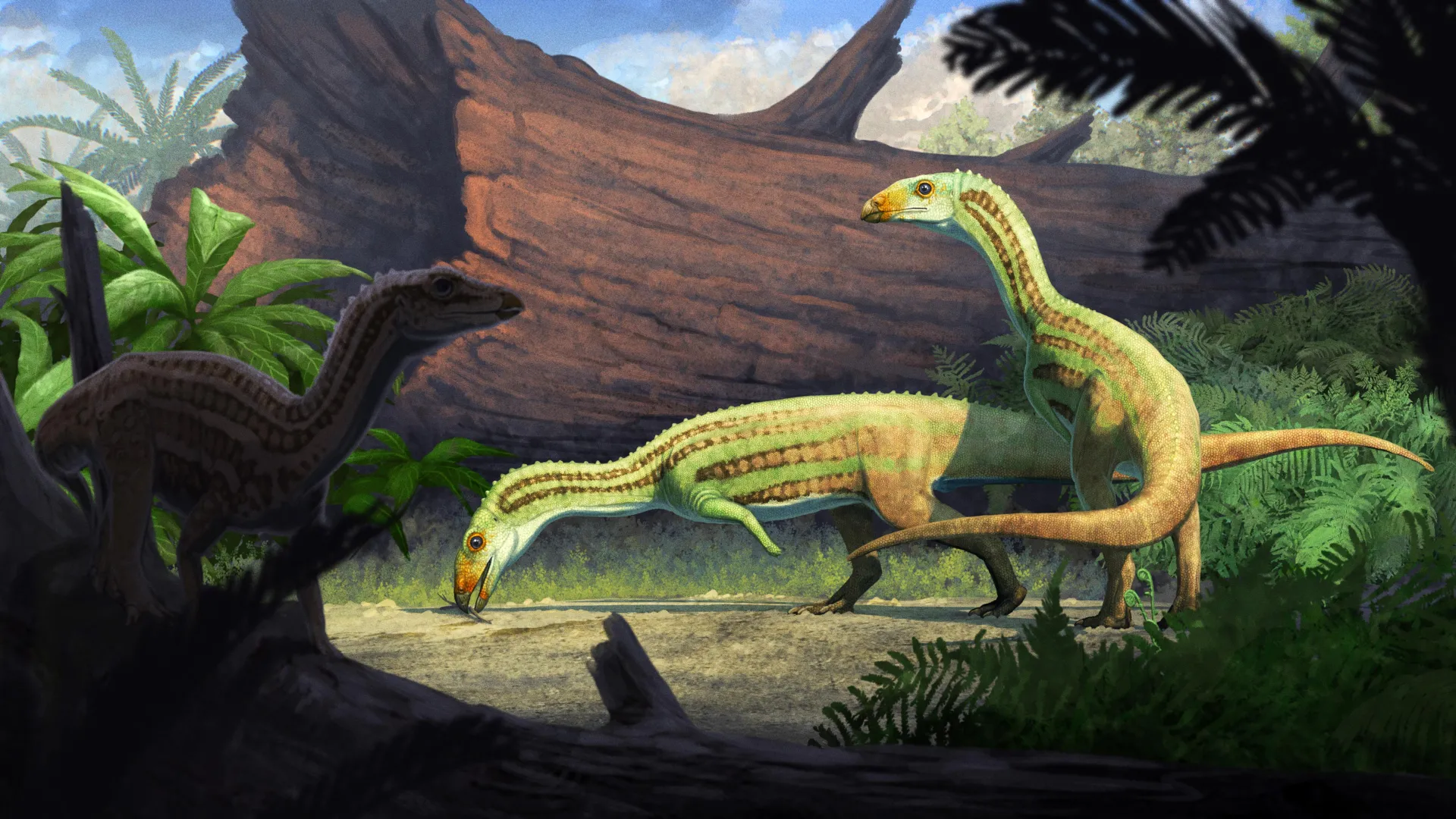
A newly described prehistoric reptile is giving scientists a surprising look at how some ancient animals may have changed the way they moved as they grew. Researchers say this "peculiar" crocodile relative likely began life walking on four legs, only to adopt a two-legged stance as it reached adulthood.
The species, called Sonselasuchus cedrus, belonged to a group of reptiles known as shuvosaurids. Many members of this group closely resembled ornithomimid dinosaurs, which lived alongside them during the Late Triassic period (approximately 225-201 million years ago).
Fossil Evidence Points to Bipedal Movement
In a peer-reviewed study published in the Journal of Vertebrate Paleontology, scientists from the University of Washington Department of Biology and the Burke Museum analyzed fossil remains and noticed unusual limb proportions. These findings suggest that the small, roughly poodle-sized reptile may have developed the ability to walk on two legs later in life.
"By analyzing the proportions of the limb skeletons of different animals, they determined its bipedal stance (standing on two feet) may have been the result of a differential growth pattern," explains lead author Elliott Armour Smith.
"We think that Sonselasuchus had more proportional forelimbs and hindlimbs as young, and their hindlimb grew longer and more robust through adulthood.
"Essentially, we think these creatures started out their lives on four legs… they then started walking on two legs as they grew up.
"This is particularly peculiar."
Armour Smith, a graduate student, conducted the research with Professor Christian Sidor of the Burke Museum.
Massive Fossil Find in Arizona
Professor Sidor was part of the excavation team that uncovered 950 fossils of Sonselasuchus in 2014 at Petrified Forest National Park in Arizona. Over a decade of digging and preparation at this site has produced more than 3,000 fossil bones, making it one of the richest discoveries of its kind.
The fossils also provide insight into the reptile's appearance. Standing about 25 inches tall, it likely had a toothless beak, large eye sockets, and hollow bones.
Dinosaur-Like Features Evolved Independently
Although Sonselasuchus looks similar to certain dinosaurs, scientists emphasize that these traits evolved separately.
"Although similar to the ornithomimid dinosaurs these features would have evolved separately," explains Armour Smith, "and this similarity was probably due to the fact that croc-line and bird-line archosaurs evolved in the same ecosystems and converged upon similar ecological roles.
"Also, despite the fact that features like bipedalism, a toothless beak, hollow bones and a large orbit are characteristic of ornithomimid theropod dinosaurs, shuvosaurids like Sonselasuchus show that these features evolved on the croc-line as well."
Life in a Triassic Forest
The animal likely lived in forested environments. Its species name, cedrus, refers to cedar trees, evergreen conifers similar to those that existed in Late Triassic forests.
The genus name Sonselasuchus (pronounced "sawn-SAY-la-SOOK-us") honors the geologic layer where the fossils were found, known as the Sonsela Member of the Upper Triassic Chinle Formation. This rock formation has yielded numerous important discoveries over time.
A Decade of Ongoing Discoveries
For Professor Sidor, the research represents more than ten years of collaboration with the National Park Service.
"Since starting fieldwork at Petrified Forest in 2014, we have collected over 3,000 fossils from the Sonselasuchus bonebed, and it doesn't seem to show any signs of petering out," Professor Sidor states.
"In addition to Sonselasuchus, the bonebed has yielded fossils of fish, amphibians, as well as dinosaurs and other reptiles. Over 30 University of Washington students and volunteers have been involved over the years. It's exciting to see that the site continues to produce new and interesting fossils."
Story Source:
Materials provided by Taylor & Francis Group. Note: Content may be edited for style and length.
Journal Reference:
- Elliott Armour Smith, Christian A. Sidor. Osteology and relationships of a new shuvosaurid (Pseudosuchia, Poposauroidea) from the Upper Triassic Chinle Formation of Petrified Forest National Park, Arizona, U.S.A.. Journal of Vertebrate Paleontology, 2026; 45 (5) DOI: 10.1080/02724634.2025.2604859
Cite This Page: