
Scientists discover how to turn gut bacteria into anti-aging factories
- Date:
- February 1, 2026
- Source:
- Howard Hughes Medical Institute
- Summary:
- Researchers found that small doses of an antibiotic can coax gut bacteria into producing a life-extending compound. In worms, this led to longer lifespans, while mice showed healthier cholesterol and insulin changes. Because the drug stays in the gut, it avoids toxic side effects. The study points to a new way of promoting health by targeting microbes rather than the body itself.
- Share:
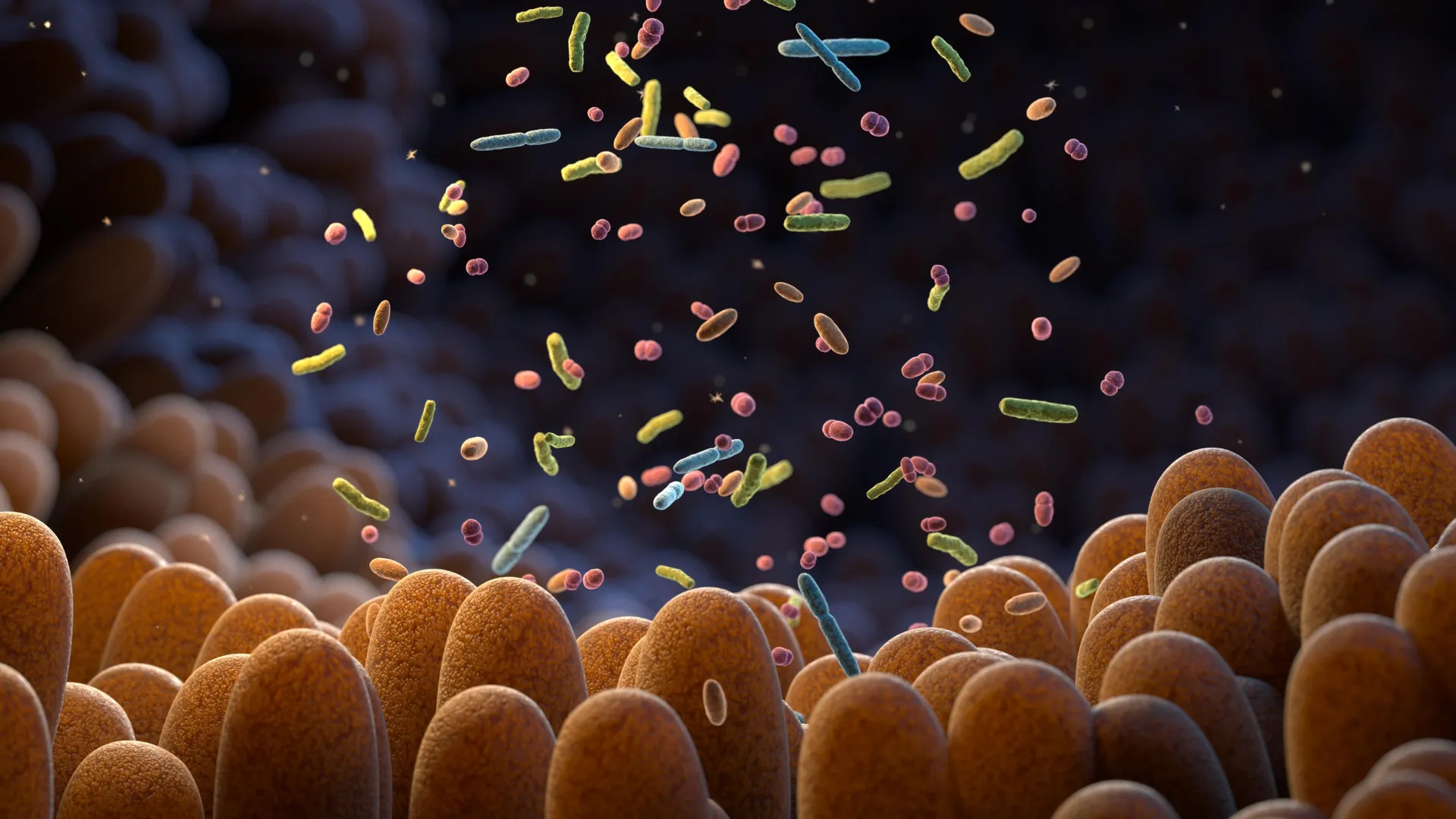
Researchers have discovered a way to coax the bacteria living in animals' digestive systems into acting like miniature factories that produce compounds linked to longer life. The findings point to a potential new approach for developing drugs that work by influencing gut microbes rather than directly targeting the body.
The work was led by Janelia Senior Group Leader Meng Wang, whose lab focuses on understanding the biology of aging. Her team wanted to find a practical way to translate their earlier discoveries about longevity-related compounds into something that could eventually be useful beyond the laboratory.
Using the Gut Microbiota to Produce Beneficial Compounds
The researchers explored whether they could prompt the body's gut microbiota (a collection of bacteria in the gut that produces many different compounds) to make substances that support health and longevity. They focused on colanic acid, a compound naturally produced by gut bacteria that had already been shown to extend lifespan in roundworms and fruit flies.
In their latest experiments, Wang's team found that gut bacteria produced much higher levels of colanic acids when exposed to low doses of the antibiotic cephaloridine. Roundworms given cephaloridine lived longer, linking the increase in this bacterial compound to improved longevity.
The researchers then tested the approach in mice. Low doses of cephaloridine activated gene expression in gut bacteria involved in making colanic acids. This led to noticeable shifts in age-related metabolism, including higher levels of good cholesterol and lower levels of bad cholesterol in male mice, along with reduced insulin levels in female mice.
Why the Approach Avoids Side Effects
Cephaloridine has an important advantage. When taken orally, it is not absorbed into the bloodstream. That means it can influence the gut microbiome without affecting the rest of the body, helping to avoid toxicity and unwanted side effects.
According to the researchers, the results highlight a promising strategy for promoting longevity using drugs that act on bacteria rather than human cells. They suggest this work could reshape how future medicines are designed, shifting the focus toward compounds that guide the microbiota to produce health-supporting molecules for their hosts.
Story Source:
Materials provided by Howard Hughes Medical Institute. Note: Content may be edited for style and length.
Journal Reference:
- Guo Hu, Marzia Savini, Matthew Brandon Cooke, Xin Wei, Dinghuan Deng, Shihong M. Gao, Ruyue Alps Xia, Youchen Guan, Alice X. Wen, Xin Yu, Jin Wang, Chao Jiang, Christophe Herman, Jiefu Li, Meng C. Wang. Chemical modulation of gut bacterial metabolism induces colanic acid and extends the lifespan of nematode and mammalian hosts. PLOS Biology, 2025; 23 (11): e3002749 DOI: 10.1371/journal.pbio.3002749
Cite This Page: