
Jupiter’s clouds are hiding something big
- Date:
- January 31, 2026
- Source:
- University of Chicago
- Summary:
- Jupiter’s swirling storms have concealed its true makeup for centuries, but a new model is finally peeling back the clouds. Researchers found the planet likely holds significantly more oxygen than the Sun, a key clue to how Jupiter—and the rest of the solar system—came together. The study also reveals that gases move through Jupiter’s atmosphere much more slowly than scientists once thought. Together, the findings reshape our understanding of the solar system’s largest planet.
- Share:
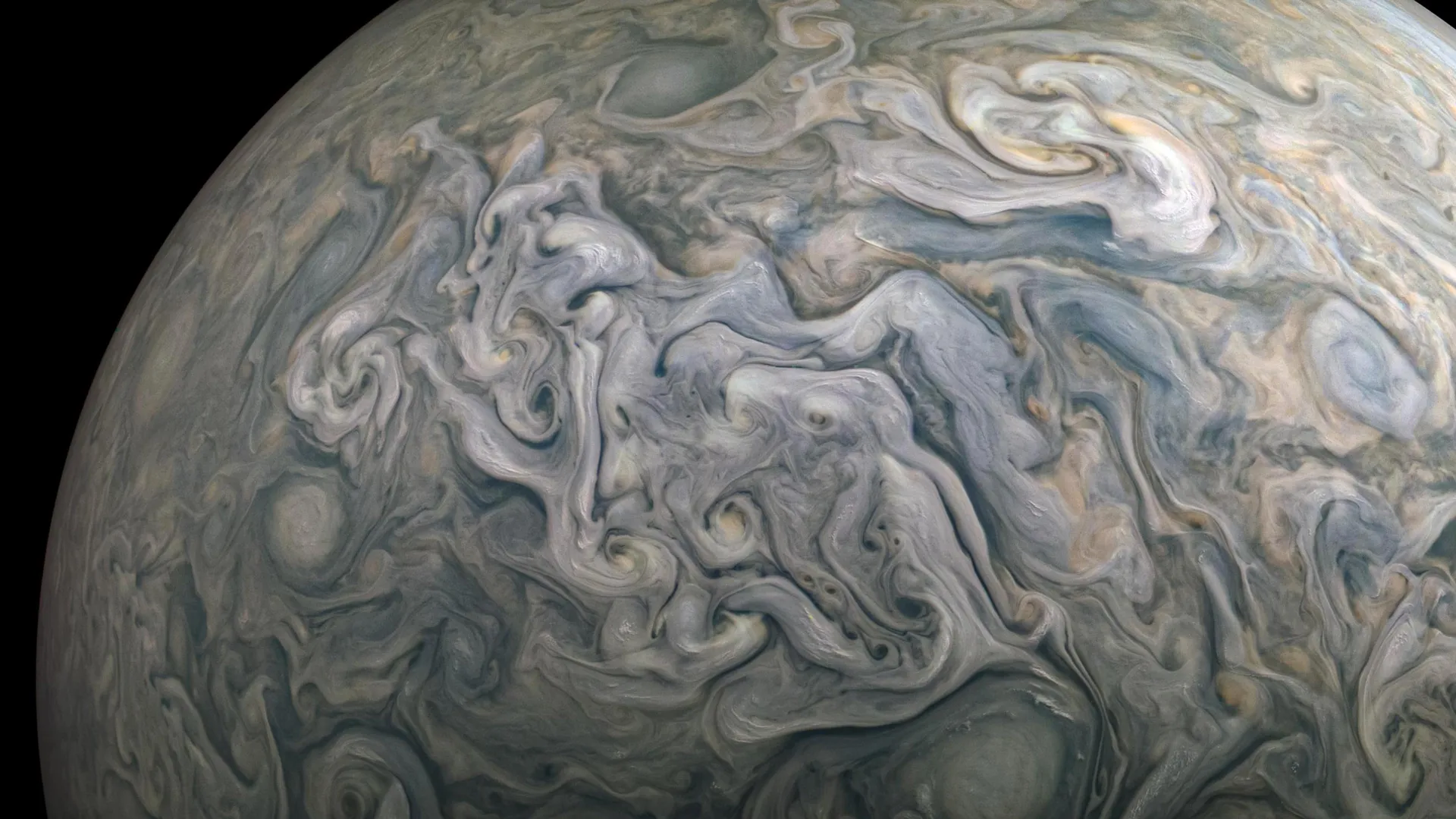
Towering clouds ripple across Jupiter's surface in dramatic patterns. Like Earth's clouds, they contain water, but on Jupiter they are far denser and far deeper. These layers are so thick that no spacecraft has been able to directly observe what lies below them.
Now, scientists have taken a major step toward solving that mystery. A new study led by researchers at the University of Chicago and the Jet Propulsion Laboratory has produced the most detailed model of Jupiter's atmosphere ever created. The work provides a deeper look into the planet's interior without needing to physically descend into its crushing depths.
One of the study's key findings helps resolve a long running debate about Jupiter's composition. The researchers estimate that the gas giant contains roughly one and a half times more oxygen than the sun. That result sharpens scientists' understanding of how Jupiter and the rest of the solar system took shape.
"This is a long-standing debate in planetary studies," said Jeehyun Yang, a postdoctoral researcher at UChicago and the study's lead author. "It's a testament to how the latest generation of computational models can transform our understanding of other planets."
The study was published Jan. 8 in The Planetary Science Journal.
Storms, Clouds, and Chemical Clues
Astronomers have been watching Jupiter's turbulent atmosphere for centuries. More than 360 years ago, early telescope observations revealed a massive, persistent feature on the planet's surface.
That feature is now known as the Great Red Spot, a colossal storm roughly twice the size of Earth that has raged for hundreds of years. It is only one part of a planet-wide system of violent winds and thick clouds that blanket Jupiter in nearly constant motion.
While these storms are visible from afar, what lies beneath them remains largely unknown. Jupiter's clouds are so dense that NASA's Galileo spacecraft lost contact with Earth when it plunged into the planet's atmosphere in 2003. Today, NASA's Juno mission studies Jupiter from orbit, gathering data from a safe distance.
From orbit, scientists can identify chemicals in the upper atmosphere, including ammonia, methane, ammonium hydrosulfide, water, and carbon monoxide. Researchers combine those measurements with known chemical reactions to infer what may be happening deeper below the clouds.
Even so, past studies have reached conflicting conclusions, especially when estimating how much water and oxygen Jupiter contains. Yang recognized that new modeling techniques could help resolve those disagreements.
A New Way to Model Jupiter's Atmosphere
Jupiter's atmosphere is a chemical maze. Molecules move between scorching temperatures deep inside the planet and cooler regions above, shifting between different states and rearranging themselves through thousands of reactions. On top of that, clouds and droplets form, dissolve, and interact with their surroundings.
To capture all of this complexity, Yang and colleagues combined atmospheric chemistry with hydrodynamics in a single model. This approach allows the simulation to track both chemical reactions and the movement of gases, clouds, and droplets together.
"You need both," Yang said. "Chemistry is important but doesn't include water droplets or cloud behavior. Hydrodynamics alone simplifies the chemistry too much. So, it's important to bring them together."
This combined approach had not been done before at this level of detail, and it led to several important insights.
Oxygen, Water, and Planetary Origins
The model produced a new estimate of Jupiter's oxygen content, pointing again to a value of about one and a half times that of the sun. This contrasts with a recent high profile study that suggested Jupiter might contain only about a third as much oxygen.
Pinning down this number matters because oxygen plays a major role in planetary formation. The elements that make up planets and living things originated in the sun, but their proportions can vary from world to world. Those differences offer clues about how planets formed and where they came from.
One open question is whether Jupiter formed where it currently orbits or whether it migrated over time. Much of the planet's oxygen is locked into water, which behaves very differently depending on temperature. Farther from the sun, water freezes into ice, which is easier for growing planets to collect than water vapor.
Understanding those conditions does not just explain Jupiter's past. It also helps scientists predict what kinds of planets might form around other stars and which ones could potentially support life.
A Slower, More Mysterious Atmosphere
The model also suggests that Jupiter's atmosphere circulates far more slowly than scientists once believed. Vertical movement of gases appears to be dramatically reduced compared to standard assumptions.
"Our model suggests the diffusion would have to be 35 to 40 times slower compared to what the standard assumption has been," said Yang. Instead of moving through an atmospheric layer in hours, a single molecule might take several weeks.
"It really shows how much we still have to learn about planets, even in our own solar system," Yang said.
Funding: NASA, Caltech-Jet Propulsion Laboratory.
Story Source:
Materials provided by University of Chicago. Original written by Louise Lerner. Note: Content may be edited for style and length.
Journal Reference:
- Jeehyun Yang, Ali Hyder, Renyu Hu, Jonathan I. Lunine. Coupled 1D Chemical Kinetic Transport and 2D Hydrodynamic Modeling Supports a Modest 1–1.5× Supersolar Oxygen Abundance in Jupiter’s Atmosphere. The Planetary Science Journal, 2026; 7 (1): 2 DOI: 10.3847/PSJ/ae28d5
Cite This Page: