
A 200-year-old physics experiment could help build future computers
A 200-year-old light phenomenon has given scientists a surprisingly simple way to create futuristic light structures that could help shape tomorrow's computing technologies.
- Date:
- July 13, 2026
- Source:
- Nanyang Technological University
- Summary:
- Scientists at Nanyang Technological University in Singapore have discovered a surprisingly simple way to create exotic light structures called optical skyrmions using a 200-year-old optical effect known as the Poisson spot. Instead of relying on expensive, highly engineered materials, they simply shine a laser at a tiny circular disc, producing stable swirling patterns in light that researchers believe could one day help power advanced data storage, communications, and computing technologies.
- Share:
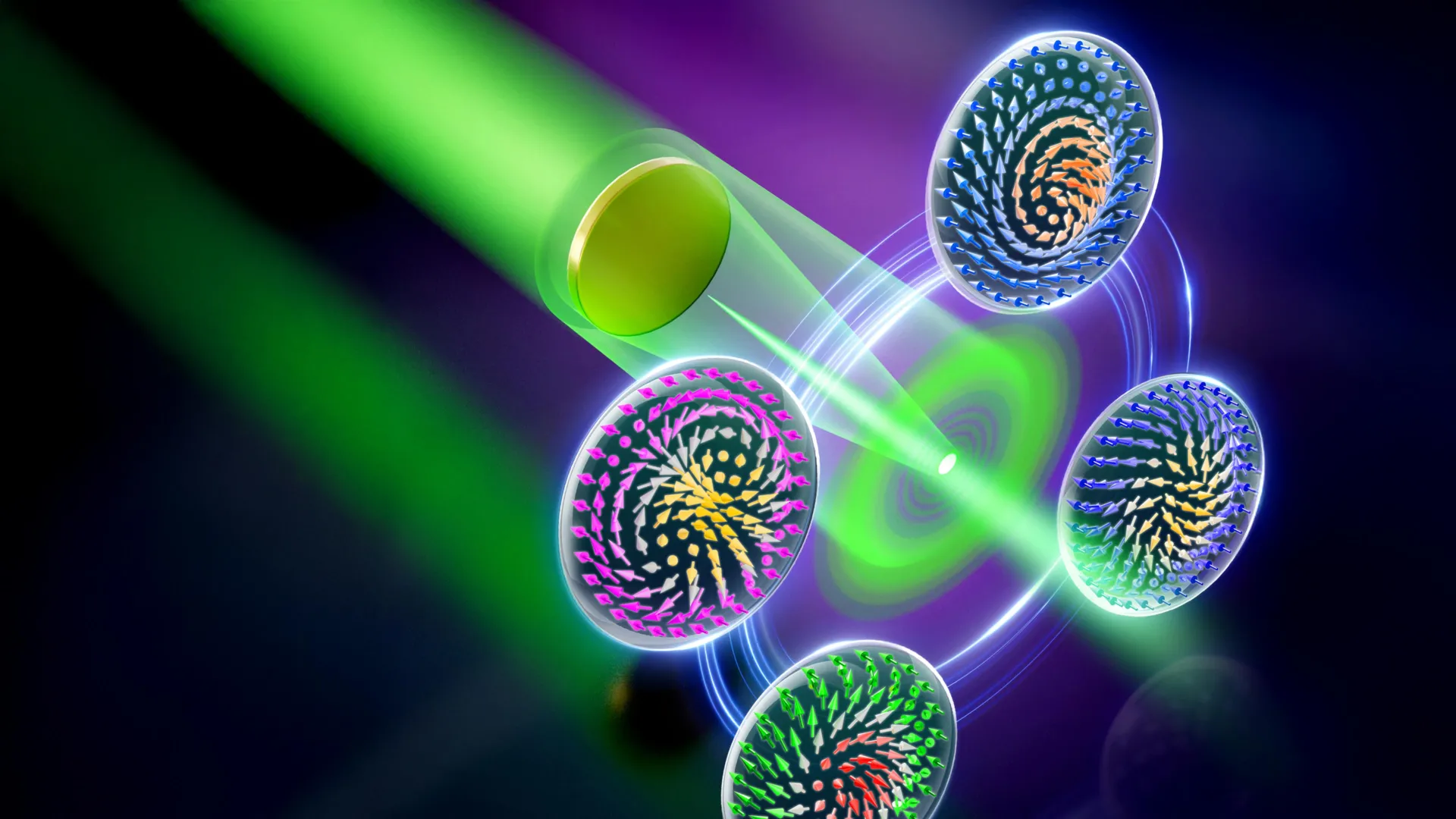
Scientists at Nanyang Technological University, Singapore (NTU Singapore) have found a much simpler way to produce unusual light structures known as optical skyrmions by reviving a classic optics experiment that dates back more than 200 years.
Optical skyrmions are tiny, stable swirling patterns formed within the properties of light. Their structure has often been compared to the spines of a hedgehog. Because they can potentially encode and store information, researchers see them as promising building blocks for future data storage, communications, and computing technologies.
Instead of relying on expensive, highly engineered metamaterials that have traditionally been needed to generate optical skyrmions, the NTU team created them by shining a laser at a small circular disc. The approach provides a far simpler way to produce, study, and control these complex light structures.
The findings, published in the journal Optica, were led by Nanyang Assistant Professor Shen Yijie from NTU's School of Physical and Mathematical Sciences and School of Electrical and Electronic Engineering.
"What is remarkable is that optical skyrmions can now be generated using a simple effect where light bends around an object, without relying on expensive, complex man-made metamaterials or highly specialized techniques," explained Asst Prof Shen.
"This could make optical skyrmions much more accessible to researchers. By lowering the technical barrier to creating and studying them, the method opens up new possibilities for scientists to study how they could be used in future optical, materials and computing research."
A Classic Light Phenomenon Finds a New Purpose
The breakthrough is based on the Poisson spot, a well known optical phenomenon in which a bright point appears at the center of the shadow cast by a circular object when it is illuminated by a coherent light source such as a laser.
The Poisson spot played an important role in the early 19th century debate over the nature of light. At the time, scientists questioned whether light traveled only as particles in straight lines or behaved as waves that could bend and spread.
Wave theory predicted that a bright point should appear in the center of the disc's shadow, where complete darkness would otherwise be expected. Observing the Poisson spot provided convincing evidence that light undergoes diffraction, meaning it bends and spreads as it passes around objects or through small openings.
Four Types of Optical Skyrmions at Once
The researchers also discovered that their Poisson spot setup naturally produced as many as four related topological field patterns simultaneously.
These included spin skyrmions, Stokes skyrmions, electric field skyrmions, and magnetic field skyrmions. Spin refers to the rotation like properties of light, while the Stokes parameters describe polarization, or the direction in which light waves vibrate as they travel.
Generating these four types together could give scientists a unique opportunity to compare how different optical skyrmions form, evolve, and interact within the same light field.
Computer simulations showed the structures as swirling arrays of arrows that illustrate how different properties of light change direction across the Poisson spot.
A Simpler Way To Control Complex Light
Light possesses many characteristics that researchers can manipulate, including its intensity, phase, polarization, spin, and its electric and magnetic field vectors.
These properties can be arranged into topological structures, which are patterns that remain stable even when stretched or distorted. By adjusting the conditions that shape the light field, scientists may be able to precisely control the size, shape, and behavior of optical skyrmions.
Asst Prof Shen said: "In the light spot that we created, several types of optical vectors could form topological structures at the same time. These different components of light are closely connected, but they do not necessarily form identical topological patterns.
"Being able to produce and compare several skyrmions within one system could help researchers uncover new links between light's electric, magnetic and other physical properties."
Potential Applications in Computing and Photonics
Skyrmions were first proposed in particle and nuclear physics before later becoming an important area of study in condensed matter physics and magnetic materials. More recently, scientists have begun investigating optical skyrmions as stable, particle like structures that exist within light fields.
Earlier methods for producing optical skyrmions relied on metamaterials, which are artificially engineered microscopic structures designed to manipulate light in ways that conventional materials cannot.
By replacing those complex systems with a much simpler optical setup, the NTU team's work could make optical skyrmion research more accessible. The findings also provide a foundation for future studies of topological light and may contribute to advances in photonics, advanced materials, information processing, and next generation computing.
Story Source:
Materials provided by Nanyang Technological University. Note: Content may be edited for style and length.
Journal Reference:
- Jun Yao, Xi Xie, Yuan Meng, Sheng Sun, Jun Hu, Yijie Shen, Yuanjie Yang. Optical skyrmions in Poisson spots. Optica, 2026; 13 (6): 1184 DOI: 10.1364/OPTICA.591840
Cite This Page: