
These “smart” crystals bend and snap back when hit with light
- Date:
- March 31, 2026
- Source:
- University of California - Davis
- Summary:
- Perovskite crystals can dramatically and reversibly change shape when hit with light, a behavior not seen in conventional semiconductors. This effect, called photostriction, can be finely tuned depending on the light’s intensity and color. Researchers say these materials act more like adjustable systems than simple switches. The finding could lead to a new generation of light-powered sensors and devices.
- Share:
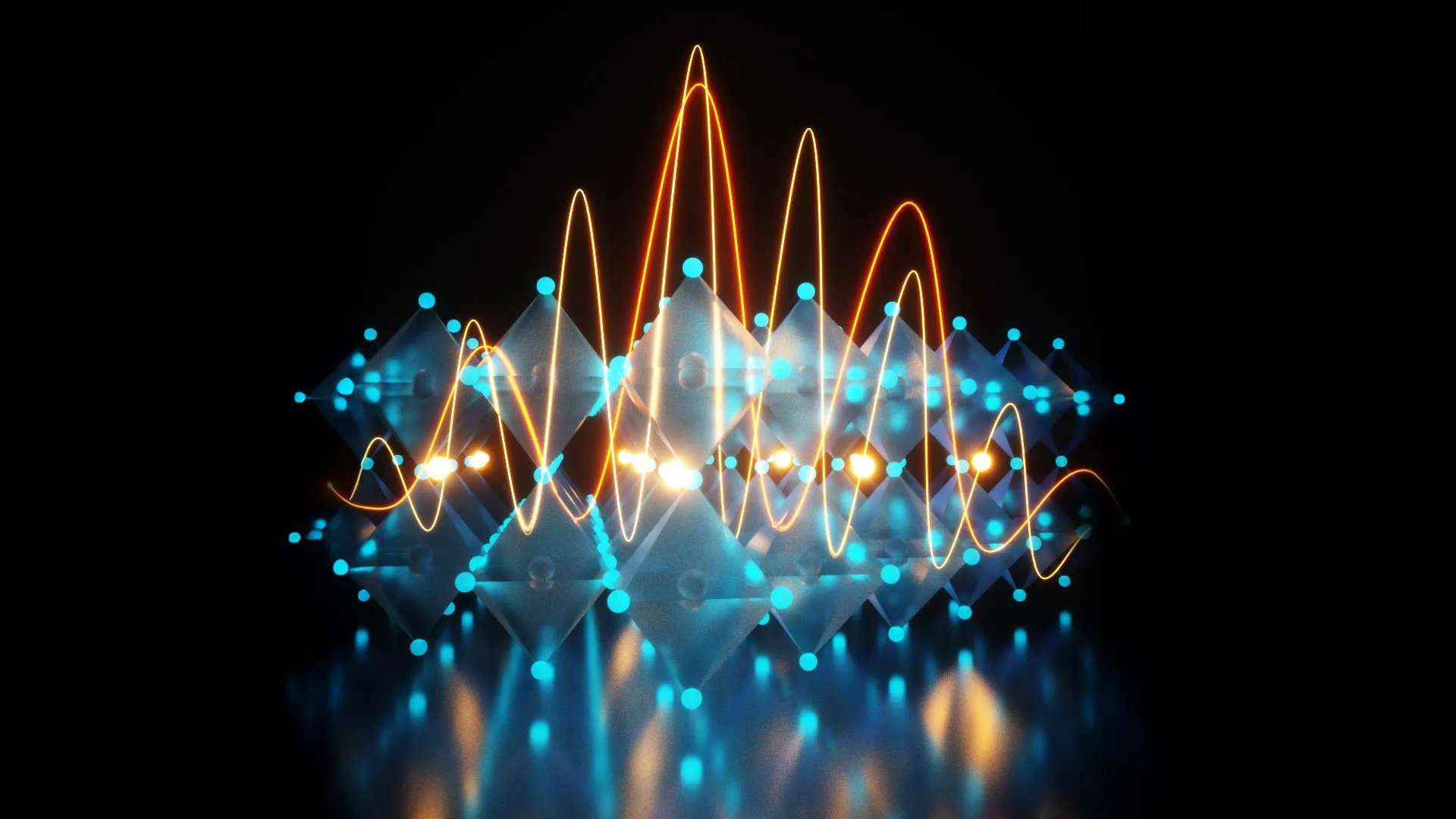
Researchers at the University of California, Davis have identified a surprising property in a class of materials known as perovskites that could pave the way for a new generation of light-controlled semiconductor devices. Their findings, published March 3 in Advanced Materials, show that halide perovskite crystals can change their shape when exposed to light and then return to their original form.
Perovskites are a type of semiconductor, but they behave very differently from traditional materials like silicon and gallium arsenide. They can be made from a mix of organic and inorganic components and are often less expensive to produce. These differences make them especially attractive for next-generation technologies.
"They are 'smart materials' that can be tuned to respond to a stimulus in a way we can control," said Marina Leite, professor of materials science engineering at UC Davis and senior author on the paper. "Their chemistry is very different in a way that can be beneficial for creating devices we couldn't build before."
All perovskites share a common structure known as ABX3. At the atomic level, this can be visualized as a central atom surrounded by an octahedron (two pyramids attached at the base) formed by six atoms, all enclosed within a cube with atoms at each corner. Because of this structure, perovskites are already widely studied for use in optoelectronics and advanced solar cells.
Light triggers rapid and reversible crystal changes
To investigate how these materials respond to light, graduate student Mansha Dubey directed laser light onto perovskite crystals and monitored how their atomic structure shifted using X-ray measurements. The crystals themselves were produced by collaborators Bekir Turedi, Andrii Kanak and Professor Maksym Kovalenko at ETH Zürich, Switzerland.
The experiments revealed that shining light on the crystals causes their internal lattice to shift quickly. When the light is removed, the structure returns to its original arrangement. This cycle can be repeated many times.
"There is a dramatic change in the lattice when you shine light on it, a unique phenomenon that you don't see with silicon or gallium arsenide," Leite said. This photostriction effect is reversible and can be repeated again and again, she said.
Tunable response depends on light and composition
One of the most promising aspects of perovskites is their flexibility. By adjusting their chemical makeup, scientists can control the wavelengths of light the crystals absorb and emit, a property known as the bandgap. Different compositions respond differently to light, especially at frequencies above the bandgap.
Researchers also found that the strength of the shape change can be tuned. Both the color and intensity of the light influence how strongly the material responds.
"It's not a binary on/off effect; it can be a scaled response, like a dimmer, depending on the light you shine on it," she said.
Toward light-controlled devices and new technologies
This ability to precisely control how a material changes shape using light could lead to new types of devices. Leite suggests that perovskites could be used in sensors or actuators that are activated or adjusted by light instead of electricity.
The research was supported by a federal Defense Advanced Research Projects Agency program focused on developing materials for switchable photonic devices, as well as by the National Science Foundation. The team also used the UC Davis Advanced Materials Characterization and Testing (AMCaT) laboratory, which was established with support from NSF.
Story Source:
Materials provided by University of California - Davis. Note: Content may be edited for style and length.
Journal Reference:
- Mansha Dubey, Bekir Turedi, Andrii Kanak, Maksym V. Kovalenko, Marina S. Leite. Reversible, Photo‐Induced Lattice Distortions in Halide Perovskites. Advanced Materials, 2026; DOI: 10.1002/adma.202521800
Cite This Page: