
Stanford scientists create shape-shifting material that changes color and texture like an octopus
- Date:
- March 31, 2026
- Source:
- Stanford University
- Summary:
- A new shape-shifting material can change both its texture and color in seconds, inspired by the camouflage abilities of octopuses. By precisely controlling how a polymer swells with water, researchers can create detailed, reversible patterns at the nanoscale. The material can even mimic realistic surfaces and dynamically adjust how it reflects light. In the future, AI could allow it to automatically blend into its surroundings.
- Share:
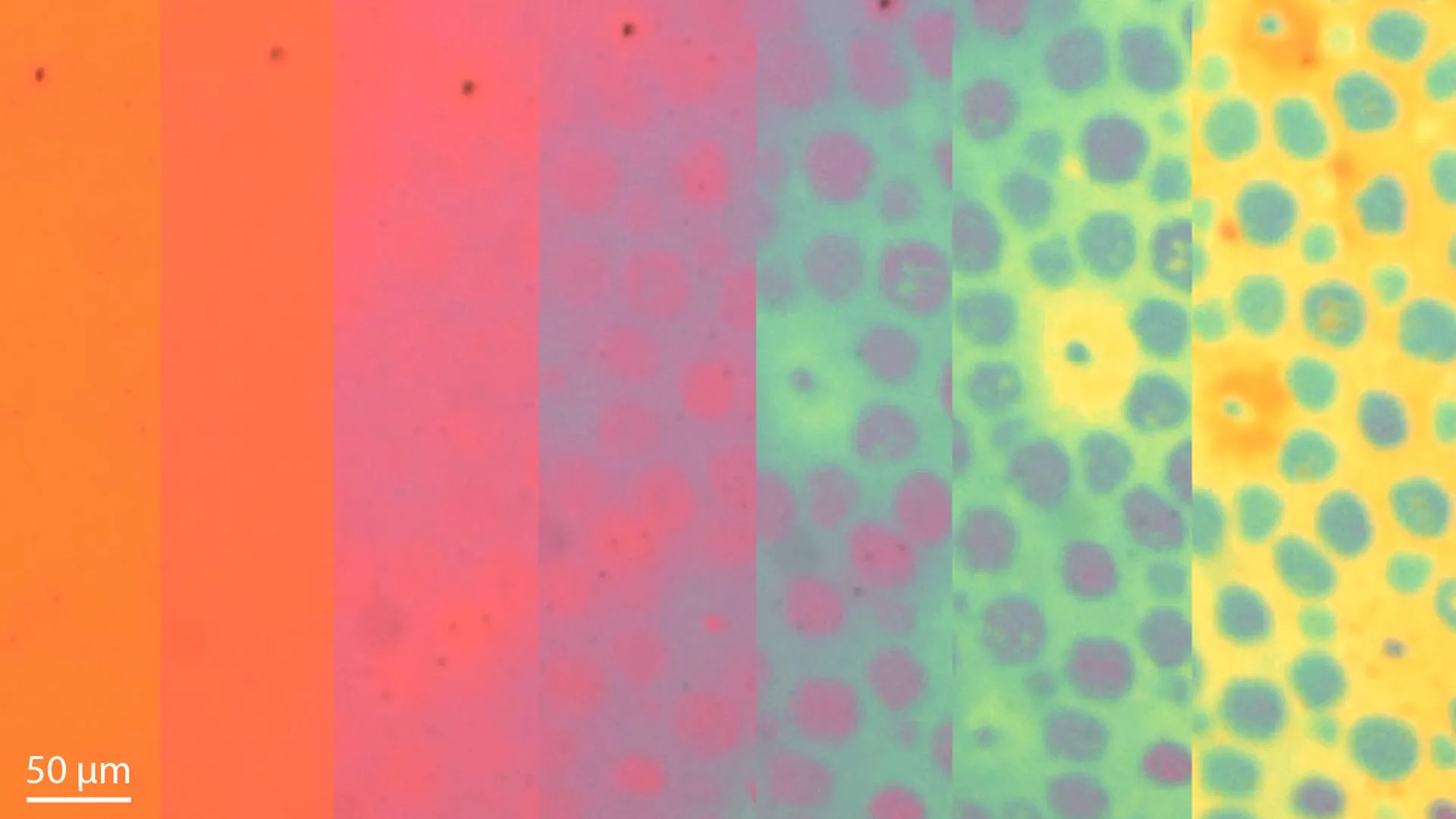
Octopuses and cuttlefish are famous for their ability to blend seamlessly into their surroundings. They can quickly alter both the color and texture of their skin, a capability scientists have long tried to replicate in man-made materials. Now, researchers at Stanford report a major advance. In a study published in Nature, they describe a flexible material that can rapidly shift its surface patterns and colors, forming features smaller than a human hair.
"Textures are crucial to the way we experience objects, both in how they look and how they feel," said Siddharth Doshi, a doctoral student in materials science and engineering at Stanford and first author on the paper. "These animals can physically change their bodies at close to the micron scale, and now we can dynamically control the topography of a material - and the visual properties linked to it - at this same scale."
This innovation could lead to improved camouflage systems for both humans and robots, as well as flexible displays that change color for wearable devices. It also opens new doors in nanophotonics, a field focused on controlling light at very small scales for uses in electronics, encryption, and biology.
"There's just no other system that can be this soft and swellable, and that you can pattern at the nanoscale," said Nicholas Melosh, a professor of materials science and engineering and a senior author on the paper. "You can imagine all kinds of different applications."
How the Material Creates Dynamic Patterns
To produce these shifting textures, the team combined electron-beam lithography, a technique widely used in semiconductor manufacturing, with a water-responsive polymer film. When exposed to a focused beam of electrons, specific regions of the film become more or less absorbent. As the material takes in water, those regions swell differently, forming intricate patterns that only appear when the film is wet.
The key insight came unexpectedly. In an earlier experiment, Doshi used a scanning electron microscope to examine nanostructures on a polymer film. Instead of discarding the samples afterward, he reused them. During later tests, the areas previously exposed to the electron beam behaved differently and displayed distinct colors.
"We realized that we could use these electron beams to control topography at very fine scales," Doshi said. "It was definitely serendipitous."
From Flat Surfaces to 3D Structures
The precision of this technique allows for remarkable detail. The researchers even created a tiny version of Yosemite's El Capitan. When dry, the surface remains completely flat. Once water is added, the structure rises from the film, forming a three-dimensional shape.
By carefully adjusting how much the material swells, the team can also control how it reflects light. This makes it possible to switch between glossy and matte finishes, producing visual effects that surpass what current screens can achieve. The process is reversible. Adding an alcohol-like solvent removes the water and returns the material to its flat state.
The same approach can also generate complex color patterns. By placing thin metal layers on both sides of the polymer, the researchers created structures known as Fabry-Pérot resonators, which select specific wavelengths of light. As the film expands or contracts, it displays different colors. With the right balance of water and solvent, a plain surface can transform into a vibrant array of patterns.
"By dynamically controlling the thickness and topography of a polymer film, you can realize a very large variety of beautiful colors and textures," said Mark Brongersma, a professor of materials science and engineering and a senior author on the paper. "The introduction of soft materials that can expand, contract, and alter their shape opens up an entirely new toolbox in the world of optics to manipulate how things look."
Future Applications in Camouflage and Robotics
When multiple layers of these films are combined, researchers can independently adjust both color and texture, allowing the material to blend into its surroundings in a way similar to an octopus (although not without some trial and error).
At present, matching a background requires manual tuning of water and solvent levels. The team hopes to automate this process by adding computer vision and AI systems that can analyze surroundings and adjust the material in real time.
"We want to be able to control this with neural networks - basically an AI-based system - that could compare the skin and its background, then automatically modulate it to match in real time, without human intervention," Doshi said.
Beyond Camouflage: New Possibilities
The potential uses extend well beyond camouflage. Fine control over surface texture could help regulate friction, allowing small robots to either grip surfaces or slide across them. At the nanoscale, changes in structure can also influence how cells behave, opening possible applications in bioengineering. The team is even collaborating with artists to explore creative uses for the material.
"Small changes in the properties of soft materials over micron distances are finally possible, which will open up all sorts of possibilities," Melosh said. "I think there are a lot of exciting things coming up."
Research Team and Support
Brongersma is a professor, by courtesy, of applied physics; a member of Stanford Bio-X, the Wu Tsai Human Performance Alliance, and the Wu Tsai Neurosciences Institute; and an affiliate of the Precourt Institute for Energy.
Melosh is a member of Stanford Bio-X and the Wu Tsai Neurosciences Institute; an affiliate of the Precourt Institute for Energy; and a faculty fellow of Sarafan ChEM-H.
Additional Stanford co-authors of this research include Alberto Salleo, the Hong She and Vivian W. M. Lim Professor and professor of photon science; Associate Professor Polly Fordyce; postdoctoral researchers Nicholas A. Güsken and Gerwin Dijk; Stanford Microfluidics Foundry director Jennifer E. Ortiz-Cárdenas; and graduate students Johan Carlström, Peter Suzuki, and Bohan Li.
This work was funded by a Stanford Graduate Fellowship, Meta PhD Fellowship, the Wu Tsai Human Performance Alliance at Stanford University and the Joe and Clara Tsai Foundation, the German National Academy of Sciences Leopoldina, the Department of Energy, the Air Force Office of Sponsored Research, and the National Science Foundation.
Story Source:
Materials provided by Stanford University. Note: Content may be edited for style and length.
Journal Reference:
- Siddharth Doshi, Nicholas A. Güsken, Gerwin Dijk, Johan Carlström, Jennifer E. Ortiz-Cárdenas, Peter Suzuki, Bohan Li, Polly M. Fordyce, Alberto Salleo, Nicholas A. Melosh, Mark L. Brongersma. Soft photonic skins with dynamic texture and colour control. Nature, 2026; 649 (8096): 345 DOI: 10.1038/s41586-025-09948-2
Cite This Page: