
After 100 years, scientists finally uncover hidden rule behind cosmic rays
A mysterious new cosmic pattern discovered by the DAMPE space telescope may finally crack the century-old mystery of cosmic rays.
- Date:
- May 14, 2026
- Source:
- Université de Genève
- Summary:
- Scientists studying mysterious ultra-powerful cosmic rays have uncovered a surprising hidden pattern that could finally help explain where these particles come from. Using the DAMPE space telescope, researchers found that cosmic ray particles—from tiny protons to heavy iron nuclei—all begin fading away more sharply at the exact same point, hinting at a universal rule governing their behavior across the galaxy.
- Share:
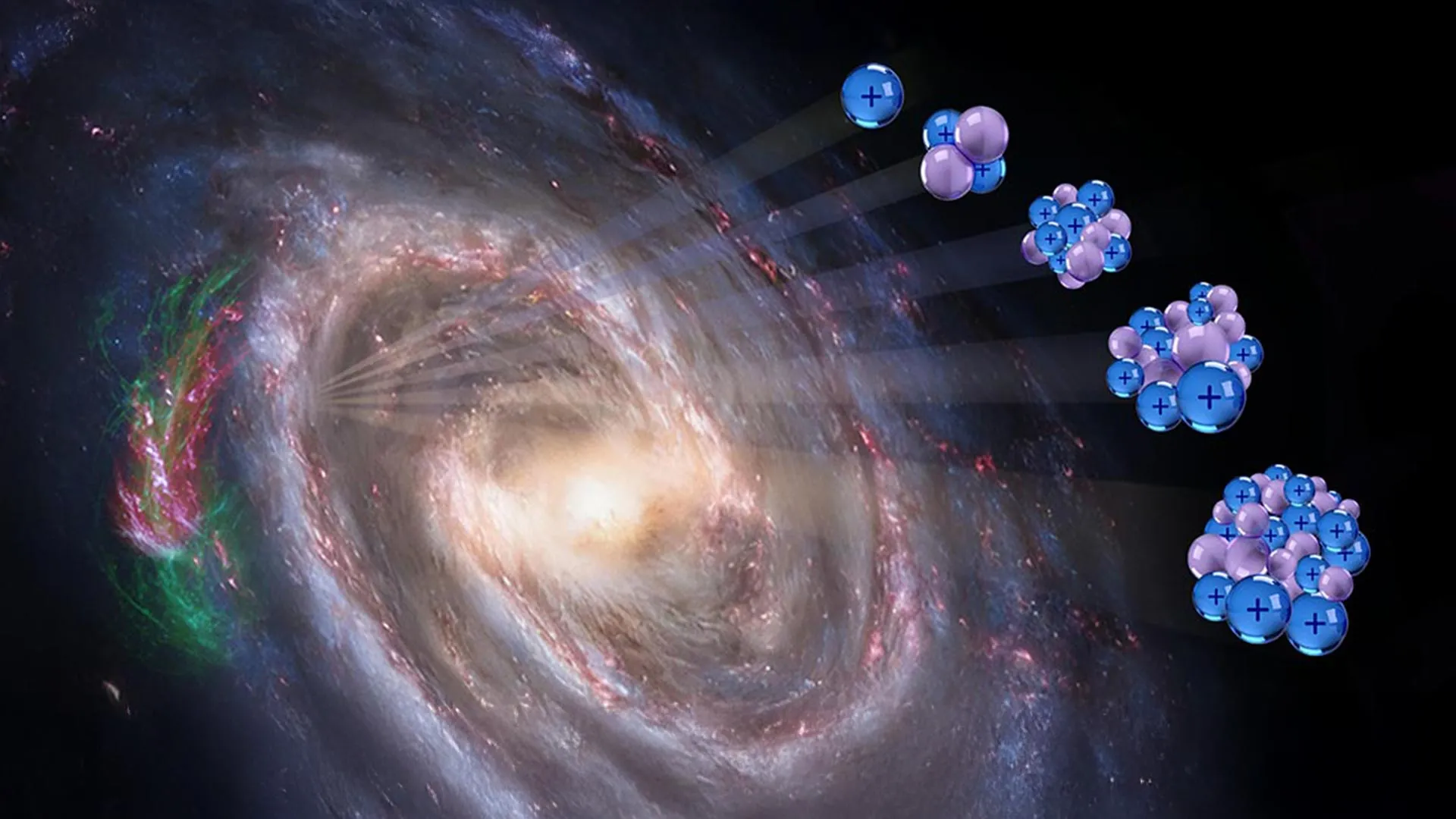
For more than 100 years, scientists have been trying to understand cosmic rays, incredibly powerful particles that travel across the universe at extreme energies. Despite decades of research, many questions about where they come from and how they are accelerated remain unanswered. Now, researchers working with the DAMPE (Dark Matter Particle Explorer) space telescope have uncovered an important new clue. Their findings, published in Nature, reveal a common feature shared by these mysterious particles and could help scientists better understand their origins.
Cosmic rays are the highest energy particles ever observed in nature. They carry far more energy than particles produced by even the most advanced accelerators on Earth. Scientists believe they are created by some of the universe's most violent events, including supernova explosions, jets from black holes, and pulsars.
Launched in December 2015, the DAMPE space telescope was designed to investigate the nature of cosmic rays and explore possible connections to dark matter. The mission includes major contributions from the astrophysics group at the Department of Nuclear and Particle Physics (DPNC) at the University of Geneva (UNIGE).
By examining highly precise data collected by DAMPE, researchers discovered a universal pattern in the energy spectra of primary cosmic ray nuclei, ranging from lightweight protons to much heavier iron nuclei.
"Cosmic rays are primarily composed of protons, but also of helium, carbon, oxygen, and iron nuclei,'' explains Andrii Tykhonov, associate professor at the DPNC in the Faculty of Science at UNIGE, and co-author of the study. "These particles are also categorised according to their energy: low, up to a few billion electron-volts; intermediate, from a few billion to several hundred billion electron-volts; and high, from 1,000 billion electron-volts and beyond."
Scientists Discover a Shared Cosmic Ray Pattern
The research showed that for every type of nucleus studied, the number of particles begins dropping much faster after reaching a certain threshold. Scientists refer to this effect as "spectral softening."
Normally, higher-energy cosmic rays become less common as energy increases. However, the DAMPE observations revealed that the decline becomes dramatically steeper beyond a rigidity of roughly 15 TV (teraelectron-volts). Rigidity describes how strongly a particle's path resists being bent by magnetic fields.
Because this same feature appears across many different types of particles, the findings strongly support theories suggesting that cosmic ray acceleration and movement through space are controlled by rigidity. At the same time, the data largely rules out competing explanations based on energy per nucleon (energy divided by the number of nucleons in the particle). According to the researchers, the confidence level against those alternative models reaches 99.999%.
AI and Advanced Detectors Help Drive the Discovery
Researchers from Geneva played a major role in the breakthrough. The team developed sophisticated artificial intelligence methods to reconstruct particle events detected by the telescope. They also contributed to important measurements involving proton and helium fluxes and helped analyze carbon nuclei data.
In addition, the Geneva group led the development of one of DAMPE's key instruments, the Silicon-Tungsten Tracker (STK). This detector is essential for accurately tracing particle paths and determining the electrical charge of incoming cosmic rays.
The findings mark an important advance in understanding how cosmic rays are created and how they travel through the galaxy. Scientists say the new results place tighter limits on existing models of particle acceleration in astrophysical sources and improve our understanding of how high-energy particles move through interstellar space.
Story Source:
Materials provided by Université de Genève. Note: Content may be edited for style and length.
Journal Reference:
- Francesca Alemanno, Qi An, Philipp Azzarello, Felicia-Carla-Tiziana Barbato, Paolo Bernardini, Xiao-Jun Bi, Hugo Boutin, Irene Cagnoli, Ming-Sheng Cai, Elisabetta Casilli, Jin Chang, Deng-Yi Chen, Jun-Ling Chen, Zhan-Fang Chen, Zi-Xuan Chen, Paul Coppin, Ming-Yang Cui, Tian-Shu Cui, Ivan De Mitri, Francesco de Palma, Adriano Di Giovanni, Tie-Kuang Dong, Zhen-Xing Dong, Giacinto Donvito, Jing-Lai Duan, Kai-Kai Duan, Rui-Rui Fan, Yi-Zhong Fan, Fang Fang, Kun Fang, Chang-Qing Feng, Lei Feng, Sara Fogliacco, Jennifer-Maria Frieden, Piergiorgio Fusco, Min Gao, Fabio Gargano, Essna Ghose, Ke Gong, Yi-Zhong Gong, Dong-Ya Guo, Jian-Hua Guo, Shuang-Xue Han, Yi-Ming Hu, Guang-Shun Huang, Xiao-Yuan Huang, Yong-Yi Huang, Maria Ionica, Lu-Yao Jiang, Wei Jiang, Yao-Zu Jiang, Jie Kong, Andrii Kotenko, Dimitrios Kyratzis, Shi-Jun Lei, Bo Li, Manbing Li, Wen-Hao Li, Wei-Liang Li, Xiang Li, Xian-Qiang Li, Yao-Ming Liang, Cheng-Ming Liu, Hao Liu, Jie Liu, Shu-Bin Liu, Yang Liu, Francesco Loparco, Miao Ma, Peng-Xiong Ma, Tao Ma, Xiao-Yong Ma, Giovanni Marsella, Mario-Nicola Mazziotta, Dan Mo, Yu Nie, Xiao-Yang Niu, Andrea Parenti, Wen-Xi Peng, Xiao-Yan Peng, Chiara Perrina, Enzo Putti-Garcia, Rui Qiao, Jia-Ning Rao, Yi Rong, Ritabrata Sarkar, Pierpaolo Savina, Andrea Serpolla, Zhi Shangguan, Wei-Hua Shen, Zhao-Qiang Shen, Zhong-Tao Shen, Leandro Silveri, Jing-Xing Song, Hong Su, Meng Su, Hao-Ran Sun, Zhi-Yu Sun, Antonio Surdo, Xue-Jian Teng, Andrii Tykhonov, Gui-Fu Wang, Jin-Zhou Wang, Lian-Guo Wang, Shen Wang, Xiao-Lian Wang, Yan-Fang Wang, Da-Ming Wei, Jia-Ju Wei, Yi-Feng Wei, Di Wu, Jian Wu, Sha-Sha Wu, Xin Wu, Zi-Qing Xia, Zheng Xiong, En-Heng Xu, Hai-Tao Xu, Jing Xu, Zhi-Hui Xu, Zun-Lei Xu, Zi-Zong Xu, Guo-Feng Xue, Ming-Yu Yan, Hai-Bo Yang, Peng Yang, Ya-Qing Yang, Hui-Jun Yao, Yu-Hong Yu, Qiang Yuan, Chuan Yue, Jing-Jing Zang, Sheng-Xia Zhang, Wen-Zhang Zhang, Yan Zhang, Ya-Peng Zhang, Yi Zhang, Yong-Jie Zhang, Yong-Qiang Zhang, Yun-Long Zhang, Zhe Zhang, Zhi-Yong Zhang, Cong Zhao, Hong-Yun Zhao, Xun-Feng Zhao, Chang-Yi Zhou, Xun Zhu, Yan Zhu. Charge-dependent spectral softenings of primary cosmic rays below the knee. Nature, 2026; 653 (8113): 52 DOI: 10.1038/s41586-026-10472-0
Cite This Page: