
Scientists just found a hidden 48-dimensional world in quantum light
- Date:
- March 21, 2026
- Source:
- University of the Witwatersrand
- Summary:
- A routine quantum optics technique just revealed an extraordinary secret: entangled light can carry incredibly complex topological structures. Researchers found these hidden patterns reach up to 48 dimensions, offering a vast new “alphabet” for encoding quantum information. Unlike previous assumptions, this topology can emerge from a single property of light—orbital angular momentum.
- Share:
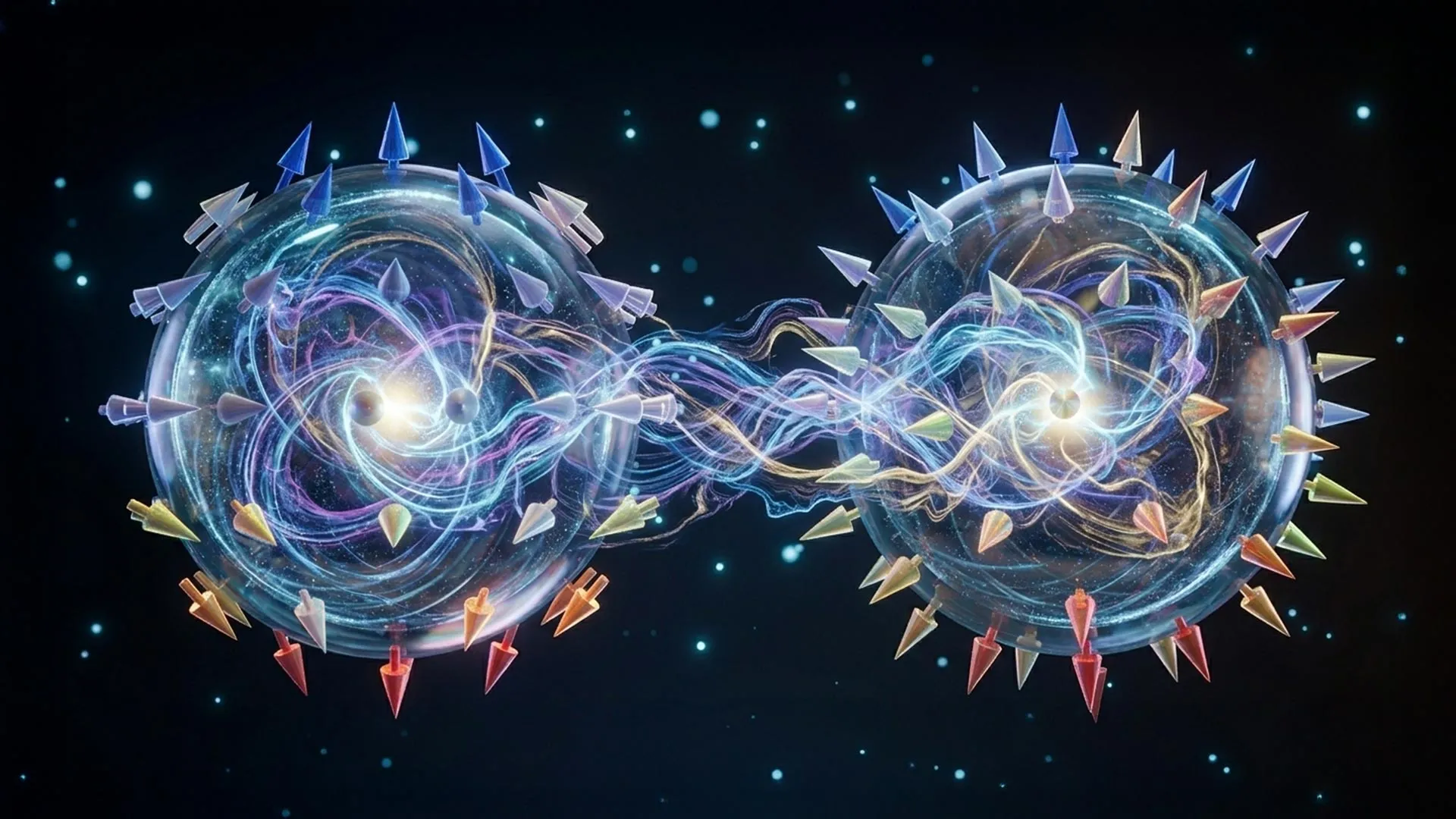
Scientists at the University of the Witwatersrand in South Africa, working with collaborators from Huzhou University, have uncovered a surprising feature in one of the most widely used tools in quantum optics. They found that standard methods for producing entangled photons can contain previously unseen topological structures. In their experiments, these structures reached a record 48 dimensions and included more than 17,000 distinct topological signatures, creating a vast new "alphabet" for encoding stable quantum information.
In most quantum optics labs, entangled photons are generated using a technique called spontaneous parametric downconversion (SPDC). This process naturally creates entanglement in the spatial properties of light. The researchers discovered that within this spatial structure lies a hidden realm of high-dimensional topologies. These complex patterns could provide new ways to store and protect information, potentially making quantum systems more resistant to noise.
The team demonstrated this effect using the orbital angular momentum (OAM) of light, which can span from simple two-dimensional cases to extremely high dimensions. This flexibility allows for much richer structures than previously recognized.
Topology Emerges From a Single Property
The findings, published in Nature Communications, show that measuring the OAM of two entangled photons reveals an intrinsic topology, a fundamental feature of the entanglement itself. Because OAM can take on an unlimited range of values, the associated topologies can also extend to very high dimensions.
"We report a major advance in this work: we only need one property of light (OAM) to make a topology, whereas previously it was assumed that at least two properties would be needed -- usually OAM and polarization," says Professor Andrew Forbes from the Wits School of Physics. "The consequence is that since OAM is high-dimensional, so too is the topology, and this let us report the highest topologies ever observed."
The researchers also found that once the topology goes beyond two dimensions, it can no longer be described by a single number. Instead, a range of topological values is required, reflecting a much richer and more complex structure than standard optical systems.
A Discovery Hiding in Plain Sight
One of the most notable aspects of this breakthrough is how accessible it is. The required resources are already present in most quantum optics laboratories, meaning no specialized equipment or "quantum engineer" is needed to take advantage of the effect.
Pedro Ornelas explains, "You get the topology for free, from the entanglement in space. It was always there, it just had to be found."
Guided by Theory, Confirmed by Experiment
According to lead author Prof. Robert de Mello Koch from Huzhou University, identifying these structures was not straightforward. "In high dimensions it is not so obvious where to look for the topology. We used abstract notions from quantum field theory to predict where to look and what to look for -- and found it in the experiment!"
Toward More Robust Quantum Technologies
Although orbital angular momentum entanglement has been widely explored, it has often been considered fragile. The researchers now suggest that viewing it through the lens of topology could change that perspective. By leveraging these newly discovered structures, scientists may be able to develop more reliable quantum systems, opening the door to practical, real-world applications.
Story Source:
Materials provided by University of the Witwatersrand. Note: Content may be edited for style and length.
Journal Reference:
- Robert de Mello Koch, Pedro Ornelas, Neelan Gounden, Bo-Qiang Lu, Isaac Nape, Andrew Forbes. Revealing the topological nature of entangled orbital angular momentum states of light. Nature Communications, 2025; 16 (1) DOI: 10.1038/s41467-025-66066-3
Cite This Page: