
Rocky planet discovered in outer orbit challenges planet formation theory
- Date:
- February 14, 2026
- Source:
- McMaster University
- Summary:
- Astronomers have uncovered a distant planetary system that flips a long-standing rule of planet formation on its head. Around the small red dwarf star LHS 1903, scientists expected to find rocky planets close in and gas giants farther out — the same pattern seen in our own Solar System and hundreds of others. And at first, that’s exactly what they saw. But new observations revealed a surprise: the outermost planet appears to be rocky, not gaseous.
- Share:
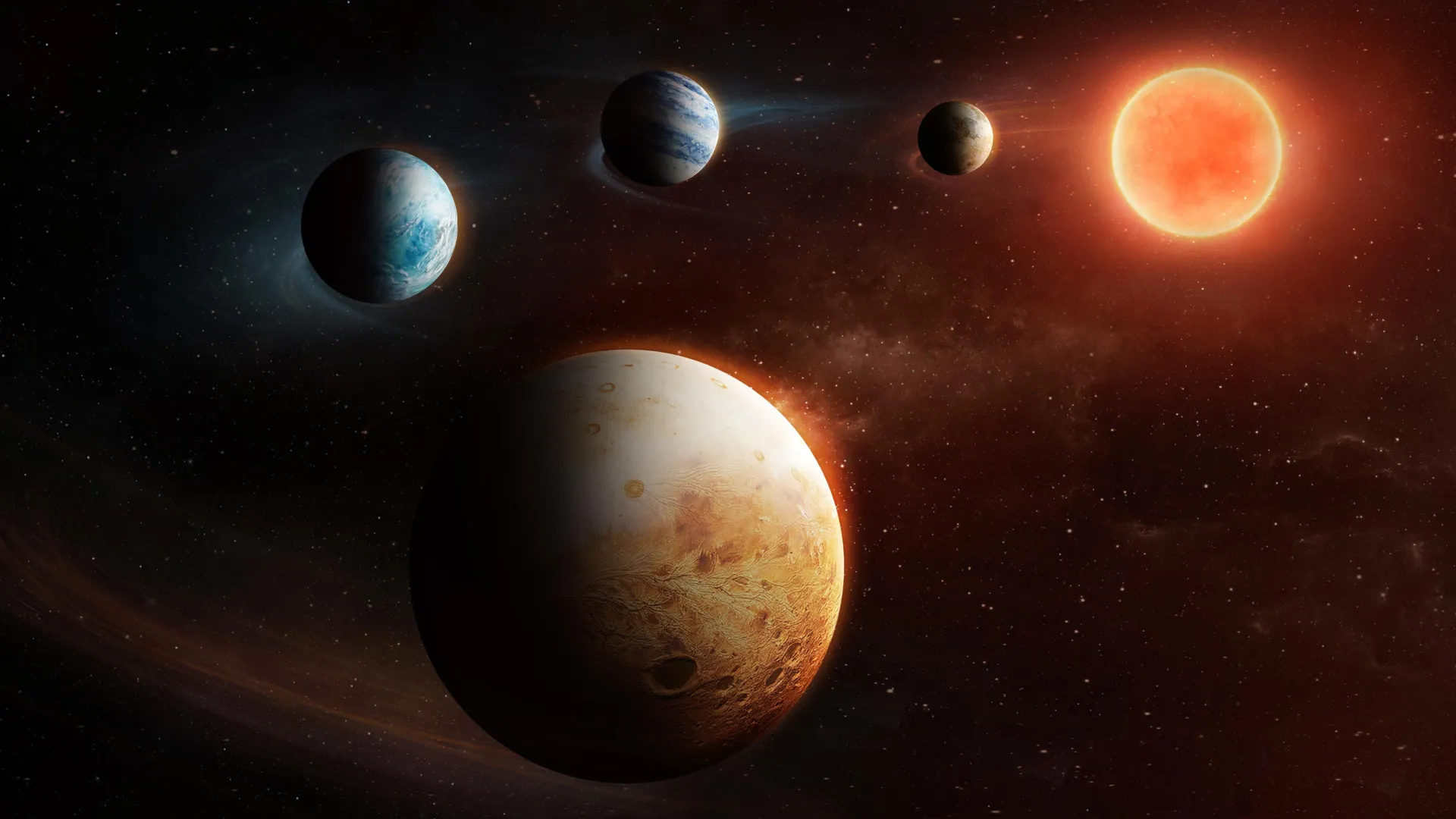
An international group of astronomers has identified a faraway planetary system that calls into question one of the most widely accepted ideas about how planets take shape.
In most planetary systems observed across the Milky Way, scientists see the same basic layout. Small, rocky planets circle close to their star, while large gas giants orbit at greater distances. Our own Solar System fits this pattern. The inner planets: Mercury, Venus, Earth and Mars, are made mostly of rock and metal. Farther out, Jupiter, Saturn, Uranus and Neptune are dominated by thick layers of gas.
This arrangement is explained by a leading theory of planet formation. Young stars emit intense radiation that can strip away gases from nearby developing planets, leaving behind solid, rocky worlds. Farther from the star, cooler temperatures allow planets to hold onto thick atmospheres, leading to the formation of gas giants.
A Rule Breaking System Around LHS 1903
A newly identified system orbiting the star LHS 1903 does not follow that script. The discovery, reported in Science, centers on a small, faint red dwarf star that is cooler and less massive than the Sun.
Researchers led by Prof. Ryan Cloutier of McMaster University and Prof. Thomas Wilson of the University of Warwick combined data from telescopes on Earth and in space to study the system. They initially identified three planets. The innermost world is rocky, followed by two gas rich planets similar to smaller versions of Neptune, a lineup that matches standard expectations.
But years of additional observations brought an unexpected twist. New measurements from the European Space Agency's CHEOPS satellite revealed a fourth planet, called LHS 1903 e, orbiting farthest from the star. Surprisingly, this outer world appears to be rocky.
"We've seen this pattern: rocky inside, gaseous outside, across hundreds of planetary systems. But now, the discovery of a rocky planet in the outer part of a system forces us to rethink the timing and conditions under which rocky planets can form," says Cloutier, who is an assistant professor in the Department of Physics and Astronomy.
Ruling Out Collisions and Planetary Shifts
The team explored several possible explanations. They considered whether a massive impact might have stripped away the planet's atmosphere. They also examined whether the planets could have shifted positions over time. Detailed computer simulations and studies of the planets' orbits ruled out both scenarios.
Instead, the findings point to a more unexpected idea. The planets in this system may not have formed simultaneously. Rather, they could have developed one after another as conditions around the star changed.
Inside Out Planet Formation
Standard models propose that planets arise within a protoplanetary disc, a swirling cloud of gas and dust surrounding a young star. In this environment, clumps of material form several planetary embryos at roughly the same time. Over millions of years, these growing bodies evolve into fully formed planets with a range of sizes and compositions.
The structure of the LHS 1903 system suggests a different pathway known as inside out planet formation. In this scenario, planets take shape sequentially in shifting environments. The local conditions at the time each planet finishes forming determine whether it becomes gas rich or remains rocky.
This framework could explain the unusual nature of LHS 1903 e. By the time it began to assemble, much of the gas in the surrounding disc may have already dissipated, leaving too little material to build a thick atmosphere.
"It's remarkable to see a rocky world forming in an environment that shouldn't favour that outcome. It challenges the assumptions built into our current models," says Cloutier, who adds that the discovery raises broader questions about whether LHS 1903 is an anomaly or an early example of a pattern scientists have yet to recognize.
"As telescopes and detection methods become more precise, we are strengthening our ability to find planetary systems that don't resemble our own and that don't conform to longstanding theories," he says.
"Each new system adds another data point to a growing picture of planetary diversity -- one that forces scientists to rethink the processes that shape worlds across the galaxy."
Story Source:
Materials provided by McMaster University. Note: Content may be edited for style and length.
Journal Reference:
- Thomas G. Wilson, Anna M. Simpson, Andrew Collier Cameron, Ryan Cloutier, Vardan Adibekyan, Ancy Anna John, Yann Alibert, Manu Stalport, Jo Ann Egger, Andrea Bonfanti, Nicolas Billot, Pascal Guterman, Pierre F. L. Maxted, Attila E. Simon, Sérgio G. Sousa, Malcolm Fridlund, Mathias Beck, Anja Bekkelien, Sébastien Salmon, Valérie Van Grootel, Luca Fossati, Alexander James Mustill, Hugh P. Osborn, Tiziano Zingales, Matthew J. Hooton, Laura Affer, Suzanne Aigrain, Roi Alonso, Guillem Anglada, Alexandros Antoniadis-Karnavas, Tamas Bárczy, David Barrado Navascues, Susana C. C. Barros, Wolfgang Baumjohann, Thomas Beck, Willy Benz, Federico Biondi, Xavier Bonfils, Luca Borsato, Alexis Brandeker, Christopher Broeg, Lars A. Buchhave, Maximilian Buder, Juan Cabrera, Sebastian Carrazco Gaxiola, David Charbonneau, Sébastien Charnoz, David R. Ciardi, Karen A. Collins, Kevin I. Collins, Rosario Cosentino, Szilard Csizmadia, Patricio E. Cubillos, Shweta Dalal, Mario Damasso, James R. A. Davenport, Melvyn B. Davies, Magali Deleuil, Laetitia Delrez, Olivier D. S. Demangeon, Brice-Olivier Demory, Victoria DiTomasso, Diana Dragomir, Courtney D. Dressing, Xavier Dumusque, David Ehrenreich, Anders Erikson, Emma Esparza-Borges, Andrea Fortier, Izuru Fukuda, Akihiko Fukui, Davide Gandolfi, Adriano Ghedina, Steven Giacalone, Holden Gill, Michaël Gillon, Yilen Gómez Maqueo Chew, Manuel Güdel, Pere Guerra, Maximilian N. Günther, Nathan Hara, Avet Harutyunyan, Yuya Hayashi, Raphaëlle D. Haywood, Rae Holcomb, Keith Horne, Sergio Hoyer, Chelsea X. Huang, Masahiro Ikoma, Kate G. Isaak, James A. G. Jackman, Jon M. Jenkins, Eric L. N. Jensen, Daniel Jontof-Hutter, Yugo Kawai, Laszlo L. Kiss, Ben S. Lakeland, Jacques Laskar, David W. Latham, Alain Lecavelier des Etangs, Adrien Leleu, Monika Lendl, Jerome de Leon, Florian Lienhard, Mercedes López-Morales, Christophe Lovis, Michael B. Lund, Rafael Luque, Demetrio Magrin, Luca Malavolta, Aldo F. Martínez Fiorenzano, Andrew W. Mayo, Michel Mayor, Christoph Mordasini, Annelies Mortier, Felipe Murgas, Norio Narita, Valerio Nascimbeni, Belinda A. Nicholson, Göran Olofsson, Roland Ottensamer, Isabella Pagano, Larissa Palethorpe, Enric Pallé, Hannu Parviainen, Marco Pedani, Francesco A. Pepe, Gisbert Peter, Matteo Pinamonti, Giampaolo Piotto, Don Pollacco, Ennio Poretti, Didier Queloz, Samuel N. Quinn, Roberto Ragazzoni, Nicola Rando, David Rapetti, Francesco Ratti, Heike Rauer, Federica Rescigno, Ignasi Ribas, Ken Rice, George R. Ricker, Paul Robertson, Thierry de Roche, Laurence Sabin, Nuno C. Santos, Dimitar D. Sasselov, Arjun B. Savel, Gaetano Scandariato, Nicole Schanche, Urs Schroffenegger, Richard P. Schwarz, Sara Seager, Ramotholo Sefako, Damien Ségransan, Avi Shporer, André M. Silva, Alexis M. S. Smith, Alessandro Sozzetti, Manfred Steller, Gyula M. Szabó, Motohide Tamura, Nicolas Thomas, Amy Tuson, Stéphane Udry, Andrew Vanderburg, Roland K. Vanderspek, Julia Venturini, Francesco Verrecchia, Nicholas A. Walton, Christopher A. Watson, Robert D. Wells, Joshua N. Winn, Roberto Zambelli, Carl Ziegler. Gas-depleted planet formation occurred in the four-planet system around the red dwarf LHS 1903. Science, 2026; DOI: 10.1126/science.adl2348
Cite This Page: