
A clear new material could make windows super efficient
- Date:
- December 13, 2025
- Source:
- University of Colorado at Boulder
- Summary:
- MOCHI uses microscopic, air-filled channels to stop heat in its tracks while remaining nearly crystal clear. If scaled up, it could transform windows into powerful energy savers and solar harvesters.
- Share:
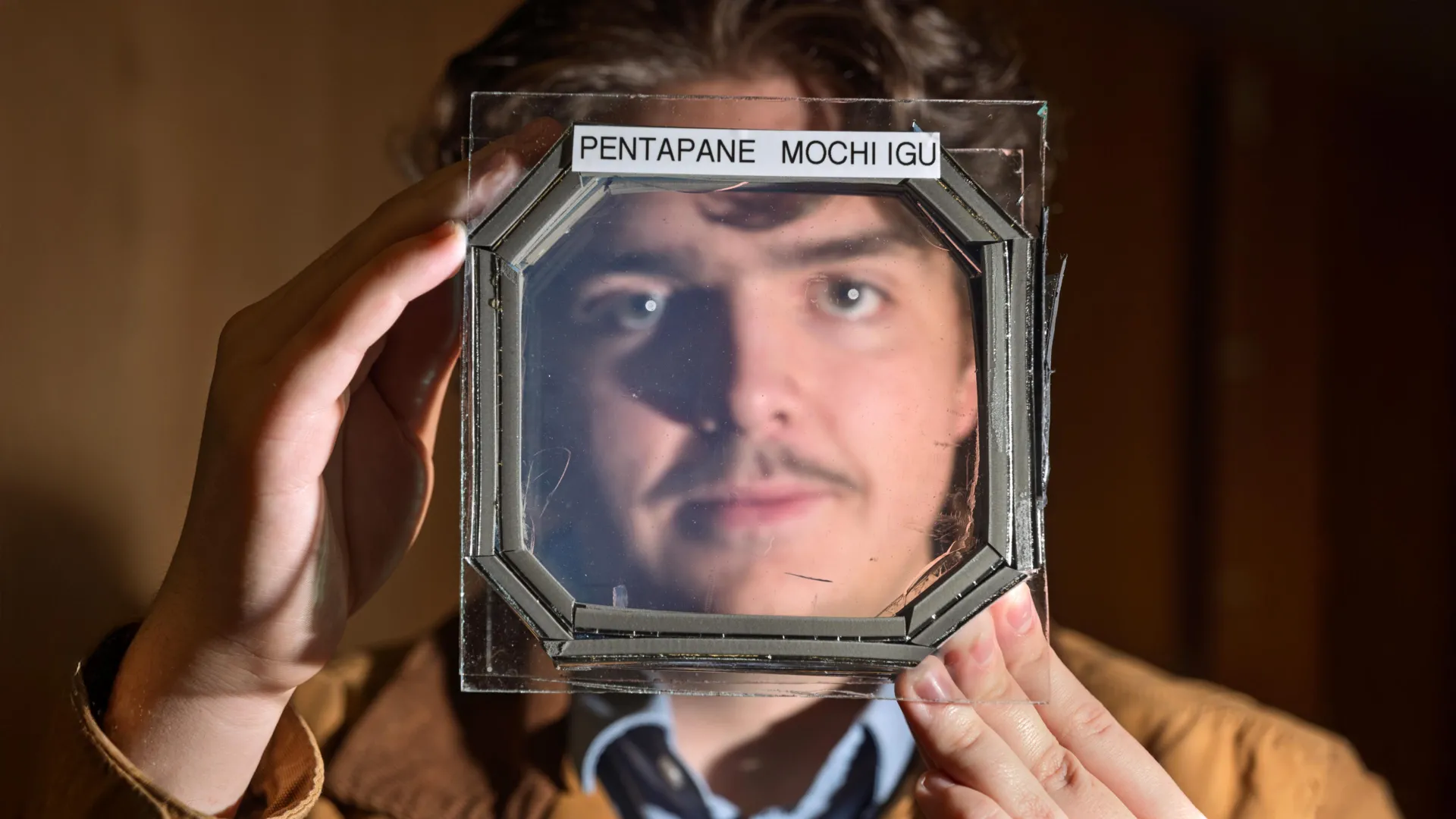
Physicists at the University of Colorado Boulder have developed a new window insulation material that could significantly improve how buildings manage heat around the world. Their creation functions somewhat like a high-tech form of Bubble Wrap, but it is designed for energy performance rather than packaging.
The material is called Mesoporous Optically Clear Heat Insulator, or MOCHI. It can be manufactured as thick blocks or thin flexible sheets that attach to the interior surface of standard windows. At present, MOCHI is only produced in the laboratory and is not yet available to consumers, but the researchers report that it is durable and nearly completely see-through.
Because of its clarity, MOCHI maintains an unobstructed view, which sets it apart from many other window insulation products.
"To block heat exchange, you can put a lot of insulation in your walls, but windows need to be transparent," said Ivan Smalyukh, senior author of the study and a professor of physics at CU Boulder. "Finding insulators that are transparent is really challenging."
The research team published its findings on Dec. 11 in the journal Science.
Why Window Heat Loss Matters
Buildings of all kinds, from houses to large office towers, account for about 40% of global energy consumption. Much of that energy is wasted as heat escapes to the outdoors during winter or enters buildings during hot weather.
Smalyukh and his collaborators hope MOCHI will slow that unwanted heat flow.
The new material is a silicone-based gel with a complex internal structure. It contains air trapped within extremely fine pores that are far thinner than a human hair. These microscopic pockets make MOCHI an excellent thermal barrier. In fact, a sheet only 5 millimeters thick is enough to let a person safely hold a flame against it.
"No matter what the temperatures are outside, we want people to be able to have comfortable temperatures inside without having to waste energy," said Smalyukh, a fellow at the Renewable And Sustainable Energy Institute (RASEI) at CU Boulder.
How MOCHI Controls Light and Heat
Smalyukh described the key to MOCHI's performance as its precisely arranged air pockets.
The new material shares similarities with aerogels, which are well-known insulators used in many industries. (NASA uses aerogels inside its Mars rovers to keep electronics warm). Aerogels also rely on air-filled pores, but those pores are typically arranged in a random pattern that scatters light. This is why aerogels often appear cloudy and are sometimes referred to as "frozen smoke."
The CU Boulder team wanted an insulating material that would maintain clarity while providing strong thermal resistance.
To build MOCHI, researchers combined surfactant molecules with a liquid mixture. These molecules naturally cluster into thread-like shapes, somewhat like the separation that occurs when oil and vinegar form layers in salad dressing. Silicone molecules in the same mixture attach themselves to the surface of those tiny threads.
Through several controlled steps, the researchers then remove the detergent clusters and replace them with air. This leaves behind a silicone framework surrounding a network of ultra-small, air-filled channels. Smalyukh likens the intricate pattern to a "plumber's nightmare."
Air accounts for more than 90% of MOCHI's volume.
Stopping Heat at the Molecular Scale
Heat travels through a gas in a way similar to a billiards-style chain reaction. Energy causes gas molecules and atoms to move faster and collide with one another, passing heat along as they strike.
The pores inside MOCHI are so tiny that the gas molecules cannot freely collide. Instead, they repeatedly hit the silicone walls, which prevents heat from easily spreading through the material.
"The molecules don't have a chance to collide freely with each other and exchange energy," Smalyukh said. "Instead, they bump into the walls of the pores."
Despite this strong heat blocking ability, MOCHI reflects only about .2% of incoming light, allowing nearly all visible light to pass through.
Potential Uses and Future Development
The researchers envision many applications for a clear material that effectively traps heat. One possibility is a device that captures warmth from sunlight and converts it into low-cost, sustainable energy.
"Even when it's a somewhat cloudy day, you could still harness a lot of energy and then use it to heat your water and your building interior," Smalyukh said.
For now, MOCHI is not ready for commercial release. Its laboratory production requires considerable time, although Smalyukh believes that more efficient manufacturing methods can be developed. The components used to make MOCHI are relatively low-cost, which supports the long-term potential for scaling the technology.
For the moment, the outlook for MOCHI remains promising, much like the clear view through a window coated with this material.
Co-authors of the study include Amit Bhardwaj, Blaise Fleury, Eldo Abraham and Taewoo Lee, all postdoctoral research associates in the Department of Physics at CU Boulder. Bohdan Senyuk, Jan Bart ten Hove and Vladyslav Cherpak, former postdoctoral researchers at CU Boulder, also contributed as co-authors.
Story Source:
Materials provided by University of Colorado at Boulder. Note: Content may be edited for style and length.
Journal Reference:
- Amit Bhardwaj, Blaise Fleury, Bohdan Senyuk, Eldho Abraham, Jan Bart ten Hove, Taewoo Lee, Vladyslav Cherpak, Ivan I. Smalyukh. Mesoporous optically clear heat insulators for sustainable building envelopes. Science, 2025; 390 (6778): 1171 DOI: 10.1126/science.adx5568
Cite This Page: