
Dead stars aren’t so dead after all: The hidden force inflating white dwarfs
Tidal forces supercharge tightly orbiting white dwarfs, reshaping their size, heat, and explosive cosmic futures.
- Date:
- December 2, 2025
- Source:
- Kyoto University
- Summary:
- Some white dwarfs in rapid binary orbits are far hotter and larger than theory predicts. Researchers found that powerful tidal forces between them generate enough heat to inflate their sizes and change their orbital behavior. This leads the stars to interact much sooner than expected, potentially triggering dramatic cosmic events. The new model may offer clues about the origins of type Ia supernovae.
- Share:
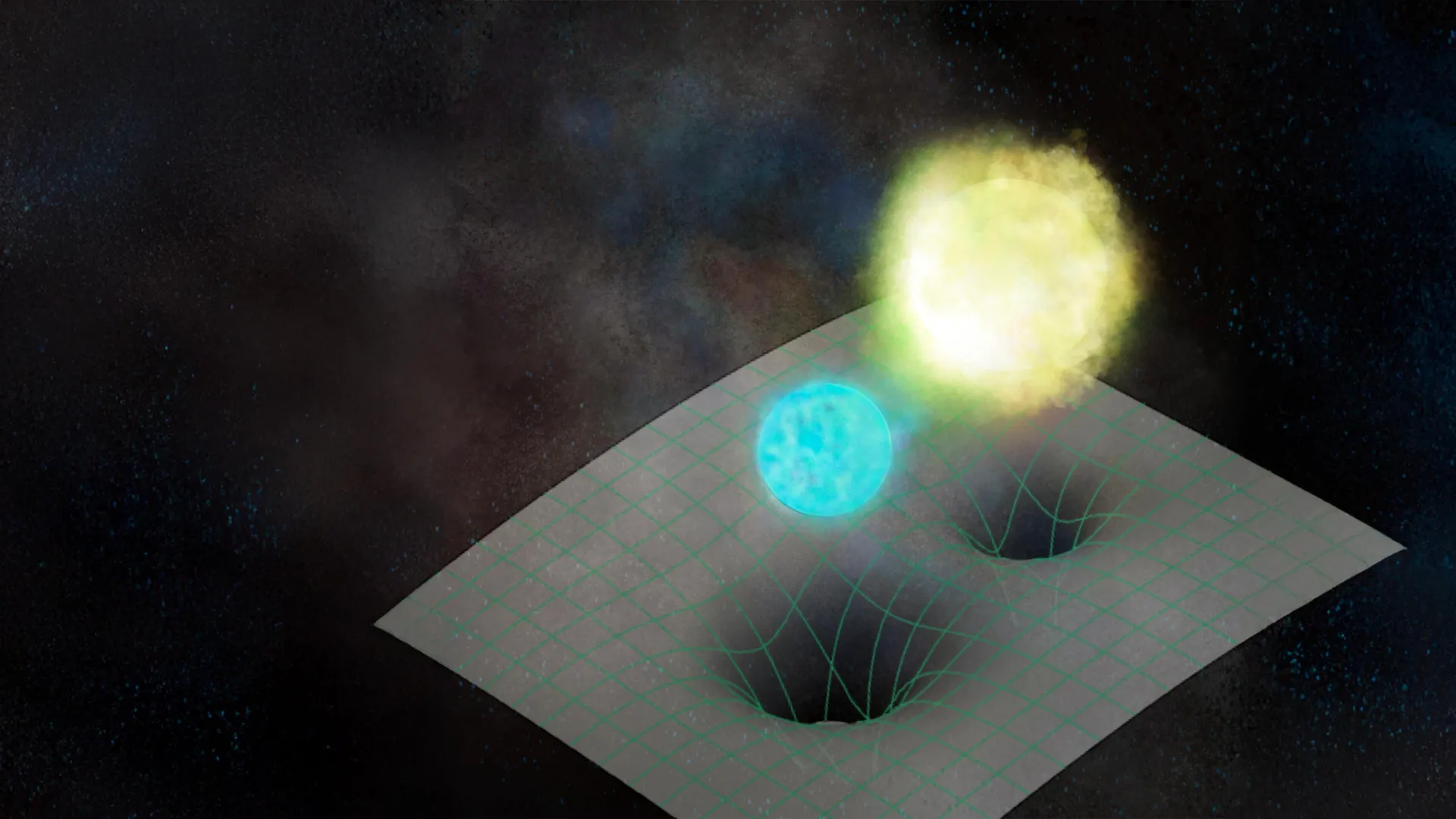
White dwarfs are the dense remnants left behind after a star stops producing energy through nuclear fusion, a stage our own sun will reach far in the future. These stellar remnants behave in unusual ways, since their internal structure makes them shrink as they gain mass, which is why they are known as degenerate stars.
White dwarfs frequently exist in binary systems, where two stars orbit each other. Most of these pairs are extremely old on galactic timescales and have cooled to temperatures near 4,000 degrees Kelvin. Recent observations, however, have uncovered a group of short period binaries in which the stars complete an orbit in less than an hour. These fast moving pairs do not match established predictions, since many appear to be roughly twice the expected size and have temperatures between 10,000 and 30,000 degrees Kelvin.
Investigating the Role of Tidal Heating
This unexpected behavior led a research team headed by Lucy Olivia McNeill of Kyoto University to examine the influence of tidal forces in these systems. Tides frequently distort objects that share close orbits, affecting how those orbits evolve over time.
"Tidal heating has had some success in explaining temperatures of Hot Jupiters and their orbital properties with their host stars. So we wondered: to what extent can tidal heating explain the temperatures of white dwarfs in short period binaries?" asks McNeill.
To explore this question, the researchers developed a theoretical model designed to estimate how much white dwarfs heat up in short period binaries. The model was built to be widely applicable, making it possible to estimate both the temperature history and the future orbital changes of white dwarfs in these systems.
Tidal Forces Reshape White Dwarf Evolution
The team's analysis showed that tidal interactions can play a major role in how these stars evolve. In particular, the gravitational pull from a smaller white dwarf can raise internal heat within a larger but less massive companion. This added heat causes the star to expand and pushes its surface temperature to at least 10,000 degrees Kelvin.
Because of this expansion, the researchers propose that white dwarfs are likely to be twice the size predicted by standard theory at the point where they begin exchanging material, a stage known as mass transfer. As a result, these short period pairs may start interacting at orbital periods that are three times longer than scientists previously believed.
"We expected tidal heating would increase the temperatures of these white dwarfs, but we were surprised to see how much the orbital period reduces for the oldest white dwarfs when their Roche lobes come into contact," says McNeill.
Implications for Stellar Explosions and Future Research
White dwarfs in extremely tight orbits will eventually interact and emit gravitational radiation. Systems of this kind are considered possible origins of type Ia supernovae and cataclysmic variables, two dramatic and scientifically important cosmic events.
Looking ahead, the team aims to apply their model to binary systems made of carbon-oxygen white dwarfs. Their goal is to better understand the potential pathways leading to type Ia explosions, especially whether realistic temperature predictions support the double degenerate (merger) scenario.
Story Source:
Materials provided by Kyoto University. Note: Content may be edited for style and length.
Journal Reference:
- Lucy O. McNeill, Ryosuke Hirai. Tidal Heating in Detached Double White Dwarf Binaries. The Astrophysical Journal, 2025; 992 (1): 154 DOI: 10.3847/1538-4357/ae045f
Cite This Page: