
Scientists create stunning, non-fading paint without a single pigment
- Date:
- November 28, 2026
- Source:
- Kobe University
- Summary:
- Researchers have developed a pigment-free coating that delivers the rich, glossy appearance of automotive paint without the problem of fading. Inspired by nature, the technology uses microscopic silicon spheres to produce durable colors that remain consistent from different viewing angles. The coating is so lightweight that the color layer for an entire passenger airliner could theoretically weigh less than a carton of milk.
- Share:
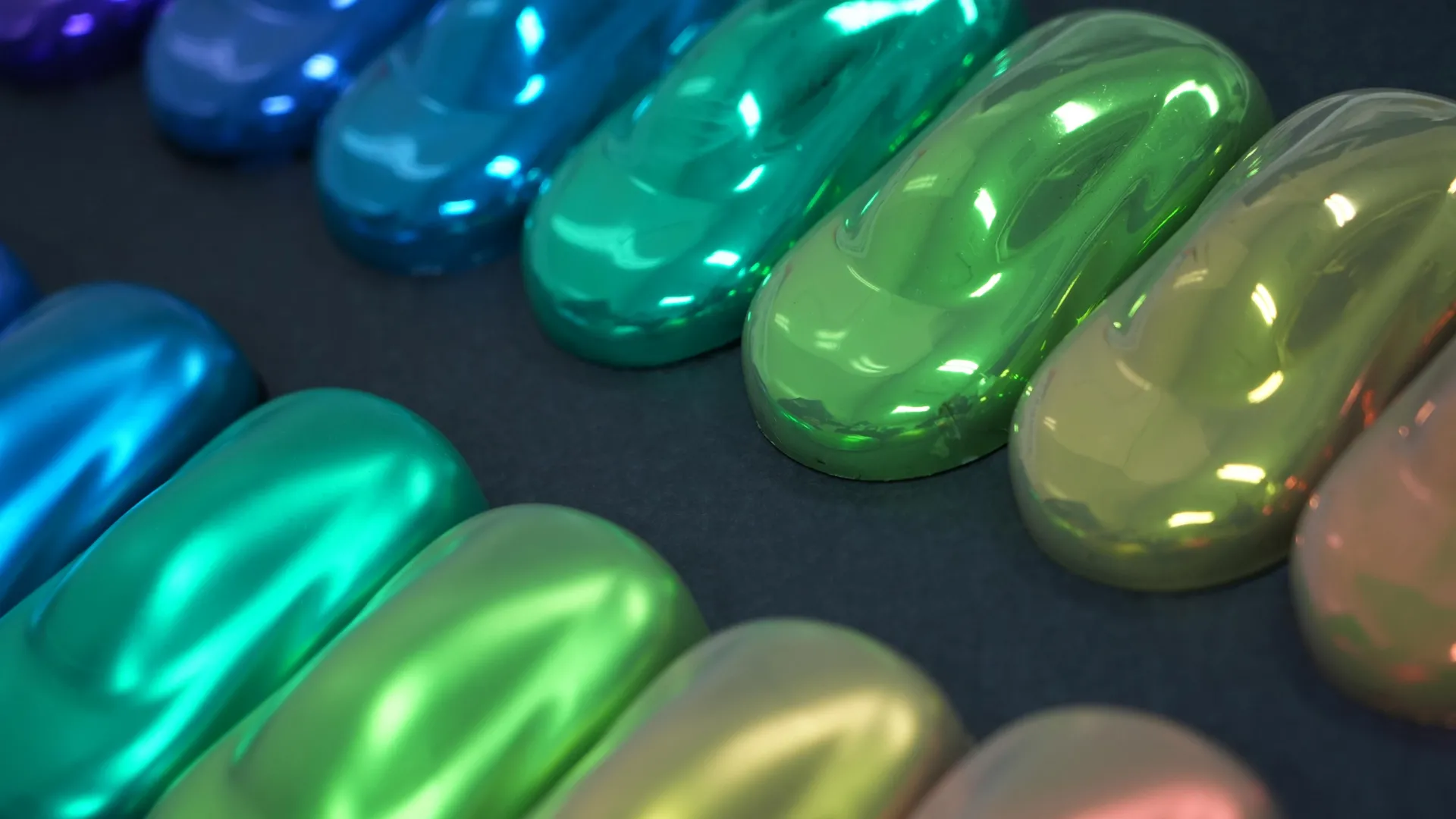
Researchers at Kobe University have developed a coating that produces the rich colors and glossy finish of automotive paint without relying on pigments. The breakthrough overcomes several major limitations of structural color, making it possible to apply colors that resist fading to large, complex surfaces, maintain a consistent hue from different viewing angles, and add protective coatings.
"Color coatings are expected to provide vivid color, brightness, gloss, and long-term durability, yet no existing technology satisfies all of these requirements simultaneously," says Kobe University materials engineer Hiroshi Sugimoto.
Traditional paints typically require relatively thick layers of pigments, which add considerable weight and can fade over time. Structural color, a phenomenon responsible for the brilliant appearance of peacock feathers, offers an alternative that avoids the fading caused by light exposure in organic pigments. However, conventional approaches to structural color require precisely arranged microscopic structures, often produce different colors depending on the viewing angle, and are incompatible with protective coatings.
Unlocking Glossy Color Without Pigments
Sugimoto previously pioneered a new method of producing structural color using tiny silicon spheres that generate consistent colors regardless of viewing angle. His team subsequently adapted the technology for inkjet printing (link). Although the resulting coatings produced color successfully, they scattered reflected light in multiple directions, leaving their surfaces without a glossy finish. The technique that made inkjet printing possible, however, also provided a potential solution to this problem.
Sugimoto explains, "Packing the nanospheres in silica shells not only protects the particles but also controls their spacing and should improve self-assembly into neat arrays." Arranging the particles more uniformly reduces the scattering of reflected light, allowing the coating to develop a glossy appearance.
In a study published in the journal Small Structures, the researchers demonstrated that they could produce and adjust the gloss of structural color coatings on large, three-dimensional surfaces. They also found that applying a protective layer had little effect on the resulting color.
"The most exciting aspect of this work is that it demonstrates glossy, non-iridescent and protection-coated structural color coatings for 3D objects in a single platform, making the technology useful for real-world applications," explains Sugimoto.
Ultra-Lightweight Paint Could Transform Aviation
One of the technology's most remarkable advantages is its extremely low weight. A single layer of silicon nanospheres is sufficient to produce bright colors with high opacity, effectively concealing the underlying surface.
The potential weight savings are particularly striking for aviation. Conventional coatings on wide-body airliners currently add several hundred kilograms to the aircraft's weight. The researchers estimate that a color coating based on their technology could weigh only several hundred grams, less than a carton of milk for an entire airplane.
The materials used to create these coatings also offer environmental advantages. Silicon is nontoxic and can be sourced from the semiconductor industry, while silica is among the most abundant materials in Earth's crust. Combined with their resistance to fading, the minimal material requirements could make future color coatings significantly less resource-intensive.
Taking Structural Color Beyond Paint
Sugimoto is helping establish a company to increase production and bring the technology to industrial markets. The coating process is particularly promising because it can be integrated into several established manufacturing techniques.
"The process is compatible with scalable coating methods such as spray coating, slot-die coating, and roll-to-roll processing."
Beyond commercial paint applications, Sugimoto hopes to use the underlying science to create advanced coatings that perform multiple functions. Future versions could combine vivid structural color with capabilities related to sensing, light-driven chemical reactions, and energy management.
He says: "We want to expand the possibility of applications for the science behind our technology beyond coloration. Looking ahead, we aim to develop multifunctional silicon nanoparticle coatings that combine structural coloration with additional optical functions such as sensing, photocatalysis, and energy management."
This research was funded by the Japan Agency for Medical Research and Development (grants JPMJPF2503, JPMJSF2405) and the Japan Society for the Promotion of Science (grants 24KF0158, 24K01287, 24K22206, 25K01608).
Story Source:
Materials provided by Kobe University. Note: Content may be edited for style and length.
Journal Reference:
- Jialu Song, Keisuke Moriasa, Yosuke Ito, Mojtaba Karimi Habil, Patrick T. Probst, Hiroshi Sugimoto, Minoru Fujii. Glossy yet Noniridescent Conformal Structural Color Coating of Three‐Dimensional Objects With All‐Dielectric Nanoparticle Monolayers. Small Structures, 2026; 7 (9) DOI: 10.1002/sstr.70600
Cite This Page: