
A new recipe unlocks “impossible” nanocrystals for LEDs, implants, and superconductors
- Date:
- August 30, 2026
- Source:
- University of Chicago
- Summary:
- Scientists have cracked a long-standing chemistry problem, creating nanocrystals from tough metal nitrides that were previously extremely difficult to produce at this scale. The breakthrough could turn familiar materials used in LEDs, implants, and superconductors into building blocks for flexible electronics, printable devices, and other technologies.
- Share:
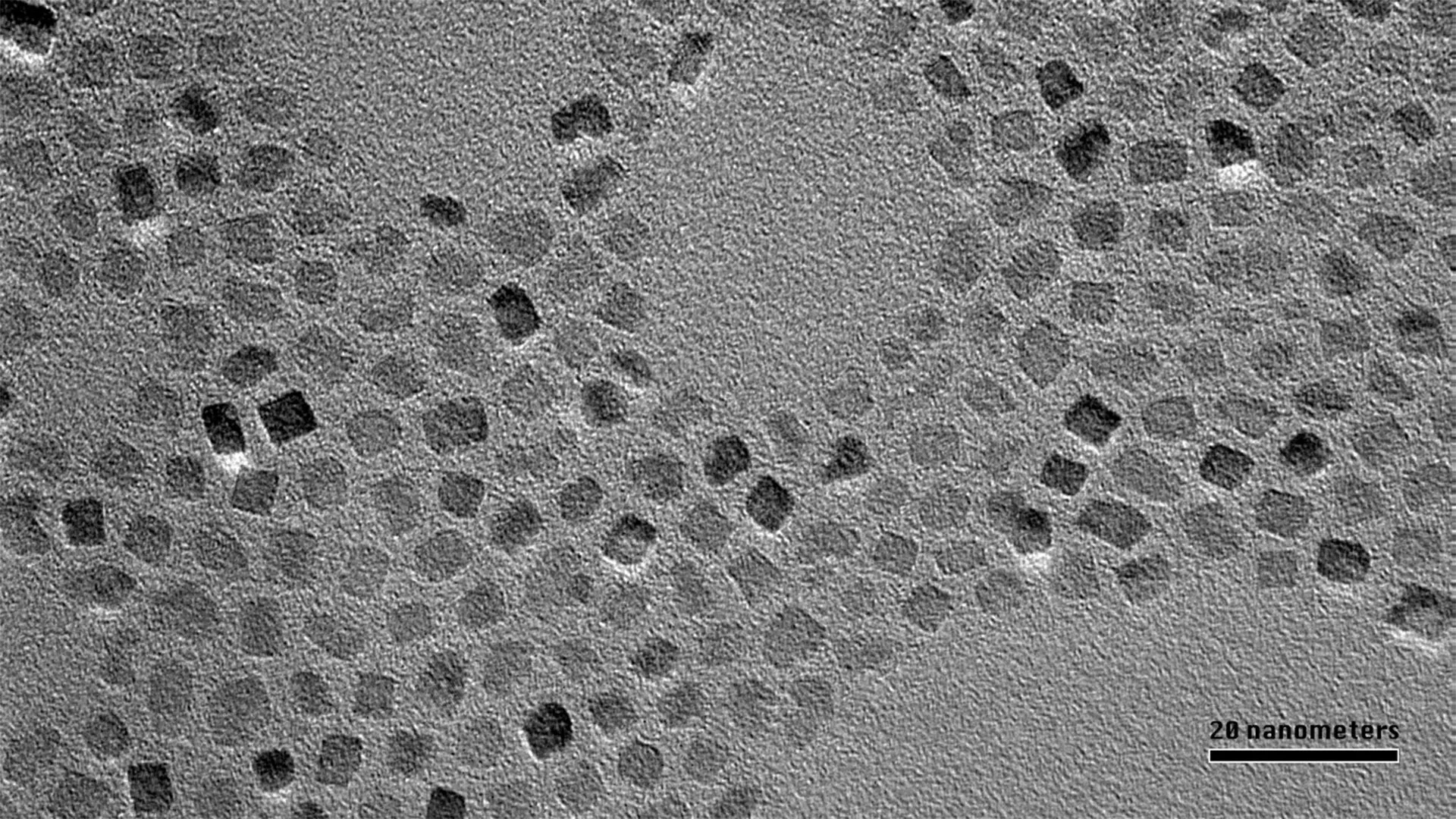
Nanocrystals have become an important part of modern materials science, with quantum dots helping inspire the 2023 Nobel Prize in Chemistry. Yet despite their enormous potential, researchers have only been able to produce these microscopic crystals from a relatively narrow range of materials.
Now, chemists at the University of Chicago and Argonne National Laboratory have developed a method for creating nanocrystals from metal nitrides, a technologically important group of materials that had resisted conventional nanocrystal synthesis. The study, published in Nature, could expand the possibilities for electronics and other applications, including flexible lighting and medical implants.
"We were able to show how to make a series of nearly a dozen materials that could not be synthesized by traditional methods," said Ruiming Lin, a graduate student at UChicago and first author on the new paper.
Unlocking Metal Nitride Nanocrystals
Metal nitrides are already widely used across technology and manufacturing. Gallium nitride, for example, is found in much of today's lighting technology, from LED bulbs to laptop displays.
Turning these materials into nanocrystals could greatly expand the ways they are used. Instead of being limited mainly to rigid films, metal nitride nanocrystals could eventually be mixed into polymers, printed with inkjet techniques, or incorporated into fabrics and other flexible devices.
"This expands the boundaries of the field beyond what were previously fundamental constraints, and lays the foundation for the use of nitrides as nanomaterials," said Dmitri Talapin, the Ernest DeWitt Burton Distinguished Service Professor of Chemistry and Molecular Engineering at UChicago, a scientist at Argonne and the senior author on the paper.
Why Nanocrystals Are So Useful
Nanocrystals are extremely small crystals, with millions or even billions able to fit on a fingernail. Materials can behave very differently at this scale, sometimes producing bright light or becoming especially effective at accelerating chemical reactions.
In principle, scientists should be able to create nanocrystals from a huge variety of substances. In practice, however, many materials have proven difficult or impossible to make in this form.
Lin and other researchers in Talapin's laboratory set out to push past those limitations.
Their attention turned to metal nitrides, compounds formed when metals combine with nitrogen. As a group, these materials are strong, biocompatible, and resistant to both heat and corrosion.
Those qualities make metal nitrides valuable for applications such as consumer electronics. But the same stability that makes them useful also makes them extremely difficult to form into nanocrystals.
Strong Bonds Create a Major Challenge
As crystals develop, their ions need enough freedom to rearrange before settling into their final positions. The process is somewhat like partners changing places during a square dance. In metal nitrides, however, the bonds are so strong that the ions are far less willing to rearrange.
"If bonds cannot break during this process, that's a death sentence for nanocrystals," said Talapin. "Once you make an incorrect bond, everything goes south."
According to the researchers, solving the problem required two key advances.
First, the Talapin lab built on a previous discovery showing that molten salts could be used as the liquid medium in the process, helping stabilize nanocrystals as they formed.
The researchers then continued testing different conditions until they identified a "sweet spot" involving temperature and ammonia pressure. Under those conditions, the bonds between metal and nitrogen atoms could break apart and reform more easily, allowing the crystal structure to organize properly.
"This process is very unusual -- it goes against every bit of common sense in the field," said Talapin. "We had to entirely rethink the approach."
Nearly a Dozen New Nanocrystal Materials
The method worked with more than just gallium nitride. The team also produced nanocrystals from several related nitride materials, including titanium nitride, which is used in medical implants; niobium nitride, an important industrial superconductor; and molybdenum nitride, which is commonly used as a catalyst.
These materials are both useful and relatively inexpensive. Researchers hope that converting them into nanocrystals will make it possible to use them in an even wider range of technologies.
"I remember the first time I looked through the electron microscope and saw those crystals," said Lin. "You always hope something you discovered will wind up in applications. I think there will be many uses."
Other authors from UChicago included Ningxin Jiang, Wooje Cho, Zirui Zhou, Di Wang, Justin Ondry, Zehan Mi, James Cassidy, Alex Hinckle, Alexander Filatov and John S. Anderson.
The scientists used resources at the UChicago-based National Science Foundation Materials Research Science and Engineering Center; the UChicago Soft Matter Characterization Facility; and Argonne's Center for Nanoscale Materials.
Funding: U.S. Department of Energy, Samsung QD Cluster Collaboration, National Science Foundation, Air Force Office of Scientific Research.
Story Source:
Materials provided by University of Chicago. Original written by Louise Lerner. Note: Content may be edited for style and length.
Journal Reference:
- Ruiming Lin, Vikash Khokhar, Ningxin Jiang, Wooje Cho, Zirui Zhou, Di Wang, Justin C. Ondry, Zehan Mi, James Cassidy, Alex M. Hinkle, Alexander S. Filatov, John S. Anderson, Richard D. Schaller, De-en Jiang, Dmitri V. Talapin. Ammonia pressure controls colloidal metal nitride synthesis in molten salts. Nature, 2026; 655 (8125): 1174 DOI: 10.1038/s41586-026-10801-3
Cite This Page: