
The best way to save giant sequoias may be more fire
To save California’s giant sequoias from extreme wildfires, scientists say forests may need more carefully controlled fire, not less.
- Date:
- July 26, 2026
- Source:
- University of California - Davis
- Summary:
- Giant sequoias are built to withstand ordinary fires, but recent extreme wildfires killed thousands of trees that had survived for centuries or even millennia. A new analysis of about 26,400 sequoias found that trees in areas treated with prescribed burns were nearly four times more likely to survive. Researchers estimate the controlled fires prevented about 1,900 deaths and could have saved thousands more if used across every grove.
- Share:
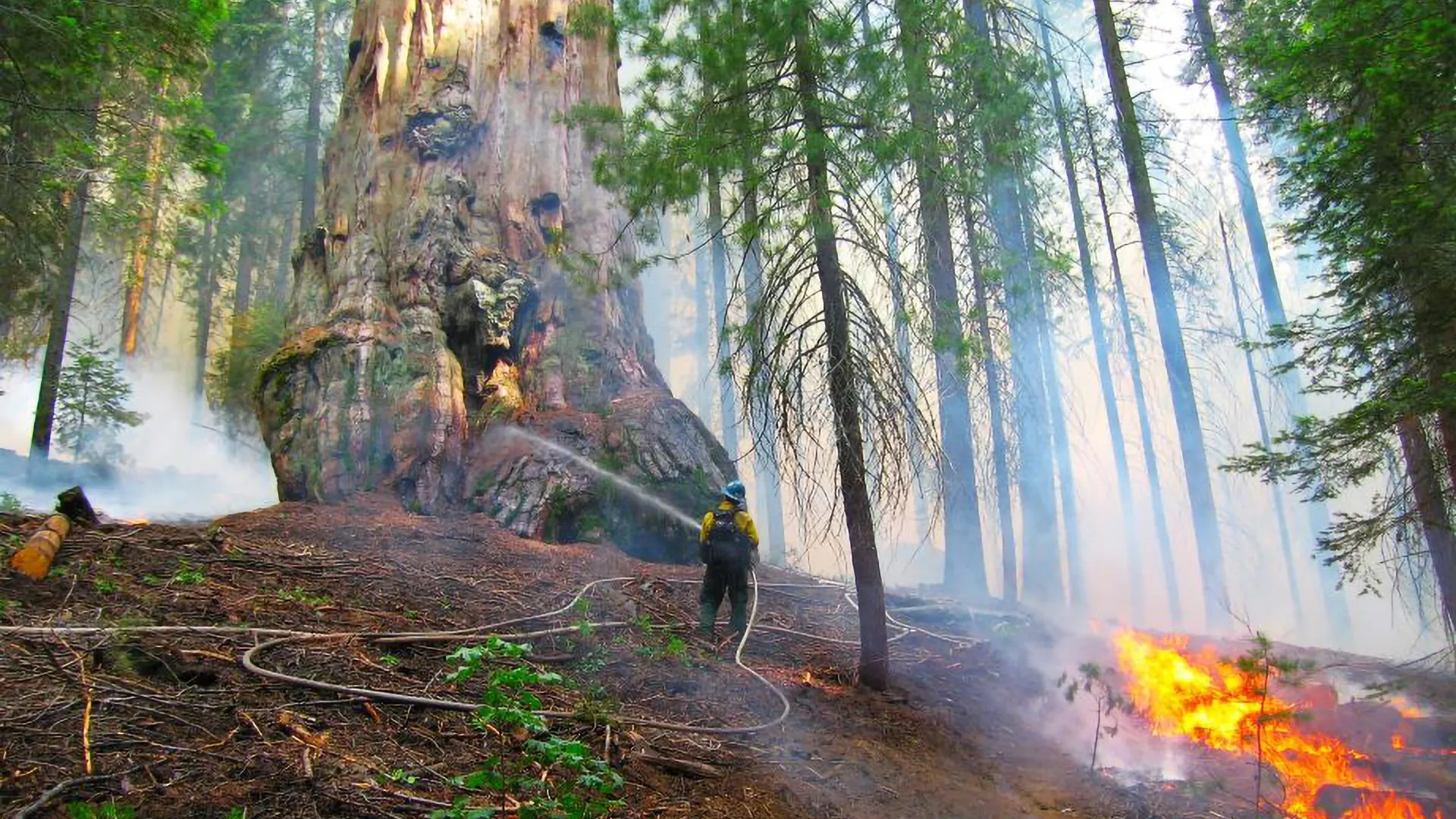
Two devastating wildfires that swept through California's Sierra Nevada in 2020 and 2021 killed thousands of giant sequoias. A new University of California, Davis study suggests the losses would have been far worse without prescribed burns.
Published in Nature Communications, the research found that giant sequoias exposed to prescribed fire during the previous 10 years were nearly four times more likely to survive the 2020 Castle Fire and the 2021 KNP Complex Fire than nearby untreated trees.
"Prescribed burns are effective at reducing giant sequoia mortality, even for today's extreme wildfires," said lead author Dan Dixon, who was a UC Davis postdoctoral researcher in Professor Yufang Jin's lab when the study was conducted. "If the goal is protecting giant sequoias, prescribed fire is an essential tool available to managers."
Ancient Giants Built for Fire
Giant sequoias are among the largest and longest-lived organisms on Earth. A single tree can weigh as much as 15 blue whales and survive for more than 3,000 years. In the wild, they grow only on the western slopes of California's Sierra Nevada.
These enormous trees evolved in a landscape shaped by periodic, low-intensity fires. Their thick bark and elevated canopies offer protection, while smaller fires clear vegetation, recycle nutrients, and create conditions that help new sequoias grow.
For that reason, many people once viewed mature sequoias as nearly fireproof. That perception changed dramatically after the 2020 and 2021 fire seasons, when images showed entire groves filled with the burned remains of trees that had survived for centuries.
"These trees live for so long and have experienced so much variability of climate, differences in wildfire, drought -- they've seen it all," Dixon said. "Having so many die in just two years was unprecedented."
Decades of Prescribed Burning Created a Natural Test
Sequoia and Kings Canyon National Parks have maintained one of the country's most extensive prescribed fire programs since the 1960s, according to the study. Over time, this created a patchwork of groves with very different fire histories.
Some sections had been treated with controlled burns relatively recently. Other areas had gone without fire for more than 100 years, allowing dead wood, shrubs, and other combustible material to accumulate.
That contrast gave researchers a rare opportunity to measure how previous prescribed burns affected giant sequoia survival during extreme wildfires.
Scientists from UC Davis, the U.S. Geological Survey, and Sequoia and Kings Canyon National Parks combined several types of remote sensing data. They used airborne lidar, which measures forest structure with laser pulses, along with high-resolution PlanetScope satellite images.
The team examined fuel conditions before the fires and estimated the outcomes for roughly 26,400 giant sequoias in 19 groves affected by the Castle and KNP Complex wildfires.
Prescribed Fire Cut the Risk of Death
The results showed a striking survival benefit. Prescribed burns carried out within the previous decade reduced a giant sequoia's odds of dying by about 77%.
Trees in treated areas were about four times more likely to survive than those in untreated portions of the same groves.
Computer simulations suggested that earlier prescribed burns prevented approximately 1,900 giant sequoia deaths. The researchers also estimated that another 3,900 trees might have survived if every sequoia in the affected groves had received similar treatment.
A Critical Tool for Sequoia Conservation
Climate change is increasing the frequency and severity of disturbances affecting old-growth forests, including drought and extreme wildfire. Giant sequoias remain naturally resistant to ordinary fire, but the study shows that even these exceptionally durable trees are vulnerable when flames become intense enough.
The findings provide strong evidence that prescribed burning can help protect sequoia groves by reducing the amount of fuel available when a major wildfire arrives.
"This is a timely study given the history of fire suppression in these forests and the state's increasing pace and scale of fuel thinning in recent years," Jin said. "By combining scalable, high-resolution remote sensing with a rigorous statistical framework, we were able to reveal insights on the effects of prescribed fires that go well beyond what traditional anecdotes or field surveys can tell us."
The study's additional coauthors are Xiaoli Dong and Andrew Latimer of UC Davis, Adrian Das, David Soderberg and Nathan Stephenson of the USGS' Western Ecological Research Center, and Anthony Caprio of the Division of Resources Management and Science at Sequoia and Kings Canyon National Parks.
The study was funded by the NASA Land Cover and Land Use Change Program, California Strategic Growth Council, and the USDA National Institute of Food and Agriculture.
Story Source:
Materials provided by University of California - Davis. Note: Content may be edited for style and length.
Journal Reference:
- Dan J. Dixon, Adrian J. Das, Xiaoli Dong, Andrew M. Latimer, David N. Soderberg, Nathan L. Stephenson, Anthony C. Caprio, Yufang Jin. Previous prescribed burns saved thousands of ancient sequoias during historically unprecedented wildfires. Nature Communications, 2026; DOI: 10.1038/s41467-026-75418-6
Cite This Page: