
Scientists think they solved the mystery of the Amaterasu particle
- Date:
- June 9, 2026
- Source:
- Penn State
- Summary:
- The mysterious Amaterasu particle may not be a proton at all. New research suggests that some of the most extreme cosmic rays could be ultraheavy atomic nuclei, heavier than iron, which are better able to retain their energy while traveling through space. This idea could help explain how these rare particles reach Earth and provide new clues about the powerful cosmic explosions that create them.
- Share:
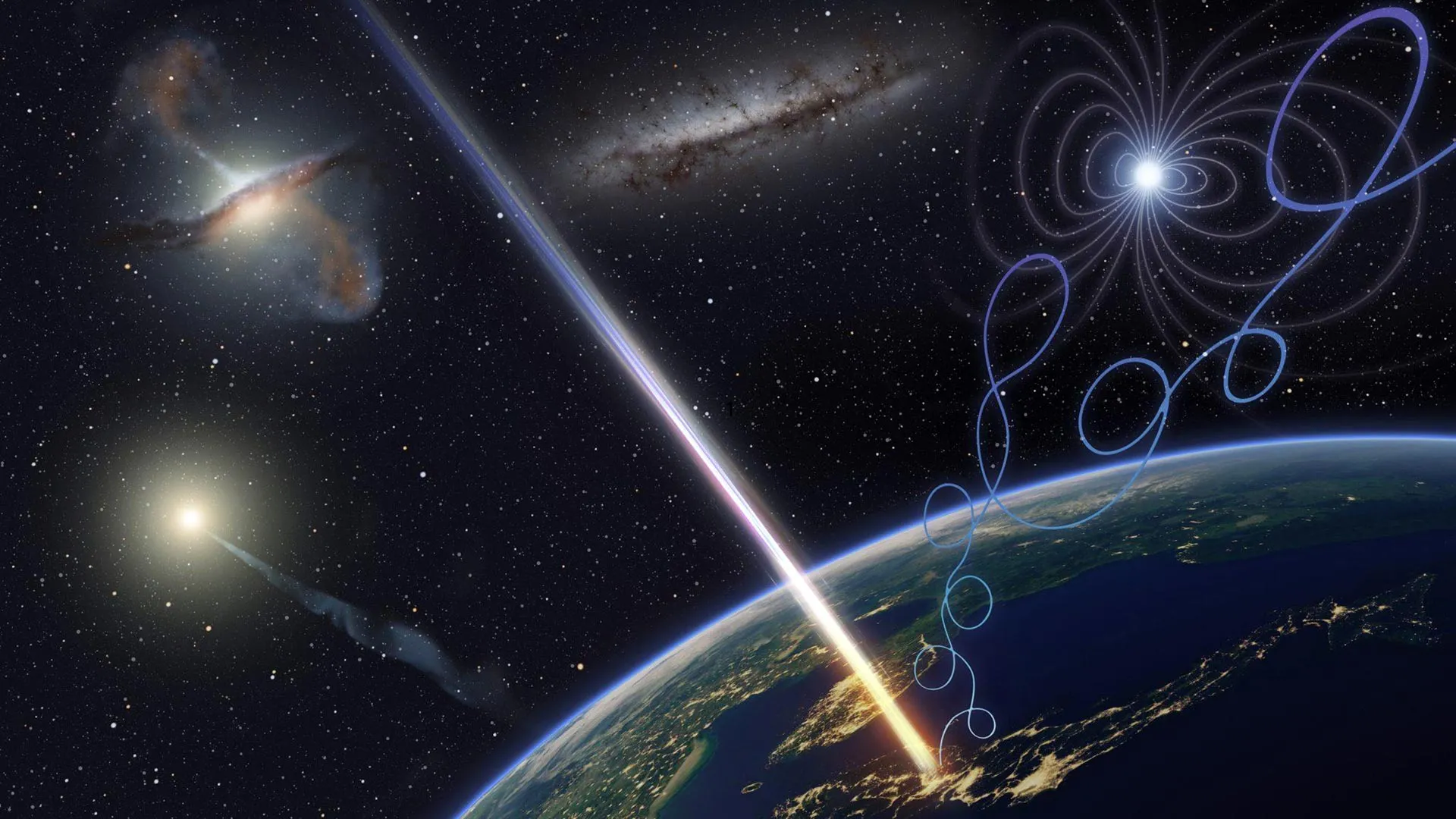
An ultraheavy particle may help explain one of the most puzzling mysteries in modern astrophysics: the origin of the most energetic particles ever detected.
Ultrahigh-energy cosmic rays are particles from space that slam into Earth with energies far beyond anything produced by human-built particle accelerators. Among the most extraordinary examples is the "Amaterasu particle," which was detected by the Telescope Array in Utah in 2021 and named for the sun goddess in Japanese mythology. Its reported energy ranks it among the most powerful cosmic-ray events ever observed, placing it in the same rare category as the "Oh-My-God particle" recorded in 1991. Yet scientists still do not know where it came from, or even exactly what it was.
Ultraheavy Cosmic Rays
New research led by scientists at Penn State and published in Physical Review Letters suggests that some of the highest-energy cosmic rays may be atomic nuclei heavier than iron. Atomic nuclei are the compact centers of atoms, made up of protons and neutrons. They hold almost all of an atom's mass while taking up only a tiny part of its total volume.
According to the team's calculations, these ultraheavy nuclei may lose energy more slowly than protons or lighter nuclei while crossing intergalactic space. That means they could survive the journey to Earth while still carrying extreme amounts of energy. The work, carried out with collaborators at the Yukawa Institute for Theoretical Physics in Japan, Virginia Tech and other institutions, may help scientists identify the types of cosmic objects powerful enough to launch such particles.
"Ultrahigh-energy cosmic rays can only be accelerated by some of the most powerful sources in the universe," said Kohta Murase, professor of physics and of astronomy and astrophysics in the Penn State Eberly College of Science and the leader of the research team. "When we detect individual cosmic-ray particles such as the Amaterasu particle here on Earth, we can often use their energies, arrival directions and expected magnetic deflections to infer their possible cosmic sources."
The Amaterasu Particle Mystery
The Amaterasu particle has been especially difficult to explain because its estimated arrival direction traces back to a cosmic void, a region of space with no clear source capable of producing ultrahigh-energy cosmic rays.
"The origins and acceleration mechanisms of ultrahigh-energy cosmic rays have been among the biggest mysteries in the field for more than 60 years, since the first example was reported," Murase said.
These rare particles can exceed 100 exa-electron volts, or 100 quintillion electron volts. That makes them about seven orders of magnitude, or 10 million times, more energetic than particles accelerated inside the Large Hadron Collider, the world's largest and most powerful particle accelerator. The Amaterasu particle was reported at about 240 exa-electron volts, giving one tiny cosmic-ray particle roughly the kinetic energy of a fast-moving tennis ball. That makes it one of the most energetic cosmic rays ever detected.
"These highest-energy cosmic rays are thought to come from extreme astrophysical sources, like two neutron stars colliding or a massive star collapsing," Murase said. "For many cosmic-ray events taken together, their energy distribution, arrival-direction pattern and statistically inferred composition provide important clues about where these particles come from and how they are accelerated."
Simulating Extreme Particles
To investigate what kinds of particles could still reach Earth at such extraordinary energies, the researchers ran detailed computer simulations. They modeled how particles of different sizes would gain or lose energy while traveling through intergalactic space.
"Our research showed that at energies comparable to that of the Amaterasu particle, ultraheavy nuclei lose energy more slowly than protons or intermediate-mass nuclei, making them better able to survive cosmic distances and reach Earth at extreme energies," Murase said. "We are not saying that all ultrahigh-energy cosmic rays are ultraheavy nuclei. But if some of the highest-energy events are ultraheavy nuclei, that would impact how we search for their sources."
The team's calculations also set new limits on how much these ultraheavy nuclei may contribute to the full population of observed ultrahigh-energy cosmic rays.
Violent Cosmic Origins
"The most promising sites for producing and accelerating such ultraheavy nuclei are massive star deaths involving explosive collapse into black holes or strongly magnetized neutron stars, as well as binary neutron-star mergers known to be powerful gravitational-wave emitters," Murase said. "These violent cosmic phenomena can also power gamma-ray bursts that are among the most energetic explosions in the universe. A contribution from these sources could also help explain a possible difference seen between the northern and southern skies in the ultrahigh-energy cosmic-ray spectrum. If ultraheavy nuclei contribute significantly at the highest energies, future data should indicate a composition heavier than iron."
Future observatories may be able to test these ideas. Murase said next-generation facilities, including the proposed AugerPrime in Argentina and the proposed Global Cosmic Ray Observatory, could look for the predicted signatures. Additional theoretical work on cosmic explosions involving black holes and strongly magnetized neutron stars may also help reveal where ultrahigh-energy cosmic rays are born.
Along with Murase, the research team included B. Theodore Zhang, a postdoctoral researcher at Kyoto University's Yukawa Institute for Theoretical Physics at the time of the research and a former Penn State postdoctoral researcher; Mukul Bhattacharya, an Eberly Postdoctoral Fellow at Penn State at the time of the research; and Nick Ekanger and Shunsaku Horiuchi, who were at Virginia Tech at the time of the research.
Story Source:
Materials provided by Penn State. Note: Content may be edited for style and length.
Journal Reference:
- B. Theodore Zhang, Kohta Murase, Nick Ekanger, Mukul Bhattacharya, Shunsaku Horiuchi. Ultraheavy Ultrahigh-Energy Cosmic Rays. Physical Review Letters, 2026; 136 (18) DOI: 10.1103/221m-gvs3
Cite This Page: