
New quantum sensor could count individual photons and hunt dark matter
Scientists just detected one of the tiniest energy signals ever measured — a breakthrough that could transform quantum computing and dark matter searches.
- Date:
- May 20, 2026
- Source:
- Aalto University
- Summary:
- Researchers have built an ultra-sensitive sensor capable of detecting unimaginably small amounts of energy — below one zeptojoule. The breakthrough relies on fragile superconducting materials that react to even the slightest temperature change. This level of precision could improve quantum computers, enable photon counting, and even help scientists detect elusive dark matter particles from space.
- Share:
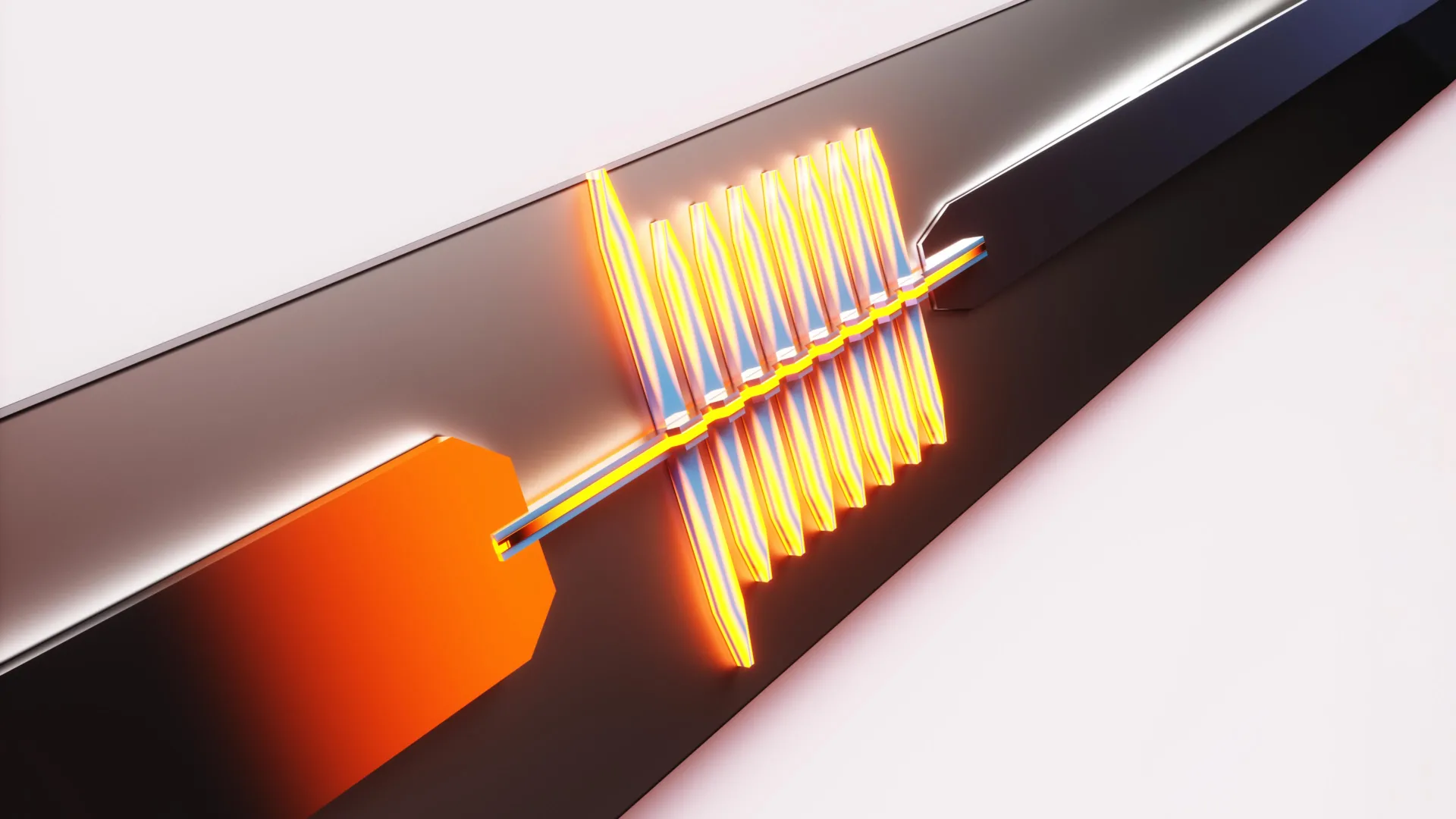
Researchers in Finland have achieved a major advance in ultra-sensitive measurement technology by detecting an amount of energy smaller than one zeptojoule, less than a trillionth of a billionth of a joule. The breakthrough could improve quantum computing technology, support the search for dark matter, and eventually make it possible to count individual photons.
Quantum mechanics operates on incredibly tiny scales, and scientists are constantly developing more precise tools to measure and control phenomena such as photons, the particles that carry light. Greater precision can open the door to more powerful quantum devices and new ways of studying some of the universe's biggest mysteries.
A zeptojoule is an almost unimaginably small quantity of energy. It is roughly equivalent to the amount of work needed to move a red blood cell upward by one nanometer in Earth's gravity.
The research team was led by Academy Professor Mikko Möttönen at Aalto University in collaboration with quantum computing company IQM and the Technical Research Centre of Finland (VTT). Their findings were published in the journal Nature Electronics.
Ultra-Sensitive Quantum Energy Detector
To reach this level of sensitivity, the researchers used a calorimeter, a device designed to measure extremely small changes in heat energy. Measuring signals this tiny is far more difficult than simply sending a beam into a detector and reading a result.
The scientists directed a microwave pulse into a sensor built from two types of metals. One part consisted of superconductors, materials that allow electricity to move freely without resistance. The other part used normal conductors, which resist electrical flow.
"That combination of metals makes superconductivity such a fragile phenomenon that it weakens immediately if the temperature in the ultracold conductor rises even a little bit. This makes it such a sensitive setup," says Möttönen, who is also a founder of the quantum computer unicorn IQM.
After carefully filtering the signal, the researchers confirmed they had detected an electromagnetic pulse measuring just 0.83 zeptojoules. According to the team, this marks the first time a calorimetric measurement device has reached such sensitivity.
Implications for Quantum Computing and Dark Matter
The advance could eventually allow scientists to count individual photons, a long-standing goal in quantum technology and astrophysics.
"We want to make this setup capable of measuring input that has an arbitrary time of arrival, which is important for things like detecting dark-matter axions in space when you have no idea when they might reach your system."
The researchers also believe the technology could become useful in quantum computers because the calorimeter operates at the same extremely cold millikelvin temperatures required by qubits, the basic units of quantum information.
"A calorimeter operates in the same millikelvin temperatures that qubits require. This introduces less disturbance into the system as we don't have to bring the device to a high temperature or amplify the qubit measurement signal to get a result. In the future, our device could be a component for reading out qubits in quantum computers, for example."
Research Facilities and Funding
The work was carried out using the facilities of OtaNano, Finland's national research infrastructure for nano-, micro- and quantum technologies.
Funding for the project primarily came from the Future Makers initiative, supported by the Jane and Aatos Erkko Foundation and the Technology Industries of Finland Centennial Foundation.
Story Source:
Materials provided by Aalto University. Note: Content may be edited for style and length.
Journal Reference:
- András Márton Gunyhó, Kassius Kohvakka, Qi-Ming Chen, Jean-Philippe Girard, Roope Kokkoniemi, Wei Liu, Mikko Möttönen. Zeptojoule calorimetry. Nature Electronics, 2026; DOI: 10.1038/s41928-026-01615-2
Cite This Page: