
Scientists discover hidden forces are warping Earth deep beneath the surface
- Date:
- April 23, 2026
- Source:
- Seismological Society of America
- Summary:
- Scientists have mapped how Earth’s deepest mantle is being deformed—and the results point to long-lost tectonic plates buried thousands of kilometers underground. Using a massive global dataset of seismic waves, they found that most deformation happens in regions where these ancient slabs are thought to reside. The findings confirm long-standing theories but, for the first time, show the pattern on a global scale. It’s a major step toward understanding how the planet’s interior slowly churns over time.
- Share:
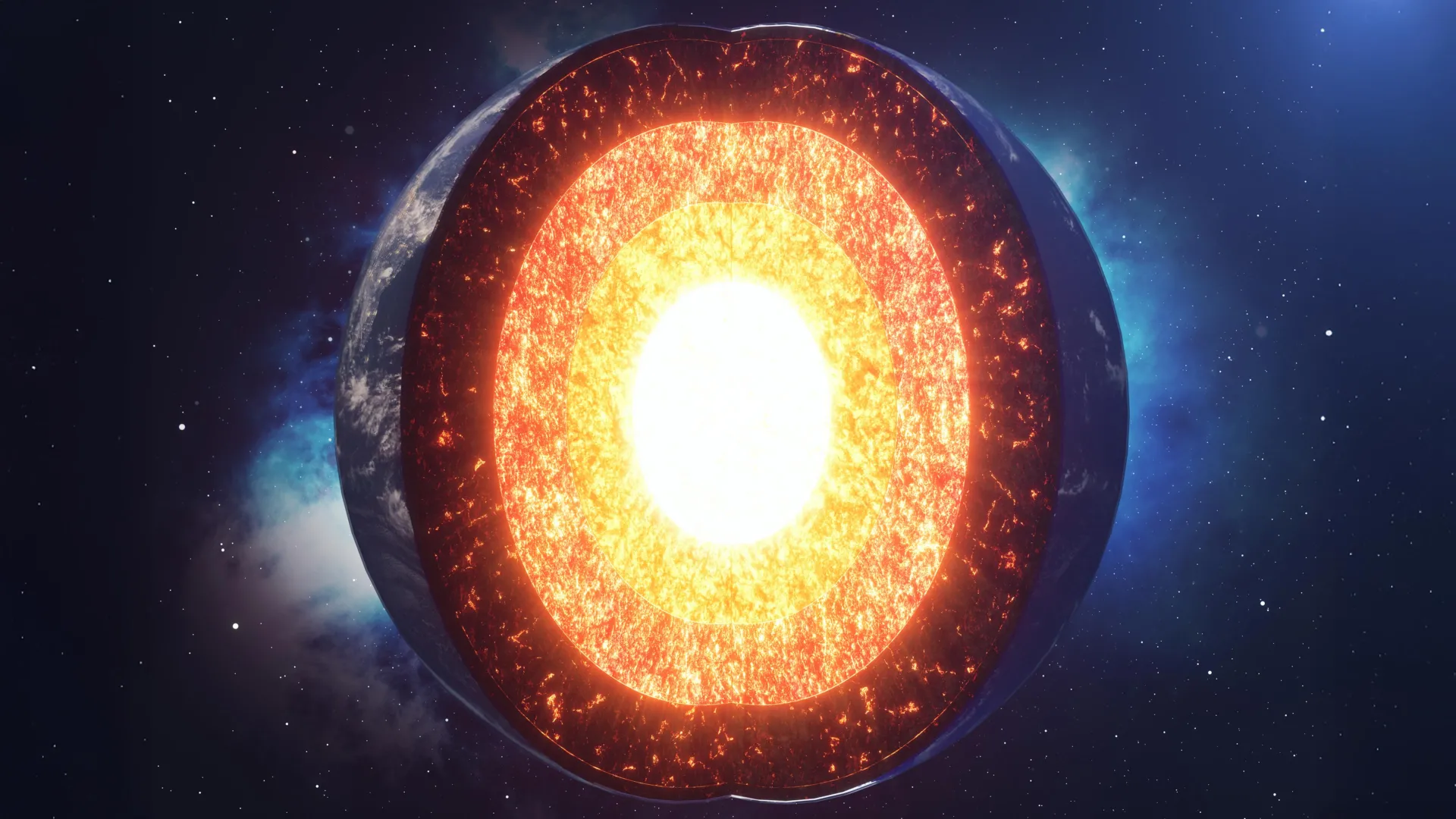
Far beneath Earth's surface, slow-moving convection currents churn within the mantle. These currents are closely tied to the movement of tectonic plates, and they do more than just shift the plates above. They also stretch and distort the mantle material itself.
A new study published in The Seismic Record shows that much of this deformation in the deepest part of the mantle occurs in regions where scientists believe ancient tectonic slabs have sunk over millions of years.
Global Map Reveals Deformation Near the Core
Scientists had long suspected a connection between deep mantle deformation and these buried slabs, but this research provides the first global view. The team examined nearly 75% of the lowermost mantle, a layer located just above the core-mantle boundary about 2,900 kilometers (1,800 miles) below Earth's surface.
Jonathan Wolf of the University of California, Berkeley, and his colleagues built this global map using an enormous dataset. They gathered and analyzed more than 16 million seismograms from 24 data centers worldwide, creating one of the most comprehensive seismic datasets ever assembled.
Seismic Waves Expose Hidden Structure
When earthquakes occur, they generate shear waves that travel through Earth's interior. These waves move at different speeds depending on their direction and the properties of the material they pass through. This directional variation, known as seismic anisotropy, allows scientists to identify areas where the mantle has been deformed.
By studying these patterns, researchers can gain valuable insight into how the mantle flows and circulates over time.
"We know that deformation in the upper mantle is dominated by the drag of the plates that move across it. And that extremely well approximates what we know from seismic anisotropy about the deformation of the upper mantle," Wolf explained. "But we don't have any of this kind of large-scale understanding for flow in the lowermost mantle. And that's really what we want to get at."
Massive Dataset Unlocks Deep Earth Patterns
Using what Wolf describes as "the largest-ever assemblage of earthquake seismic data," the team analyzed multiple phases of seismic waves that travel down through the mantle, pass into the core, and then return to the mantle.
These waves are especially useful for mapping seismic anisotropy across distances of hundreds of kilometers, offering a clearer picture of how deformation is distributed in the deepest mantle.
The results showed anisotropy across roughly two-thirds of the regions studied. While the patterns are complex, most of the deformation appears in areas where deeply subducted slabs are thought to exist.
"This isn't that surprising in a sense, because that is predicted by geodynamic simulations," Wolf said. "But at the scale that we're looking at, it's not really been shown using those methods that we're using."
What Causes Deformation in Subducted Slabs
Scientists are still working to understand exactly why these slabs show seismic anisotropy. According to Wolf, one possibility is that the slabs retain some "fossil" anisotropy from when they were closer to the surface.
However, a more likely explanation is that intense deformation occurs as the slabs sink and interact with the core-mantle boundary. As they descend, they also push and reshape surrounding material. The extreme heat and pressure at these depths can alter the minerals within the slabs, creating a new anisotropic "fabric."
Limits of Detection and Future Research
Wolf emphasized that areas lacking a detectable anisotropic signal should not be assumed to be free of deformation. In some regions, the signal may simply be too weak for current methods to detect.
The vast dataset behind this study remains a valuable resource. Wolf described it as a "treasure trove" that researchers will continue to explore for further insights into Earth's deep interior.
"If I can dream, we will someday have enough information to really say much more about global flow directions of the lowermost mantle, knowing the seismic anisotropy across different lateral scales in the mantle, illuminating it from many directions," he said.
Story Source:
Materials provided by Seismological Society of America. Note: Content may be edited for style and length.
Journal Reference:
- Jonathan Wolf, Barbara Romanowicz, Ed Garnero, Weiqiang Zhu, John D. West. Widespread Deformation at the Base of the Mantle Linked to Subducted Slabs. The Seismic Record, 2026; 6 (2): 117 DOI: 10.1785/0320260001
Cite This Page: