
This strange “pearling” motion inside cells could change how we understand disease
- Date:
- April 13, 2026
- Source:
- Ecole Polytechnique Fédérale de Lausanne
- Summary:
- Mitochondria don’t just generate energy—they also carefully organize their own DNA in a surprisingly elegant way. Scientists have discovered that a long-overlooked phenomenon called “mitochondrial pearling,” where mitochondria briefly form bead-like shapes, helps evenly space clusters of mitochondrial DNA.
- Share:
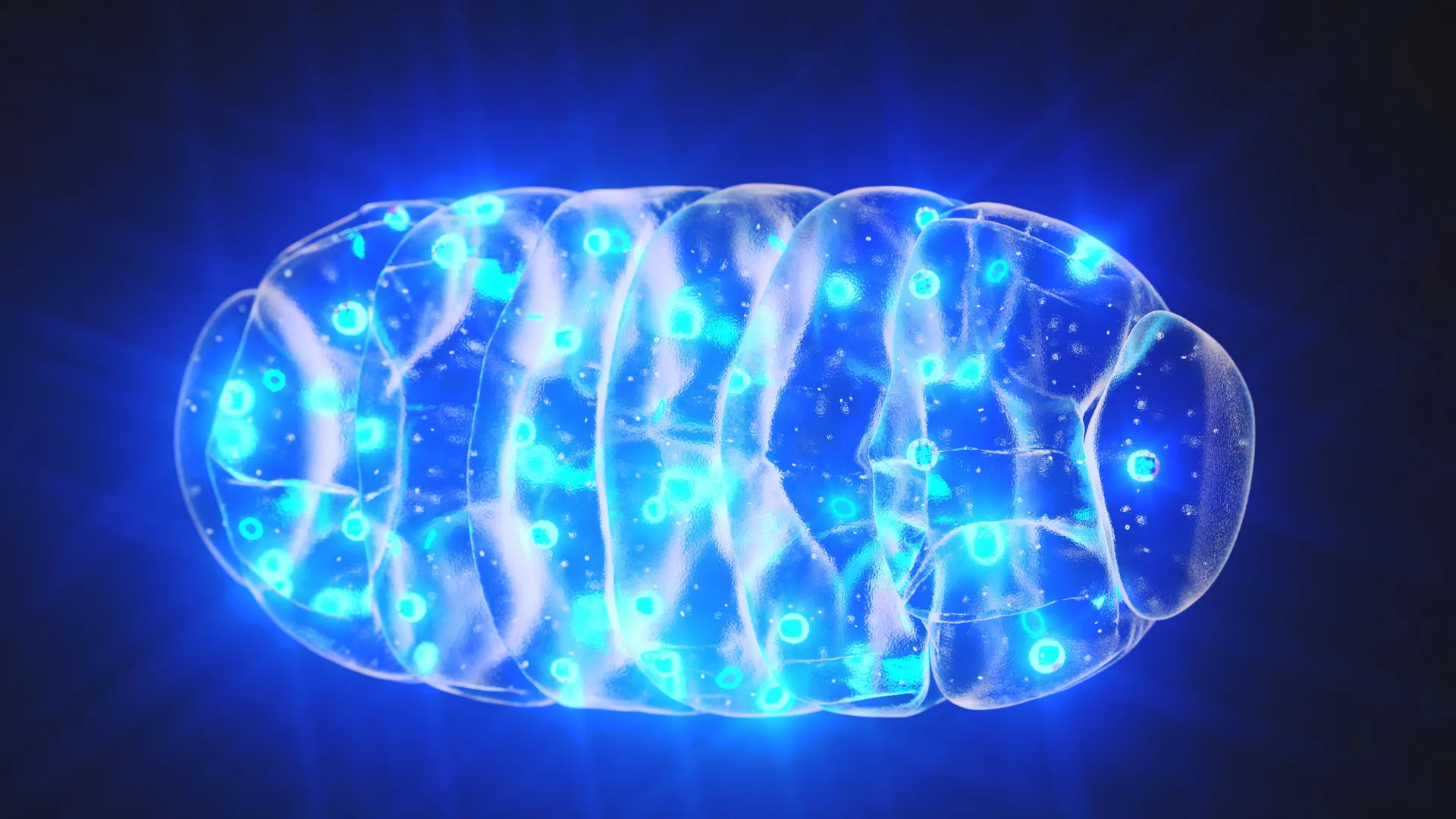
Mitochondria are often called the power plants of the cell because they produce the energy cells need to function. To support this role, they carry their own genetic material, known as mitochondrial DNA (mtDNA).
Each cell holds hundreds to thousands of copies of mtDNA. These copies are grouped into compact structures called nucleoids. Scientists have long observed that these nucleoids are spaced in a regular pattern within mitochondria. This organization helps ensure that mtDNA is reliably passed on when cells divide and that its genes are expressed evenly throughout the mitochondria.
When mitochondria or their DNA do not function properly, the effects can be serious. Disruptions have been linked to metabolic and neurological conditions such as liver failure and encephalopathy, as well as aging-related disorders like Alzheimer's and Parkinson's disease.
A Long-Standing Mystery in Cell Biology
Given how important mtDNA is, researchers have been trying to understand how cells maintain such consistent spacing of nucleoids. The answer has remained unclear.
"Proposed mechanisms related to mitochondrial fusion, fission, or molecular tethering cannot explain it, since nucleoid spacing is maintained even when they are disrupted," says Suliana Manley, professor at the Laboratory of Experimental Biophysics (LEB) at EPFL.
Manley and her colleague Juan Landoni, a postdoctoral fellow at the LEB, have now identified the mechanism responsible. Their work points to a process called "mitochondrial pearling," which had previously received little attention.
Mitochondrial pearling is a temporary shape change in which mitochondria form a structure that looks like beads on a string. During this transformation, clusters of mtDNA are separated and redistributed. This allows nucleoids to spread out more evenly, maintaining their regular spacing.
Watching Mitochondria in Action
To study this process, the researchers used a combination of advanced imaging methods to observe mitochondria and their DNA inside living cells. These included super-resolution imaging, correlated light and electron microscopy, and phase contrast microscopy.
With these tools, the team was able to follow individual nucleoids, capture rapid changes in mitochondrial shape, and better understand how the internal structure is organized.
What Happens During Pearling
Live-cell imaging showed that pearling events can happen several times per minute. During these moments, mitochondria briefly form evenly spaced constrictions along their length. The distance between these "pearls" closely matches the usual spacing between nucleoids.
Most of these bead-like sections contain a nucleoid near the center, although the structures can also form without mtDNA present.
As the process continues, larger clusters of nucleoids often break apart into smaller groups that settle into neighboring pearls. When the mitochondrion returns to its normal tubular shape, the nucleoids remain separated, preserving their even distribution.
What Controls the Process
The researchers also explored what drives and regulates pearling. Through genetic and pharmacological experiments, they found that calcium entering the mitochondria can trigger the process. In addition, internal membrane structures help maintain the separation of nucleoids.
When these regulatory factors are disrupted, nucleoids tend to clump together instead of staying evenly spaced.
A Rediscovered Feature of Mitochondria
"Since Margaret Reed Lewis first sketched mitochondrial pearling in 1915, it has largely been dismissed as an anomaly linked to cellular stress," says Landoni. "Over a century later, it is emerging as an elegantly conserved mechanism at the heart of mitochondrial biology. This biophysical process offers a simple and energy efficient means to distribute the mitochondrial genome."
Why This Discovery Matters
The findings show that cells rely not only on complex molecular systems but also on physical processes to stay organized. Understanding how mitochondrial pearling works and how it is controlled could provide important insights into diseases linked to mtDNA.
This knowledge may eventually help guide new approaches to treating conditions associated with mitochondrial dysfunction.
Other Contributors
- Pontificia Universidad Católica de Chile
- Howard Hughes Medical Institute
- University of California, San Francisco
Story Source:
Materials provided by Ecole Polytechnique Fédérale de Lausanne. Note: Content may be edited for style and length.
Journal Reference:
- Juan C. Landoni, Matthew D. Lycas, Josefa Macuada, Willi Stepp, Roméo Jaccard, Christopher J. Obara, Andrew S. Moore, David Hoffman, Jennifer Lippincott-Schwartz, Wallace Marshall, Gabriel Sturm, Suliana Manley. Pearling drives mitochondrial DNA nucleoid distribution. Science, 2026; 392 (6793): 102 DOI: 10.1126/science.adu5646
Cite This Page: