
Physicists found hidden order in violent proton collisions
- Date:
- January 5, 2026
- Source:
- The Henryk Niewodniczanski Institute of Nuclear Physics Polish Academy of Sciences
- Summary:
- Inside high-energy proton collisions, quarks and gluons briefly form a dense, boiling state before cooling into ordinary particles. Researchers expected this transition to change how disordered the system is, but LHC data tell a different story. A newly improved collision model matches experiments better than older ones and reveals that the “entropy” remains unchanged throughout the process. This unexpected result turns out to be a direct fingerprint of quantum mechanics at work.
- Share:
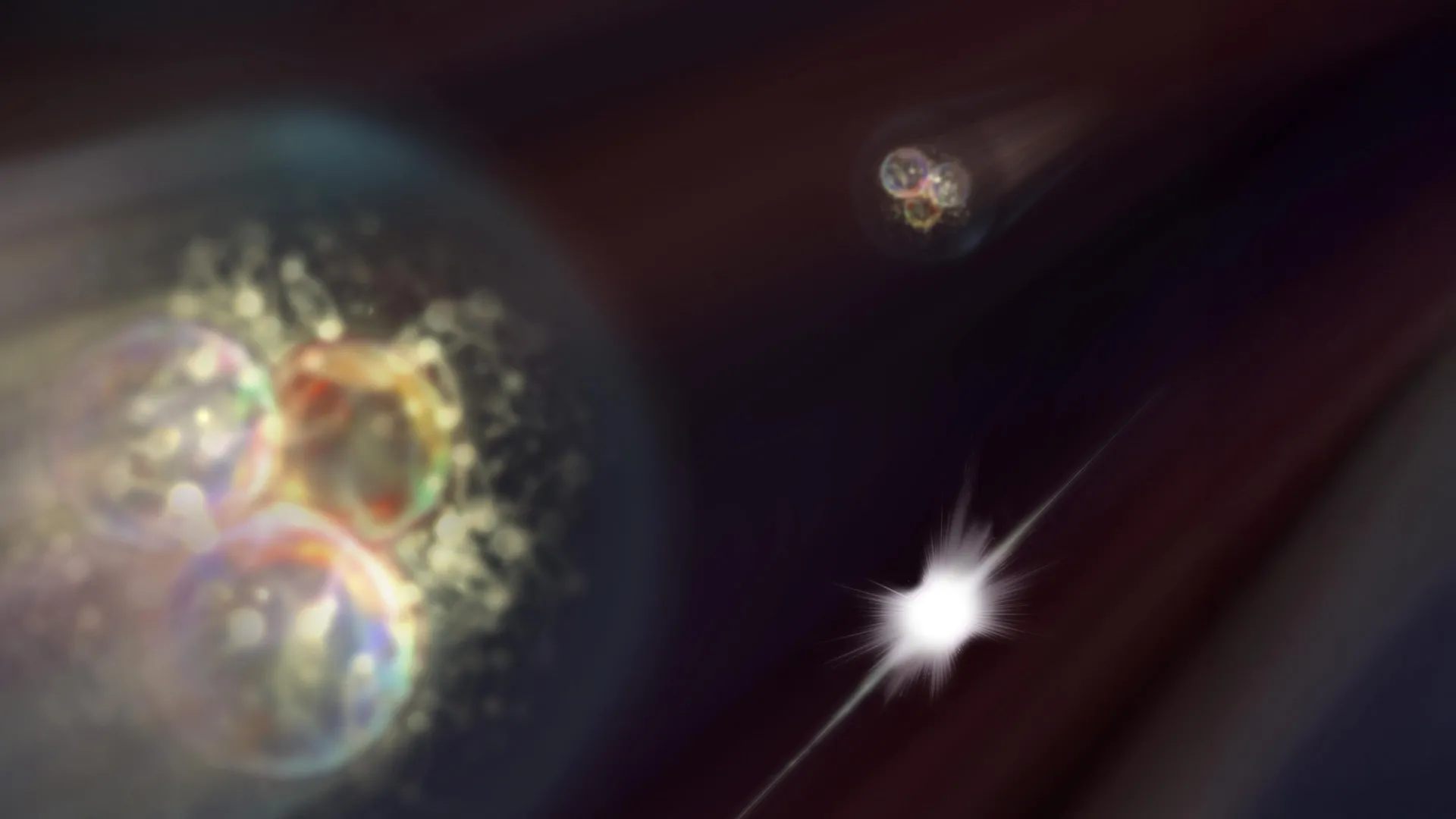
High energy proton collisions can be pictured as a roiling sea of quarks and gluons, including short lived virtual particles. At first glance, this extreme environment seems far more complex than the later stage, when fewer and more stable particles fly outward from the collision point. One might expect particles in this early phase to behave very differently. But data from the Large Hadron Collider (LHC) show that this intuition is misleading. The results are better explained by a refined model that captures how proton collisions truly unfold.
When two protons collide at very high energies, an enormous amount happens in an instant. Protons are hadrons, meaning they are made of partons, which include quarks and the gluons that hold them together. During a collision, these quarks and gluons, including virtual ones that appear only briefly, interact in complicated ways. As the system cools, quarks combine to form new hadrons that scatter outward and are detected by experiments. Based on this picture, it seems reasonable to assume that the disorder of the system, known as entropy, should change between the early parton phase and the later hadron phase. The parton stage looks especially chaotic, with many particles interacting at once.
New Research on Entropy in Proton Collisions
The latest findings on this question were published in Physical Review D by Prof. Krzysztof Kutak and Dr. Sandor Lokos from the Institute of Nuclear Physics of the Polish Academy of Sciences (IFJ PAN) in Cracow. Their work focuses on comparing entropy in the early quark gluon phase with the entropy of the particles eventually produced and measured.
"In high-energy physics, so-called dipole models have been used for some time to describe the evolution of dense gluon systems. These models assume that each gluon can be represented by a quark-antiquark pair that forms a dipole of two colors -- here we are not talking about ordinary colours, but the colour charge that is a quantum property of gluons. Dipole models based on the average number of hadrons produced in a collision allow us to estimate the entropy of partons," explains Prof. Kutak, who has studied the entropy of quark gluon systems for more than ten years.
Improving Dipole Models With New Ideas
Two years ago, Prof. Kutak and Dr. Pawel Caputa of Stockholm University introduced an updated version of the dipole model. They started with an established model that describes how gluon systems evolve and treated it as the dominant contribution. They then added additional effects that become important at lower collision energies, where fewer hadrons are produced. This advance was possible because the researchers identified links between the equations used in dipole models and those found in complexity theory.
To test this generalized dipole model, Dr. Lokos suggested comparing it with real experimental data from the LHC. Measurements from the ALICE, ATLAS, CMS and LHCb experiments were included. Together, these data span a broad range of collision energies, from 0.2 teraelectronvolts up to 13 TeV, which is the highest energy currently achievable at the LHC.
"In our article, we show that the generalized dipole model describes the existing data more accurately than previous dipole models and, moreover, works well in a wider range of proton collision energies," Prof. Kutak says.
Entropy and a Core Rule of Quantum Mechanics
This raises a key question. Does the entropy during the quark and gluon dominated phase of a proton collision differ from the entropy of the hadrons that later escape the collision zone? According to the Kharzeev-Levin formula for entropy, it should not. The new analysis confirms this prediction. While this result surprises some physicists, others see it as a natural outcome of one of the most basic principles of quantum mechanics known as unitarity.
Unitarity may sound abstract, but the idea itself is straightforward. The equations that describe how a quantum system evolves over time must conserve total probability, which always adds up to one, and they must allow processes to be reversed. Put simply, unitarity means that information and probability cannot disappear or appear from nothing.
"The unitarity of quantum mechanics is something that physics students learn about. The formalism of quantum chromodynamics, the theory describing the world of quarks and gluons, is based on unitarity. However, it is one thing to deal with a theory that exhibits a certain feature at the level of quarks and gluons on a daily basis, and quite another to observe it in real data on produced hadrons," Prof. Kutak notes. He adds that unitarity makes it possible to extract information about parton entropy across a wide range of collision energies.
What Comes Next for Testing the Model
Further tests of the generalized dipole model are expected in the coming years. After the planned upgrade of the LHC, the improved ALICE detector will be able to study regions where gluon interactions are even denser than those examined so far. Additional insights are also expected from the Electron-Ion Collider (EIC), now under construction at Brookhaven National Laboratory in the USA. At the EIC, electrons will collide with protons. Because electrons are elementary particles, these experiments will offer a clearer way to probe dense gluon systems inside individual protons.
Story Source:
Materials provided by The Henryk Niewodniczanski Institute of Nuclear Physics Polish Academy of Sciences. Note: Content may be edited for style and length.
Journal Reference:
- Krzysztof Kutak, Sándor Lökös. Entropy and multiplicity of hadrons in the high energy limit within dipole cascade models. Physical Review D, 2025; 112 (9) DOI: 10.1103/23wn-66np
Cite This Page: