
A strange star near a black hole is defying expectations
- Date:
- December 26, 2025
- Source:
- University of Hawaii at Manoa
- Summary:
- Astronomers have decoded the hidden past of a distant red giant star by listening to tiny vibrations in its light, revealing clues of a dramatic cosmic history. The star, which quietly orbits a dormant black hole, appears to be spinning far faster than it should—and its internal “starquakes” suggest it may have once collided and merged with another star. Even more puzzling, its chemical makeup makes it look ancient, while its internal structure reveals it’s relatively young.
- Share:
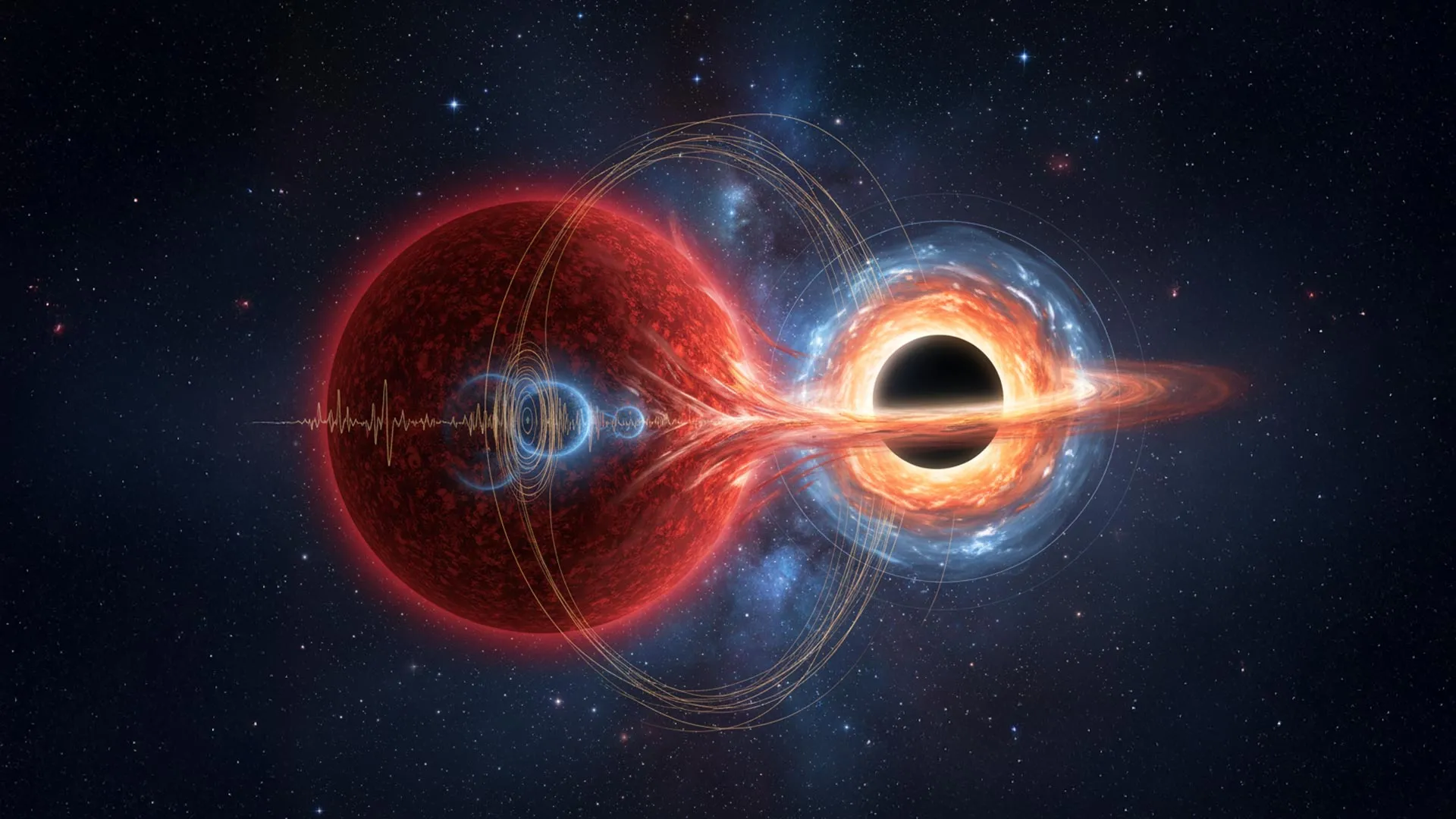
Astronomers at the University of Hawaiʻi Institute for Astronomy (IfA) have pieced together the dramatic history of a distant red giant by studying subtle changes in its light. Tiny fluctuations in brightness reveal that the star may have collided and merged with another star long ago, a violent event that likely left it spinning much faster than normal. Today, this unusual star circles a quiet black hole in a system known as Gaia BH2.
Using observations from NASA's Transiting Exoplanet Survey Satellite (TESS), the team detected faint vibrations known as "starquakes" moving through the red giant, which is the companion to the black hole. Gaia BH2 itself was first identified in 2023 by the European Space Agency's Gaia mission. Much like earthquakes help scientists explore Earth's interior, these stellar tremors allowed astronomers to probe deep inside the star and precisely measure properties of its core. The results of this work were recently published in Astronomical Journal.
"Just like seismologists use earthquakes to study Earth's interior, we can use stellar oscillations to understand what's happening inside distant stars," said IfA research scientist Daniel Hey, lead author of the study. "These vibrations told us something unexpected about this star's history."
A Star That Appears Older Than It Is
One of the most surprising findings came from the star's chemical composition. The red giant is described as "alpha-rich," meaning it contains large amounts of heavy elements that are typically found in very old stars. Based on its chemistry alone, the star should be ancient.
However, analysis of its internal vibrations told a different story. The star is actually about 5 billion years old, far younger than its chemical makeup would suggest. That mismatch presents a puzzle for astronomers trying to understand how the star formed.
"Young, alpha-rich stars are quite rare and puzzling," explained Hey. "The combination of youth and ancient chemistry suggests this star didn't evolve in isolation. It likely acquired extra mass from a companion, either through a merger or by absorbing material when the black hole formed."
Spinning Faster Than Expected
Additional clues came from long-term monitoring with ground-based telescopes. These observations show the star completes one full rotation every 398 days, which is unusually fast for a red giant of its age that evolved alone.
"If this rotation is real, it can't be explained by the star's birth spin alone," said co-author Joel Ong, a NASA Hubble Fellow at IfA. "The star must have been spun up through tidal interactions with its companion, which further supports the idea that this system has a complex history."
Comparing Quiet Black Hole Systems
The researchers also studied Gaia BH3, another black hole system with an even stranger companion star. Existing models predicted that this star should display strong oscillations, yet none were observed. This unexpected result suggests that current theories about stars with extremely low metal content may need to be revised.
Both Gaia BH2 and Gaia BH3 belong to a class of dormant black hole systems. These black holes are not actively pulling in material from their companion stars, which means they do not emit X-rays. Instead, astronomers discovered them by carefully tracking the motion of nearby stars. These findings are changing how scientists search for and study black holes within the Milky Way.
What Comes Next
Future observations from TESS will allow astronomers to study Gaia BH2's stellar vibrations in even greater detail. With more data, the team hopes to confirm whether the red giant truly formed through a past stellar merger and to better understand how these quiet black hole pairs develop over time.
Story Source:
Materials provided by University of Hawaii at Manoa. Note: Content may be edited for style and length.
Journal Reference:
- Daniel Hey, Yaguang 亚光 Li 李, J. M. Joel 加冕 Ong 王. Asteroseismology of the Red Giant Companions to Gaia BH2 and BH3. The Astronomical Journal, 2025; 170 (6): 304 DOI: 10.3847/1538-3881/ae0e25
Cite This Page: