
Ozempic and Wegovy may raise hair loss risk in some men
- Date:
- September 12, 2026
- Source:
- NYU Langone Health / NYU Grossman School of Medicine
- Summary:
- GLP-1 drugs such as Ozempic, Wegovy, and Zepbound may increase hair-loss risk by 7% in men who are already genetically susceptible to male-pattern baldness. The findings suggest thinning hair may not be caused only by rapid weight loss and could also reflect a biological link between GLP-1 activity and hair follicles.
- Share:
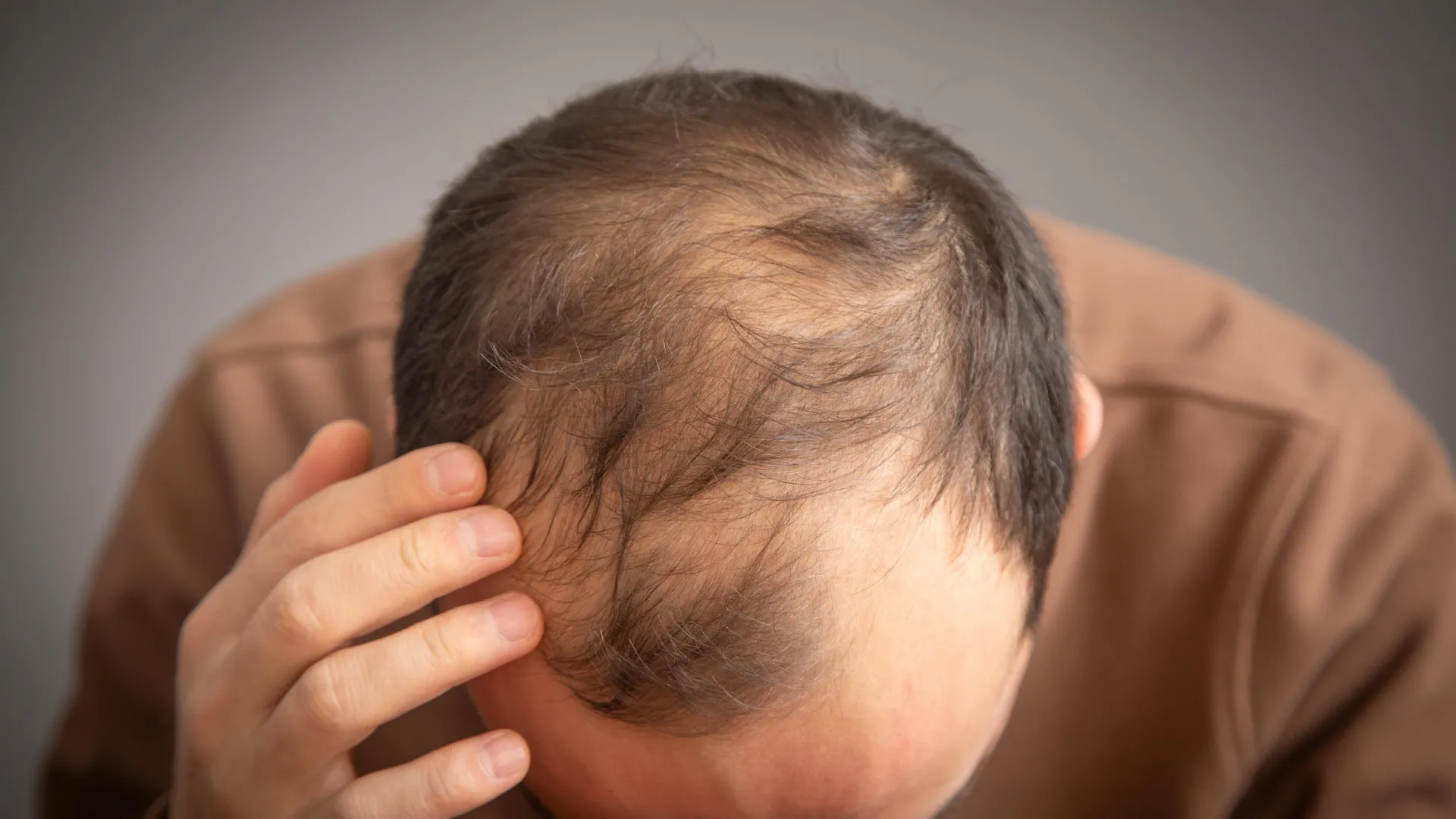
Men who are already genetically predisposed to the most common type of hair loss may face an additional 7 percent risk of losing hair when using drugs such as Ozempic, Wegovy, and Zepbound for type 2 diabetes and obesity, according to a new study.
Researchers at NYU Langone Health examined the GLP1R gene, which naturally influences levels of glucagon-like peptide-1 (GLP-1) receptor proteins in the body. They used activity involving this gene as an indicator of GLP-1 agonist activity. Greater GLP1R activity is associated with higher levels of GLP-1 receptor proteins.
The team compared genetic patterns associated with GLP1R activity with genes found in men who have androgenetic alopecia, the inherited form of hair loss that typically affects the top and front of the scalp. Because male hair loss has been studied far more extensively than hair loss in women, the researchers were only able to investigate a possible causal connection in men.
Hair Loss Has Already Been Reported by GLP-1 Users
Hair thinning has been reported by both men and women taking GLP-1 drugs. Until now, researchers have generally attributed much of that shedding to rapid weight loss, since these medications lower blood sugar and reduce appetite.
In many cases, people taking GLP-1 drugs have reported that their hair begins growing again several months after their weight stabilizes. However, scientists have also suspected that genetics might play a role in the hair loss associated with these medications.
The new findings, published online Sept. 3 in the Journal of Investigative Dermatology, provide evidence supporting that possibility.
Researchers found that genetic variants associated with naturally higher levels of GLP-1 receptor proteins were more common in men with androgenetic alopecia.
The team then adjusted its analysis to account for hypertension, a known risk factor for hair loss. High blood pressure is thought to interfere with blood flow to the scalp, potentially damaging the ability of hair follicles to grow normally. Even after accounting for hypertension, the additional 7 percent risk remained.
Other Hair Loss Risk Factors Did Not Explain the Link
The researchers also examined whether other conditions might account for the association, including insulin resistance (a cause of type 2 diabetes) and reduced testosterone levels.
Neither factor explained the result. The increased hair loss risk associated with GLP-1 activity remained at 7 percent.
Because the study examined genetic activity related both to GLP-1 use and to hair loss, the researchers say the overlapping genetic risk suggests that the two may share an underlying biological connection.
"Our study provides the first genetic link between GLP-1 use and an increased risk of male- pattern hair loss from androgenetic alopecia, an association long suspected but until now not shown scientifically," said study senior investigator Lynn Petukhova, PhD, an assistant professor in the Ronald O. Perelman Department of Dermatology and the Department of Population Health at NYU Grossman School of Medicine.
Genetic Screening Could Eventually Identify Higher Risk
The findings could eventually help doctors identify people who may be especially vulnerable to hair loss before they begin taking GLP-1 medications.
"Our findings suggest that, if future experiments prove successful, some men, and possibly women too, could be screened and benchmarked for their risk of hair loss before being prescribed GLP-1 medications," said Dr. Petukhova. "We could also envision these findings leading to some GLP-1 users being prescribed combination treatments to prevent hair loss, such as minoxidil or some other drug."
Dr. Petukhova said more research will be necessary to determine exactly how GLP-1 activity might interfere with hair follicle growth. She also plans to investigate whether the same genetic connection found in men is present in women.
Large Genetic Databases Provided the Evidence
For the analysis, the researchers drew on large publicly available genetic databases. These included the eQTLGen database, which contains information from 31,684 mostly White men and women, and the Complex Traits Genetics group database, which includes 205,327 mostly White men.
Androgenetic alopecia is estimated to affect about half of White American males over age 50. Nearly the same proportion of White American females over age 50 are affected, particularly those who are postmenopausal.
GLP-1 medications have also become increasingly common. Surveys indicate that an estimated 12 percent of Americans have used GLP-1 drugs solely for weight loss, including one-fifth of women ages 50 to 64. Since the first GLP-1 drug (Ozempic) was approved by the Food and Drug Administration in 2020, prescriptions for the medication have more than tripled.
Funding support for this study was provided by National Institutes of Health grants R01AR080796 and K01AR075111.
Besides Dr. Petukhova, NYU Langone researchers involved in the study were co-investigators Jerry Shapiro, MD, and Kristen Lo Sicco, MD. Other study co-investigators were Derek Mass, MBA; Mary Casagrande, MPH; and Poppy Gould, PhD; and co-lead investigator Archie Spindler.
Drs. Shapiro and Lo Sicco have in the past served as study investigators for hair loss drugs and devices manufactured by Pfizer and Regen Labs. Dr. Lo Sicco is a paid consultant for Pfizer, Lilly, Ro, Priovant, Veradermics, and Aquis. The terms and conditions of all these relationships are being managed in accordance with the policies of NYU Langone.
Additional study authors are co-lead investigator Ravi Ramesur, MD, PhD, at the University of Pennsylvania and King's College London, and co-investigator Atlas Khan, PhD, at Columbia University.
Story Source:
Materials provided by NYU Langone Health / NYU Grossman School of Medicine. Note: Content may be edited for style and length.
Journal Reference:
- Ravi Ramessur, Archie Spindler, Derek Maas, Mary Casagrande, Poppy A. Gould, Atlas Khan, Jerry Shapiro, Kristen I. Lo Sicco, Lynn Petukhova. A causal effect of increased GLP1R expression on male-pattern hair loss is suggested by 2-sample Mendelian randomization. Journal of Investigative Dermatology, 2026; DOI: 10.1016/j.jid.2026.07.024
Cite This Page: