
This total solar eclipse looked strangely golden — here’s why
- Date:
- August 20, 2026
- Source:
- NASA
- Summary:
- Spain’s total solar eclipse delivered an unexpected sight: a corona glowing gold instead of its usual pearly white. Because the Sun was setting, its light passed through more atmosphere, while smoke from nearby wildfires filtered out even more blue light. The result was a dramatic golden eclipse, punctuated by a bright pink solar prominence.
- Share:
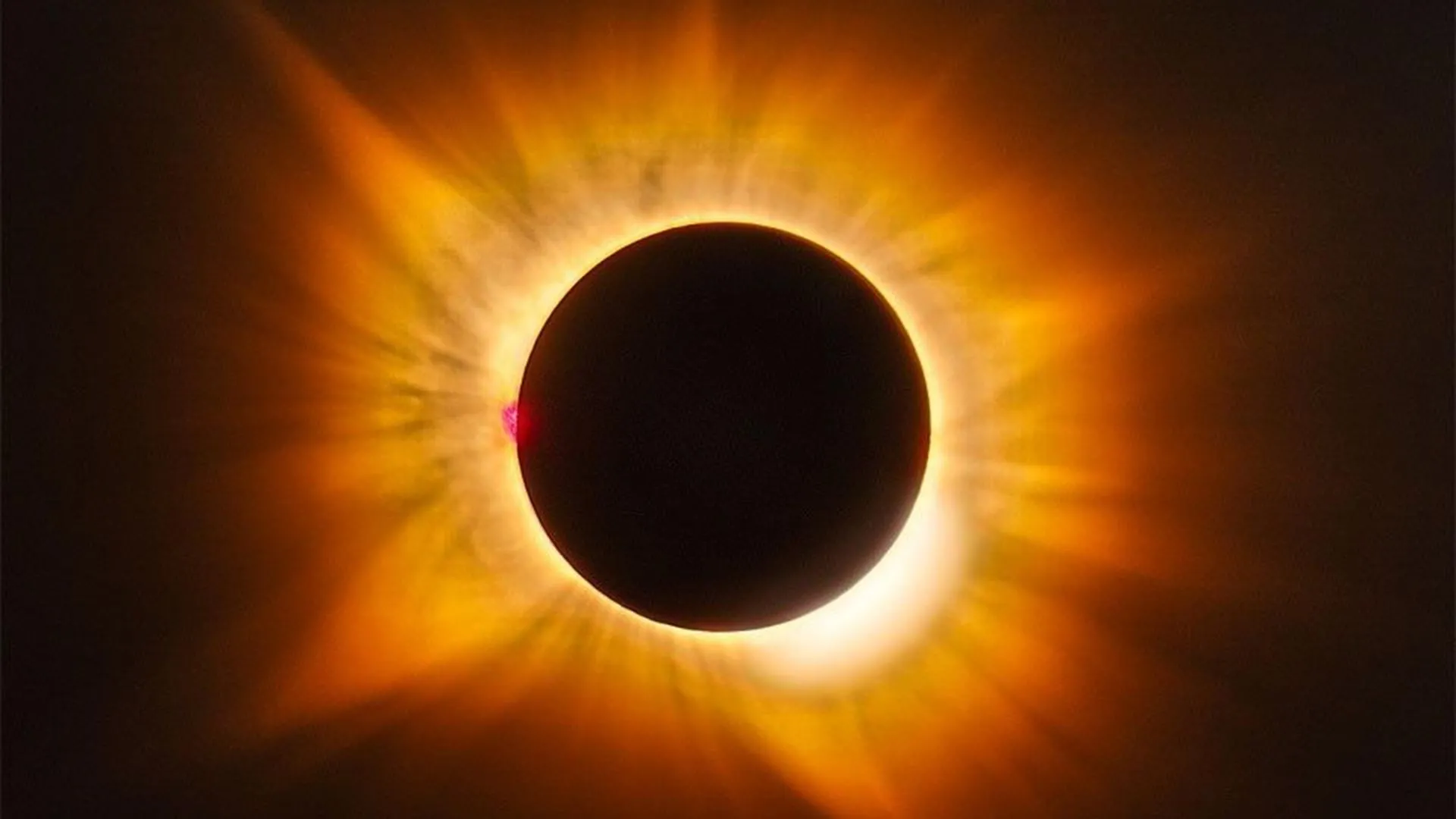
Last week's total solar eclipse offered more than a spectacular view. It also produced an unusual atmospheric effect that gave the Sun's outer atmosphere a striking golden appearance.
During a total solar eclipse, the Moon completely blocks the bright disk of the Sun, making the much fainter solar corona visible. The corona is the Sun's extremely hot outer atmosphere, and during most eclipses it appears white or silvery. Some people watching last week's eclipse did see this familiar pearly color. In Spain, however, observers were treated to something different. The corona took on an unusually rich golden hue.
Why the Eclipse Looked Golden
The timing of the eclipse played an important role. In Spain, totality occurred while the setting Sun was already close to the horizon. When the Sun sits that low in the sky, its light must travel through much more of Earth's atmosphere before reaching an observer.
Along that longer path, molecules in the air scatter shorter wavelengths of visible light, especially blue. This is the same basic process that helps make sunsets appear orange and red. With more blue light removed, the warmer colors that remain become much more noticeable.
Conditions that day added another layer to the effect. An unusually large amount of smoke in the air from nearby forest fires acted like an additional atmospheric filter. Smoke particles scattered even more of the remaining blue wavelengths, intensifying the golden tones in the visible light surrounding the eclipsed Sun.
A Pink Solar Prominence Stood Out
The remarkable featured image was created using multiple exposures and HDR processing. HDR, or high dynamic range imaging, combines exposures with different brightness levels so that both very bright and very faint details can be preserved in a single image. The photograph was captured last week from Benavente, Spain.
Not everything around the Sun was transformed into gold. A large prominence remained visible along the Sun's left edge. Solar prominences are enormous structures of glowing plasma that extend outward from the Sun's surface and are often shaped by powerful magnetic fields.
This prominence emitted strongly in light associated with hydrogen, allowing its original bright pink color to survive despite the atmospheric filtering. Against the unusually golden corona, the vivid pink structure made an already rare eclipse scene even more striking.
Cite This Page: