
Twisted laser light can tell mirror-image molecules apart
- Date:
- July 28, 2026
- Source:
- Tata Institute of Fundamental Research
- Summary:
- Scientists have created twisted laser beams that interact differently with right-handed and left-handed molecules, revealing their identity through the fragments they produce. The approach could provide a faster, simpler, and more sensitive way to analyze important molecules used in chemistry and pharmaceuticals.
- Share:
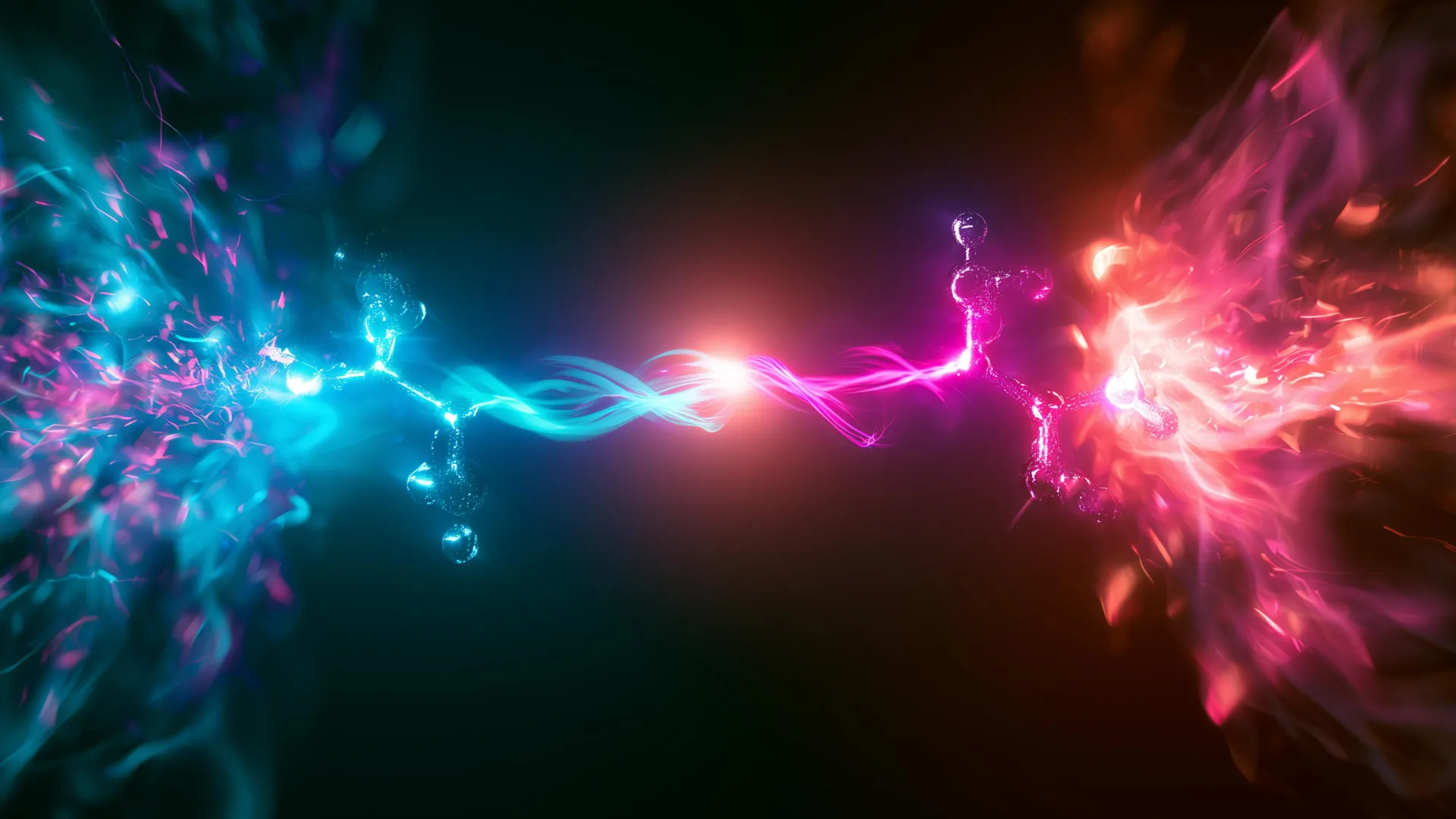
Many molecules come in two forms that are mirror images of one another, much like left and right hands. Although these molecular twins can appear nearly identical, they may behave in dramatically different ways, particularly in living systems and medicines. Telling these enantiomers (also called chiral molecules) apart has remained a major scientific and technological challenge.
One way to understand molecular handedness is to think about a screw and a nut. A right-handed screw fits a right-handed thread, while a left-handed screw does not. Researchers have now shown that specially shaped light can act as a similar type of threaded probe, interacting differently with molecules depending on their handedness.
Giving Laser Light a Twist
Scientists from Tata Institute of Fundamental Research, Indian Institute of Technology Mumbai, and Indian Institute of Technology Hyderabad engineered light that does more than spin. It also twists as it moves forward.
When this structured light strikes a chiral molecule, the interaction changes depending on how the light's "twist" matches the molecule's natural handedness. This creates a measurable difference that can be used to identify which mirror-image form is present.
Breaking Molecules Into Detectable Fragments
The experiments took place at the laser facility at TIFR Hyderabad. Researchers directed ultrashort laser pulses (a few hundred fs) with carefully controlled spin and twist at gaseous samples of R- or S-Camphor, a well-known chiral molecule.
The laser pulses caused the molecules to break into charged fragments. Scientists then examined those fragments with a time-of-flight mass spectrometer, an instrument that identifies ions by measuring how quickly they reach a detector. Lighter fragments arrive sooner than heavier ones.
The team observed a key pattern. The number of fragments produced changed according to the combination of the light's twist and the molecule's handedness. Simply comparing the fragment counts allowed the researchers to tell the two mirror-image forms apart.
A Simpler Way to Detect Molecular Handedness
Conventional methods for detecting chirality often measure extremely small differences in how molecules absorb light. Other techniques track the directions in which electrons are emitted. These approaches can require complicated equipment, precise alignment, angular measurements, or coincidence detection.
The new technique instead identifies chirality directly through ion signals. This reduces the need for complex measurements while also increasing sensitivity.
Studying Molecules Without Outside Interference
The researchers examined molecules in the gas phase, where they were separated from outside influences such as solvents and surfaces. This made it possible to observe the underlying interaction between the structured light and the molecular shape more directly.
The twisted light also strengthened the difference between the two enantiomers. As a result, the signals were larger than those commonly produced by traditional optical methods.
Matching Twisted Light With Chiral Molecules
The results introduce a new way to "match the threads" between light and matter. By using twisted laser beams as probes, scientists may be able to identify molecular handedness more easily and accurately.
The method could create new opportunities in chemistry, biology, and pharmaceutical science. In these fields, selecting the correct enantiomer can be essential because two mirror-image versions of the same molecule may have very different biological or medical effects.
Story Source:
Materials provided by Tata Institute of Fundamental Research. Note: Content may be edited for style and length.
Journal Reference:
- Haritha Venugopal, Parishkrith Aravind, Angitha Sajeevan, Sanket Sen, Abhisek Sinha, Sucharita Giri, Gopal Dixit, Ram Gopal, Vandana Sharma. Enhanced chiral discrimination in mass spectrometry with orbital angular momentum beams. Science Advances, 2026; 12 (23) DOI: 10.1126/sciadv.aec6549
Cite This Page: