
Hundreds of millions at risk as river deltas sink faster than rising seas
- Date:
- April 20, 2026
- Source:
- Virginia Tech
- Summary:
- Many of the world’s largest river deltas—home to hundreds of millions of people—are sinking faster than rising seas, according to a sweeping global study. Using high-resolution satellite radar maps, researchers found that human activities like groundwater pumping, reduced sediment flow, and rapid urban growth are driving widespread land subsidence across 40 major deltas.
- Share:
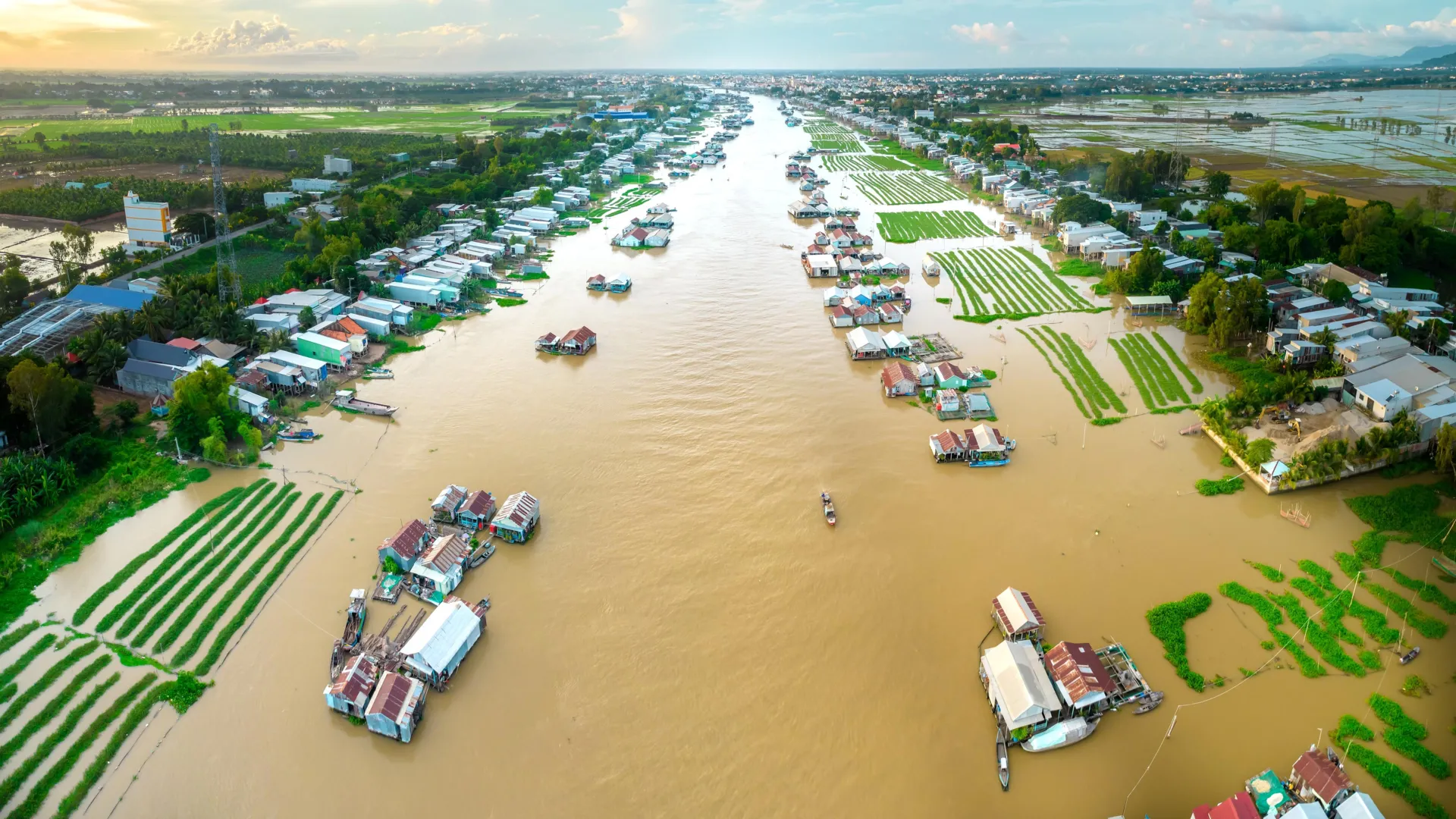
A new study published in Nature finds that many of the world's largest river deltas are subsiding more quickly than global sea levels are rising, putting hundreds of millions of people at potential risk.
The primary drivers behind this trend include intensive groundwater extraction, a decline in sediment carried by rivers, and rapid urban development.
Global Mapping Reveals Widespread Delta Sinking
This research offers the first detailed, high-resolution analysis of elevation loss across 40 river deltas around the world. The project was led by Leonard Ohenhen, a former Virginia Tech graduate student who is now an assistant professor at the University of California, Irvine. The work was overseen by Virginia Tech geoscientists Manoochehr Shirzaei and Susanna Werth.
Results show that almost every delta studied contains areas where the land is dropping faster than nearby sea levels are rising. In 18 of the 40 deltas, this downward movement, known as subsidence, already exceeds local sea-level rise. That trend is increasing near-term flood risk for more than 236 million people.
Satellite Data Tracks Elevation Loss Across Continents
Researchers used advanced satellite radar systems to measure changes in surface elevation across deltas on five continents. The resulting high-resolution maps capture changes at a scale of 75 square meters per pixel, allowing scientists to detect localized patterns of sinking.
Several major deltas are experiencing especially rapid elevation loss, including those of the Mekong, Nile, Chao Phraya, Ganges-Brahmaputra, Mississippi, and Yellow rivers.
"In many places, groundwater extraction, sediment starvation, and rapid urbanization are causing land to sink much faster than previously recognized," Ohenhen said.
In some areas, the rate of sinking is more than double the current global pace of sea-level rise.
Human Activity Driving Accelerated Subsidence
"Our results show that subsidence isn't a distant future problem -- it is happening now, at scales that exceed climate-driven sea-level rise in many deltas," said Shirzaei, co-author and director of Virginia Tech's Earth Observation and Innovation Lab.
The study identifies groundwater depletion as the strongest overall factor linked to delta subsidence, although the main cause varies by region.
"When groundwater is over-pumped or sediments fail to reach the coast, the land surface drops," said Werth, who co-led the groundwater analysis. "These processes are directly linked to human decisions, which means the solutions also lie within our control."
The research was supported by the National Science Foundation, the Department of Defense, and NASA.
Story Source:
Materials provided by Virginia Tech. Note: Content may be edited for style and length.
Journal Reference:
- L. O. Ohenhen, M. Shirzaei, J. L. Davis, A. Tiwari, R. Nicholls, O. Dasho, N. Sadhasivam, K. Seeger, S. Werth, A. J. Chadwick, F. Onyike, J. Lucy, C. Atkins, S. Daramola, A. Ankamah, P. S. J. Minderhoud, J. Oelsmann, G. C. Yemele. Global subsidence of river deltas. Nature, 2026; 649 (8098): 894 DOI: 10.1038/s41586-025-09928-6
Cite This Page: