
Mars dust storms are crackling with electricity
- Date:
- December 29, 2025
- Source:
- CNRS
- Summary:
- Mars isn’t just dusty—it crackles with electricity. Scientists discovered that dust devils can generate tiny electric sparks, captured for the first time by Perseverance’s microphone. These static discharges may rapidly destroy chemicals like methane and reshape how Mars’ atmosphere works. The sparks could even affect climate patterns and pose risks to future missions.
- Share:
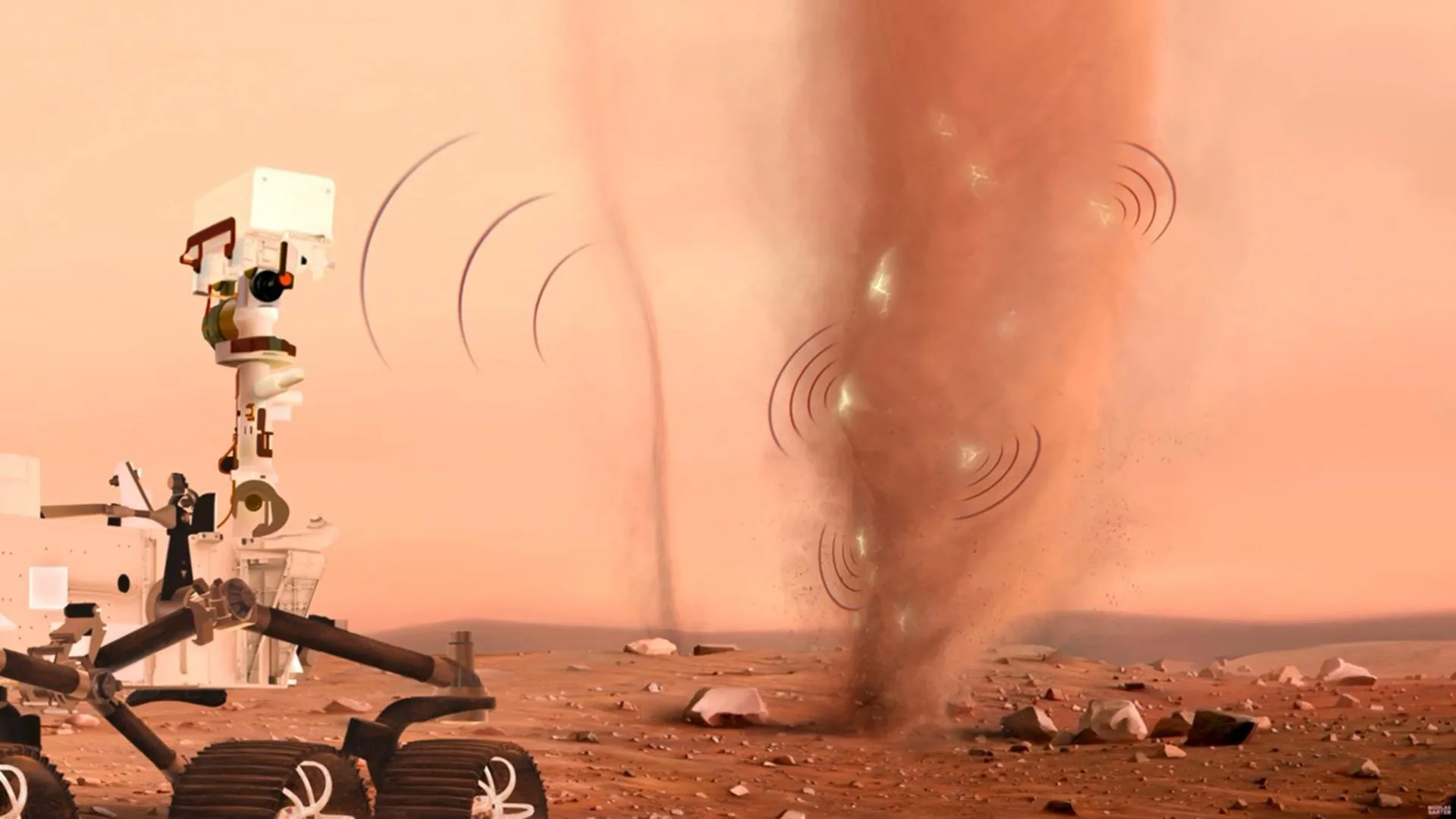
Mars is constantly swept by winds that lift fine dust into spinning whirlwinds known as dust devils. While studying two of these storms, the microphone on the SuperCam instrument aboard NASA's Perseverance rover unexpectedly picked up unusually strong signals. This microphone was the first ever used on Mars. Scientists later realized that the sounds came from the very center of the dust devils.
Researchers from the Institut de recherche en astrophysique et planétologie (CNES/CNRS/Université de Toulouse) and the laboratoire Atmosphères et observations spatiales (CNRS/Sorbonne Université/Université de Versailles Saint-Quentin-en-Yvelines) analyzed the recordings and identified them as both electromagnetic and acoustic signals created by electric discharges. These discharges are similar to the mild static shocks people sometimes feel on Earth after touching a metal object in dry conditions. Although scientists had predicted such activity for decades, this marks the first time electric discharges in the Martian atmosphere have been directly observed.
How Dust Creates Electricity on Mars
The sparks form when countless tiny dust grains collide and rub against one another. This friction causes the particles to collect electrical charges, which are eventually released as short electric arcs only a few centimeters long. These tiny bursts of electricity also generate small shock waves that can be heard.
On Earth, dust particles are known to build up electric charges, especially in deserts, but this process rarely leads to visible or measurable discharges. Mars, however, provides a much more favorable environment. Its atmosphere is extremely thin and composed mostly of carbon dioxide, which means far less electrical charge is needed to trigger sparks than on Earth.
Why These Sparks Matter for Mars Chemistry
The discovery has major implications for how scientists understand the chemistry of Mars' atmosphere. The presence of electric discharges shows that the atmosphere can reach charge levels high enough to speed up the creation of highly oxidizing compounds. These reactive substances can break down organic molecules on the surface and alter many atmospheric chemicals.
This process may help explain a long standing mystery on Mars: the rapid disappearance of methane. Methane has been detected repeatedly, but it vanishes faster than existing models can explain. Electrically driven chemical reactions could be destroying it more quickly than expected.
Impacts on Climate and Future Missions
Electrical charging inside dust storms may also influence how dust moves across the planet. Since dust plays a key role in shaping Martian weather and climate, these effects could be central to understanding atmospheric behavior that remains poorly understood.
There are also practical concerns. Electrical discharges could interfere with sensitive electronics aboard robotic spacecraft and may pose hazards for future human missions if not properly managed.
Listening to Mars for New Discoveries
The SuperCam microphone aboard NASA's Perseverance rover recorded the first ever sounds from Mars in 2021, just one day after landing. Operating daily since then, it has captured more than 30 hours of audio from the planet, including wind gusts, the spinning blades of the Ingenuity helicopter, and now the sounds linked to electric discharges.
These findings highlight how powerful sound recordings can be for exploring other worlds. By listening closely, scientists are uncovering hidden processes that would otherwise remain invisible.
Story Source:
Materials provided by CNRS. Note: Content may be edited for style and length.
Journal Reference:
- Baptiste Chide, Ralph D. Lorenz, Franck Montmessin, Sylvestre Maurice, Yann Parot, Ricardo Hueso, German Martinez, Alvaro Vicente-Retortillo, Xavier Jacob, Mark Lemmon, Bruno Dubois, Pierre-Yves Meslin, Claire Newman, Tanguy Bertrand, Grégoire Deprez, Daniel Toledo, Agustin Sánchez-Lavega, Agnès Cousin, Roger C. Wiens. Detection of triboelectric discharges during dust events on Mars. Nature, 2025; 647 (8091): 865 DOI: 10.1038/s41586-025-09736-y
Cite This Page: