
New research uncovers a surprisingly cheap way to farm kelp offshore
- Date:
- December 11, 2025
- Source:
- University of Maine
- Summary:
- A new economic modeling tool is helping Maine kelp farmers identify cost-saving strategies with remarkable precision. By analyzing farm design, weather, vessel types, and processing methods, it highlights how decisions ripple through overall profitability. When tested, the tool demonstrated that simple redesigns and mechanization could dramatically reduce production costs. Its findings could reshape the future of offshore kelp farming.
- Share:
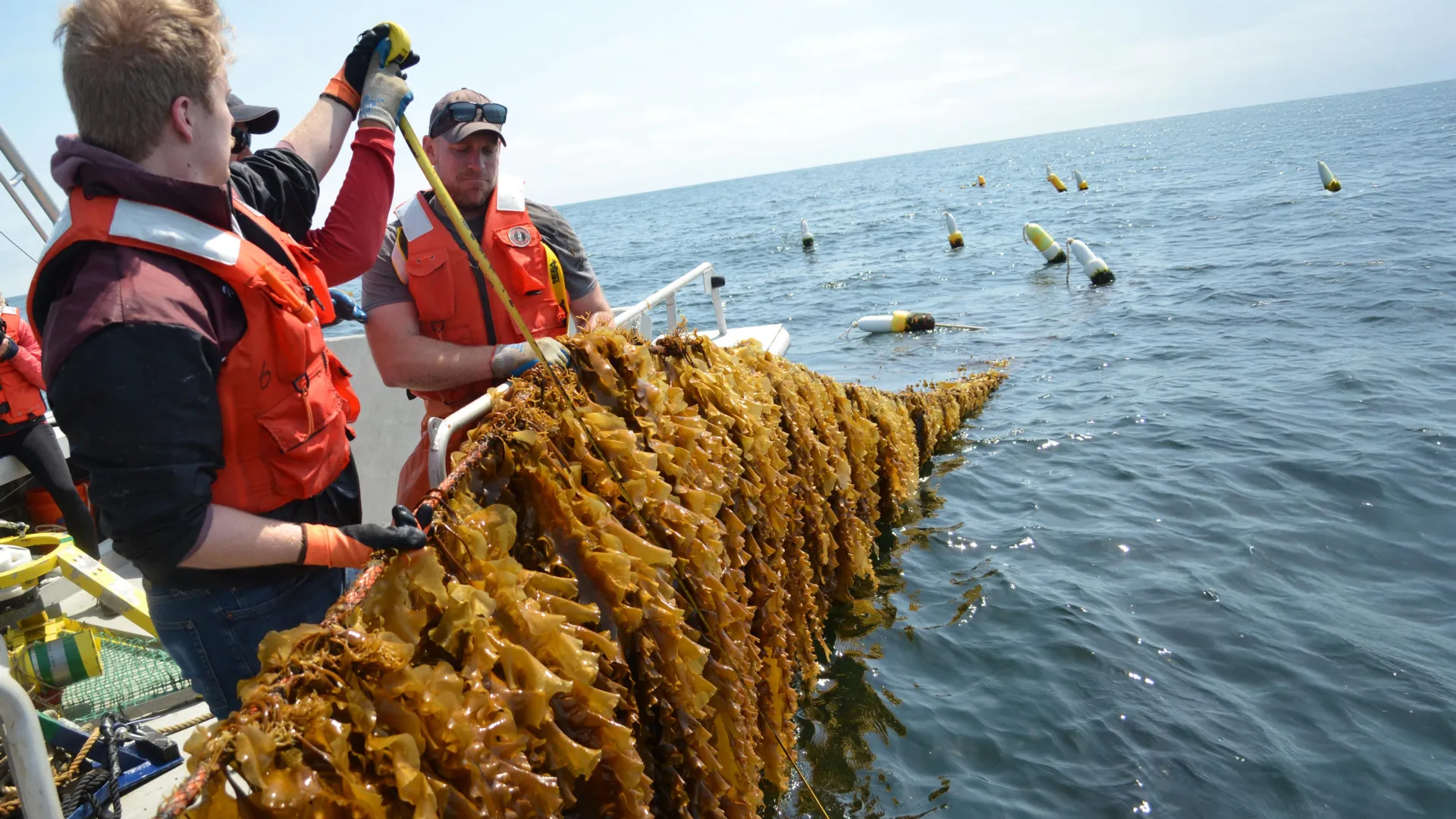
In Maine, growing kelp for use in foods, cosmetics, fertilizer additives and other products is rapidly expanding, but it remains expensive to do. For many new growers, one of the biggest challenges is the lack of reliable cost analysis tools that can guide spending decisions and help them build sustainable business plans.
To address this gap, researchers from Kelson Marine in Portland, Maine and the University of Maine created a tool that gives kelp farmers detailed economic analyses and highlights strategies to lower the cost of farmed seaweed. The model factors in differences in site selection, weather patterns, crop size and many other scenario specific details. It is designed for both nearshore and offshore operations, including large farms in the Gulf of Maine that sit fully exposed to nor-easter driven waves.
Project lead Zach Moscicki, an ocean engineer with Kelson Marine, described how the tool is meant to be used. "By using this tool to investigate the comprehensive implications of any given farm design or operational decision, we can help kelp farmers meaningfully reduce production costs and achieve economic sustainability," said project lead Zach Moscicki, ocean engineer with Kelson Marine. "The tool allows us to carefully navigate the multitude of tradeoffs associated with any such decision and avoid leaning into overly narrow-scoped improvements that may reduce costs in one way, but increase costs or reduce production via some other indirect but connected pathway."
Modeling real world kelp farming conditions
The model pulls together a wide range of information from each farming scenario, such as site specific ocean and weather conditions, crop traits and growth patterns for different kelp species, vessel types and sizes, labor setups, technologies used in daily operations, nearby shore-side infrastructure, maintenance schedules and more.
By showing how all of these elements combine to affect overall profitability, and how different farm layouts and operating choices interact with each other, the tool offers kelp farmers insight into the true impact of cost saving ideas. Possible changes include processing or storing kelp on board vessels, or adding equipment that allows crews to work more quickly.
Testing the model on offshore sugar kelp
To see how the model performs, the team applied it to a hypothetical sugar kelp operation covering 1000 acres, located about 12 miles offshore in water that is 330 feet deep. They ran multiple scenarios, comparing different farm layouts and operational approaches, to understand how each choice would affect farming at this challenging site.
The model showed that running a kelp farm designed simply for low construction costs and high output would result in production costs of $2618 per tonne of fresh kelp. When the researchers systematically tested alternative design and operational choices with the tool, they identified a combination of improvements that cut the projected cost of production by 85% to $383 per tonne of fresh kelp. Among the most effective changes were installing deeper cultivation lines, using mechanized equipment for seeding and harvesting, processing kelp on site into a slurry, adjusting vessel sizes and choosing different types of vessels.
The Kelson Marine and UMaine team worked with scientists from the University of New Hampshire, Woods Hole Oceanographic Institute and Vertical Bay Maine to support the effort.
Publication, outreach and research support
The framework behind the tool and the results from the case study are described in Algal Research. Kelp growers in Maine and elsewhere who are interested in having their operations analyzed with the tool can contact Moscicki at [email protected].
Funding for this work came from Conscience Bay Research, The Builders Initiative and Fiscal Year 2024 Congressionally Directed Spending secured by U.S. Sens. Susan Collins, chair of the Senate Appropriations Committee, and Angus King through the U.S. Small Business Administration. Structural analysis tools developed and tested under the U.S. Department of Energy's Advanced Research Projects Agency-Energy Macroalgae Research Inspiring Novel Energy Resources (ARPA-e MARINER) program were also used in the study.
Advancing Maine's blue economy
The new tool is part of a broader pattern of activity in which UMaine students and faculty are helping to sustain and expand the state's blue economy, the group of industries that draw on ocean resources to support economic growth while protecting the environment.
Through new technologies and workforce development efforts, the university is expanding understanding of ecological and socioeconomic changes that influence coastal communities and businesses in Maine. Faculty members and students are also investigating opportunities for emerging markets and sectors connected to the sea.
"What is exciting about this new model is that it is the most comprehensive and detailed cost analysis of offshore kelp growth in the U.S. to date," said Damian Brady, professor of marine sciences at UMaine. "And this type of analysis helps us find pain points where investments in technology can rapidly change the cost-benefit analysis."
Story Source:
Materials provided by University of Maine. Note: Content may be edited for style and length.
Journal Reference:
- Zachary Moscicki, Adam T. St. Gelais, Struan Coleman, Alexander Kinley, Tobias Dewhurst, Scott Lindell, David W. Fredriksson, Damian C. Brady. Comprehensive quantification of production costs for large-scale kelp aquaculture and cost reduction opportunities. Algal Research, 2025; 92: 104383 DOI: 10.1016/j.algal.2025.104383
Cite This Page: