
This surprising discovery rewrites the Milky Way’s origin story
- Date:
- December 9, 2025
- Source:
- Royal Astronomical Society
- Summary:
- New simulations of Milky Way-like galaxies reveal that the strange split between two chemically distinct groups of stars may arise from several very different evolutionary events. Bursts of star formation, shifts in flowing gas, and even streams of metal-poor material from a galaxy’s outskirts can all create this double pattern. The findings challenge the long-held assumption that a major ancient collision caused the split.
- Share:
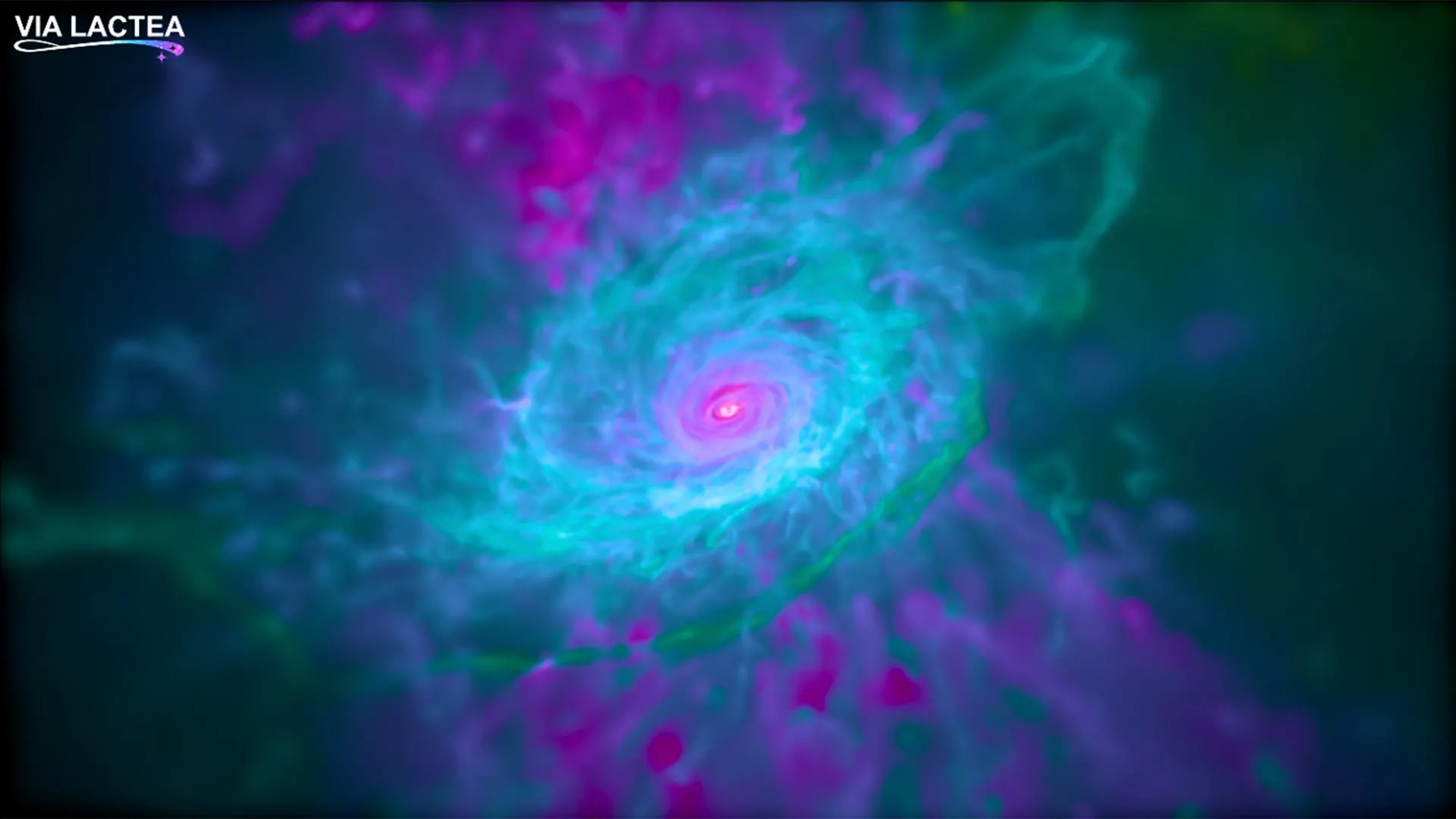
A new investigation is offering fresh insight into how galaxies like the Milky Way take shape, evolve over time, and develop unexpected chemical patterns in their stars.
Published in Monthly Notices of the Royal Astronomical Society, the study examines the origin of a long-standing mystery within the Milky Way: two clearly defined groups of stars with different chemical signatures, a feature known as the "chemical bimodality."
When researchers look at stars located near the Sun, they consistently identify two major categories based on the relative amounts of iron (Fe) and magnesium (Mg) they contain. These categories create two separate "sequences" on chemical plots, even though they overlap in metallicity (how rich they are in heavy elements like iron). This unusual split has puzzled astronomers for years.
Simulations Reveal How the Chemical Split May Form
To investigate why this structure appears, researchers from the Institute of Cosmos Sciences of the University of Barcelona (ICCUB) and the Centre national de la recherche scientifique (CNRS) used advanced computer models (called the Auriga simulations) to recreate the formation of Milky Way-like galaxies inside a virtual universe. By examining 30 simulated galaxies, the team searched for processes that might shape these chemical sequences.
Gaining a clearer picture of the Milky Way's chemical development helps scientists understand how our galaxy, along with others, assembled over cosmic time. This includes Andromeda, the Milky Way's nearby companion galaxy, where no similar chemical bimodality has been identified so far. Insights from this work also shed light on early-universe conditions and the roles of gas flows and past mergers.
"This study shows that the Milky Way's chemical structure is not a universal blueprint," said lead author Matthew Orkney, a researcher at ICCUB and the Institut d'Estudis Espacials de Catalunya (IEEC).
"Galaxies can follow different paths to reach similar outcomes, and that diversity is key to understanding galaxy evolution."
Multiple Routes to the Milky Way's Dual Chemical Structure
The results indicate that galaxies resembling the Milky Way can form two distinct chemical sequences through several different pathways. One possibility is a cycle of intense star formation followed by calmer periods. Another involves variations in the gas streaming into a galaxy from its surroundings.
The study also challenges an earlier explanation involving a smaller galaxy known as Gaia-Sausage-Enceladus (GSE). While this past collision influenced the Milky Way, the simulations show it is not required to produce the chemical split. Instead, metal-poor gas from the circumgalactic medium (CGM) appears to play a central role in creating the second branch of stars.
The researchers found that the specific shape of the two chemical sequences is tightly connected to the galaxy's star formation history.
New Observations Will Help Test These Predictions
As observatories such as the James Webb Space Telescope (JWST) and future missions like PLATO and Chronos gather more precise data, scientists will be able to test these simulation predictions and refine models of how galaxies evolve.
"This study predicts that other galaxies should exhibit a diversity of chemical sequences. This will soon be probed in the era of 30m telescopes where such studies in external galaxies will become routine," said Dr. Chervin Laporte, of ICCUB-IEEC, CNRS-Observatoire de Paris and Kavli IPMU.
"Ultimately, these will also help us further refine the physical evolutionary path of our own Milky Way."
Story Source:
Materials provided by Royal Astronomical Society. Note: Content may be edited for style and length.
Journal Reference:
- Matthew D A Orkney, Chervin F P Laporte, Robert J J Grand, Volker Springel. The Milky Way in context: the formation of galactic discs and chemical sequences from a cosmological perspective. Monthly Notices of the Royal Astronomical Society, 2026; 545 (1) DOI: 10.1093/mnras/staf1551
Cite This Page: