
A massive Bronze Age city hidden for 3,500 years just surfaced
Semiyarka uncovers a hidden Bronze Age powerhouse where steppe nomads forged an advanced urban and industrial civilization.
- Date:
- December 5, 2025
- Source:
- University College London
- Summary:
- An immense Bronze Age settlement has emerged from the Kazakh Steppe, revealing a surprisingly urban and industrial society where archaeologists once expected nomadic camps. At Semiyarka, researchers uncovered massive residential compounds, a possible ceremonial or administrative building, and an entire industrial zone dedicated to producing tin bronze—an extremely rare discovery for the region. The site’s strategic perch above trade routes and mineral-rich mountains suggests it was a major hub of exchange, craftsmanship, and power.
- Share:
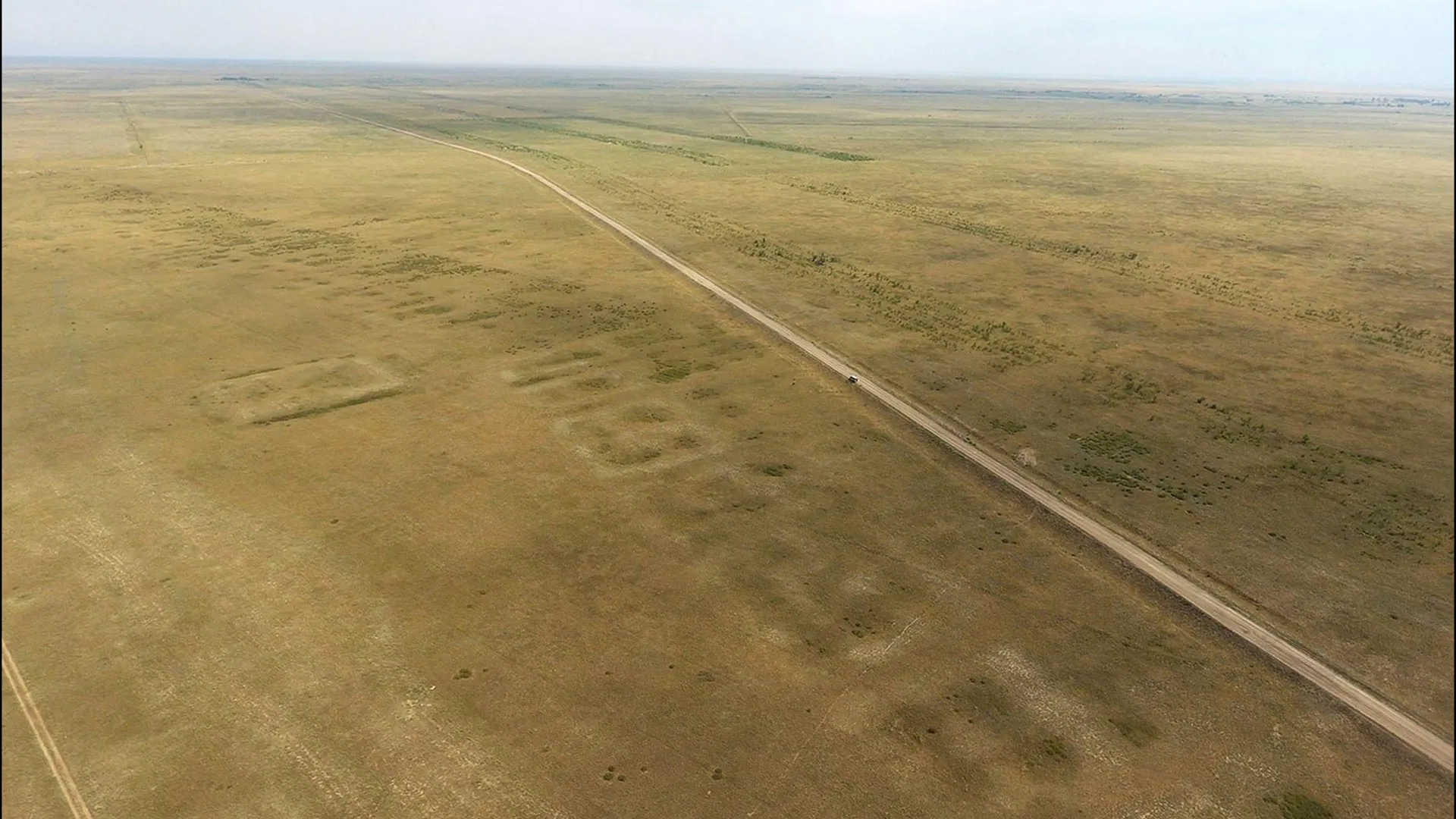
An international team of archaeologists co-led by researchers from UCL has uncovered the remains of a vast Bronze Age settlement on the Kazakh Steppe. More than 3,500 years ago, this site likely served as a key regional center for large-scale bronze production, making it one of the most important industrial hubs of its time in this part of Eurasia.
Published in Antiquity Project Gallery and co-led by Durham University and Kazakhstan's Toraighyrov University, the new study presents the first comprehensive archaeological survey of Semiyarka, a carefully planned settlement covering about 140 hectares. It is the largest known ancient site of its kind in the region. Although researchers at Toraighyrov University first identified Semiyarka in the early 2000s, it has only recently been studied in detail. Dating to around 1600 BC, the settlement provides a rare glimpse of a period when local nomadic groups began to form permanent, urban-style communities.
Lead author Dr. Miljana Radivojević (UCL Archaeology) said: "This is one of the most remarkable archaeological discoveries in this region for decades. Semiyarka changes the way we think about steppe societies. It shows that mobile communities could build and sustain permanent, organized settlements centered on a likely large-scale industry -- a true 'urban hub' of the steppe."
Planned Homes and a Mysterious Central Structure
What survives of this ancient city today includes two long rows of rectangular earthen mounds, each about a meter high. These low ridges once formed the foundations of enclosed houses with several rooms. Close by, archaeologists identified the remains of a much larger central building, roughly twice the size of the surrounding homes.
The function of this central structure is still uncertain. It may have been used for rituals, could have served as a shared gathering place, or might have been the residence of an influential family or community leader.
The sheer size and long-term nature of the settlement came as a surprise. Scholars had previously believed that people living in this region at the time were mostly semi-nomadic, moving between temporary camps or occupying only small villages.
Co-author Professor Dan Lawrence of Durham University said: "The scale and structure of Semiyarka are unlike anything else we've seen in the steppe zone. The rectilinear compounds and the potentially monumental building show that Bronze Age communities here were developing sophisticated, planned settlements similar to those of their contemporaries in more traditionally 'urban' parts of the ancient world."
Major Tin Bronze Production Center
Semiyarka appears to have been a leading center for tin bronze production in the region, an unusually well-preserved example for the Eurasian Steppe. At the southeastern edge of the settlement, the team uncovered signs of a dedicated industrial zone focused on tin bronze metallurgy, the key alloy that defined much of the Bronze Age.
Excavations and geophysical surveys in this area revealed crucibles, slag, and tin bronze artifacts. Together, these finds provide the first clear evidence that metallurgists at Semiyarka were running complex production systems rather than only small, scattered workshops.
Currently, little is known about tin bronze production in the Eurasian Steppe during the Bronze Age, even though museum collections hold hundreds of thousands of tin bronze artifacts from the region. Only one other site in eastern Kazakhstan, the Late Bronze Age mining settlement of Askaraly, has previously been directly associated with tin bronze production.
Semiyarka, by contrast, displays a whole sector of the settlement set aside for making tin bronze. This suggests a highly organized industry, possibly restricted or carefully managed, centered on this valuable alloy. The researchers hope that further work at the site will reveal much more about ancient production methods that remain poorly understood.
Strategic River Promontory and Metal-Rich Hinterland
The city occupies a promontory overlooking the Irtysh River in northeastern Kazakhstan and was first recorded in the early 2000s. Its name, Semiyarka, translates as "Seven Ravines," referring to the network of valleys spread out below the site.
This elevated position and river access indicate that Semiyarka likely served as both a regional power center and an important node of exchange. The settlement is also close to copper and tin deposits in the nearby Altai Mountains, which would have supplied the key raw materials needed for its bronze production.
Co-author Dr. Viktor Merz of Toraighyrov University in Kazakhstan, who originally discovered the site, said: "I have been surveying Semiyarka for many years with the support of Kazakh national research funding, but this collaboration has truly elevated our understanding of the site. Working with colleagues from UCL and Durham has brought new methods and perspectives, and I look forward to what the next phase of excavation will reveal now that we can draw on their specialist expertise in archaeometallurgy and landscape archaeology."
Ancient Peoples, Trade Networks, and Future Research
Analysis of finished metal objects and pottery fragments suggests that the settlement was mainly inhabited by the Alekseevka-Sargary people, one of the earliest groups in the region known to build permanent houses within established settlements.
Some artifacts, however, resemble items associated with the Cherkaskul people, a group believed to have led a more mobile lifestyle across the wider region. These finds indicate that the inhabitants of Semiyarka probably interacted and traded with Cherkaskul communities and other neighboring groups.
The research team aims to investigate how Semiyarka's residents organized production and trade with surrounding communities, and to study the environmental effects of their activities. In addition, they have identified several nearby burial grounds and short-term camps dating to the same period, which could offer further clues about social life, mobility, and belief systems in the ancient steppe.
The research was funded by the British Academy, Kazakh Ministry for Science and Higher Education and the ERC awarded/UKRI-funded DREAM Project.
Story Source:
Materials provided by University College London. Note: Content may be edited for style and length.
Journal Reference:
- Miljana Radivojević, Dan Lawrence, Victor K. Merz, Ilya V. Merz, Elena Demidkova, Mark Woolston-Houshold, Richie Villis, Peter J. Brown. A major city of the Kazakh Steppe? Investigating Semiyarka’s Bronze Age legacy. Antiquity, 2025; 1 DOI: 10.15184/aqy.2025.10244
Cite This Page: