
A giant crater may reveal the origin of Mars’ doomed moon
- Date:
- September 19, 2026
- Source:
- Universe Today
- Summary:
- A massive crater on Mars’ moon Phobos may hide a dense region of compressed material that could reveal whether the moon is a captured asteroid or debris from an ancient impact on Mars. Japan’s upcoming MMX sample return mission could provide the measurements and physical evidence needed to solve the mystery.
- Share:
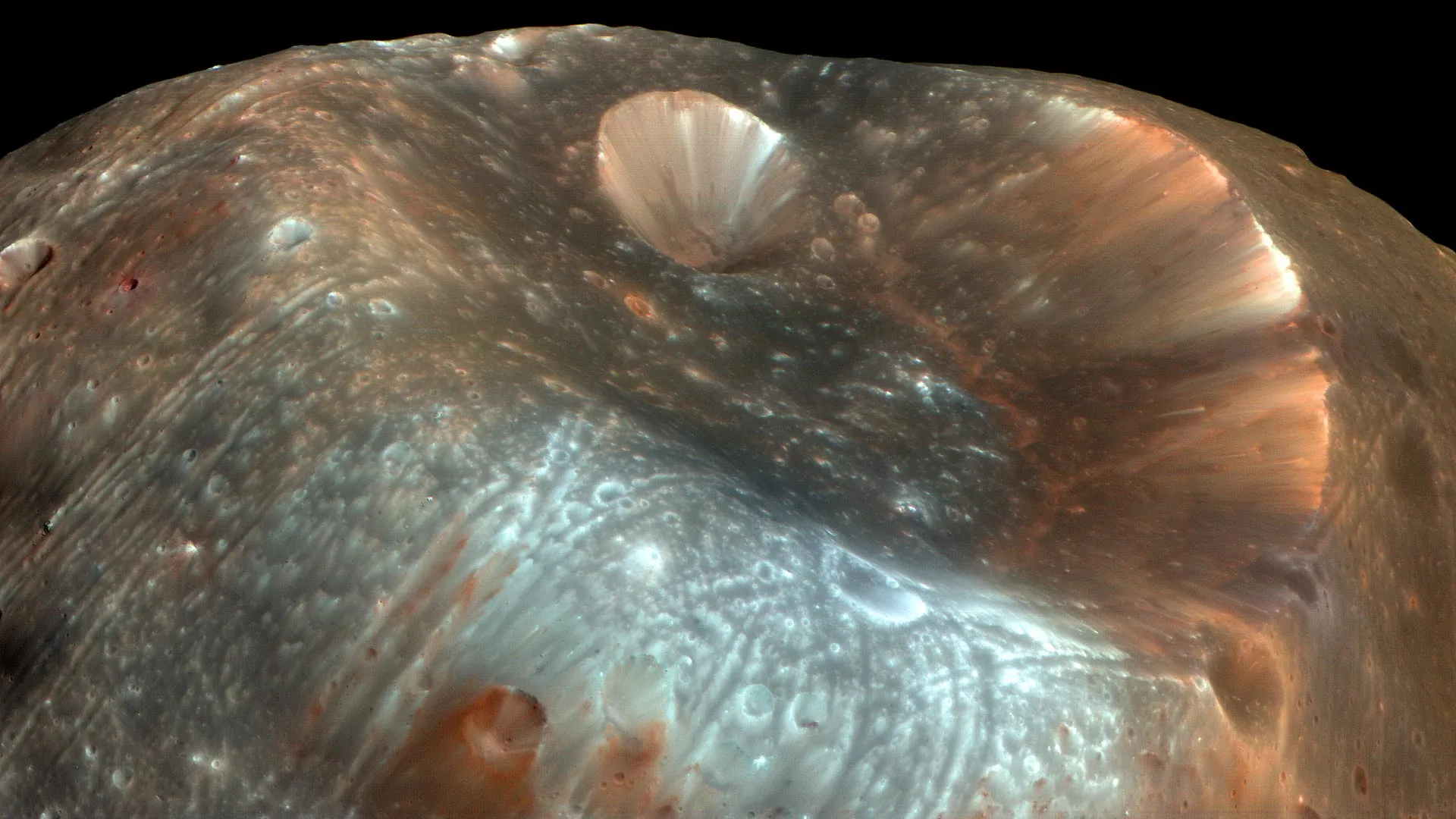
Mars' innermost moon, Phobos, has puzzled planetary scientists for decades. One of the biggest unanswered questions is where it came from. Some researchers think Phobos is an asteroid that was captured by Mars, while others argue that it formed from debris thrown into orbit after a massive object slammed into the planet.
Solving that mystery may depend on something scientists still know surprisingly little about: what Phobos looks like on the inside.
Researchers are now trying to narrow down the possibilities by studying subtle characteristics of the moon, including its gravity and motion. At the recent European Geosciences Union general assembly in Vienna, scientists presented work modeling these geophysical measurements around one of Phobos' most dramatic features, Stickney Crater.
Stickney Crater Could Hold a Key Clue
The enormous Stickney Crater is central to the debate over Phobos' history. If Phobos formed from debris created by a giant impact on Mars, the collision that produced the 9 km (5.6 mile) diameter crater may have occurred roughly 4.2 billion years ago. If Phobos was instead captured as an asteroid, the Stickney impact could have happened much later, around 2.6 billion years ago.
Current estimates suggest that Phobos has a porous interior that may contain water ice, according to Benjamin Haser and co-author Thomas Andert in a 2026 paper published in The Monthly Notices of the Royal Astronomical Society (MNRAS).
One promising way to investigate those possibilities is to map Phobos' gravity in greater detail. The researchers are particularly interested in whether the Stickney impact created a concentrated region of denser material beneath the crater.
The Stickney event is one of the most important episodes in Phobos' history, and learning more about it could help scientists determine where the moon came from, Haser, a doctoral student in planetary science at Germany's Universität der Bundeswehr München, told me in Vienna.
Phobos Is More Than a Rock in Orbit
Phobos is small and strangely shaped, but Haser says it should not be viewed as simply a 'rock in orbit.'
The moon has a mean diameter of only 22.2 km (13.8 miles) and races around Mars once every 7 hours and 39 minutes.
Scientists have developed two main explanations for its origin.
Under one scenario, a giant object struck Mars and blasted material into orbit. That debris eventually formed a disc around the planet and later produced Mars' two moons, Phobos and Deimos, Haser and Andert write in their MNRAS paper.
The competing idea is that the moons began as asteroids and were later captured by Mars' gravity. Their spectral properties, along with models of asteroid capture, provide support for that possibility, according to the researchers.
Understanding Phobos' gravitational field is therefore a critical step toward learning how mass is distributed inside the moon and, in turn, determining how it formed. Haser noted in his EGU 26 paper that current estimates point to a porous interior, possible water ice, and a denser concentration of material near Phobos' equatorial region.
Could Phobos Be Like a Giant Sponge?
Stickney Crater raises another difficult question. An impact large enough to create such an enormous scar might be expected to destroy a moon as small as Phobos.
Haser says survival may have been possible if the moon had an unusually low and relatively uniform density, allowing it to absorb the impact somewhat like a sponge.
"You would assume that such an impact would have shattered Phobos, unless it has a very low homogeneous density, like a sponge that can absorb that kind of impact," says Haser.
The collision also would have generated intense heat around the impact site.
"And at that impact region, there must be very high temperature that melted and compressed the stone beneath it," he says.
That compression could have left behind a denser region below Stickney Crater, creating a subtle gravitational signature that scientists may be able to detect.
A Possible Rubble Pile Asteroid
Haser says several characteristics of Phobos fit well with the captured asteroid explanation. In particular, the moon's irregular appearance resembles what scientists call a rubble pile asteroid, an object made from many pieces of rock held together relatively loosely by gravity.
But fitting all the evidence into one explanation remains difficult.
Phobos' present-day gravity field, shape, density, spectral properties, and changing orbit must all be reconciled within a single geophysical model. Its highly irregular shape and extreme proximity to Mars make interpreting its gravity and internal structure especially challenging.
In the paper, we investigate how a compressed mass beneath Stickney crater affects the tiny moon's gravitational signal, moments of inertia, and libration amplitude (essentially how Phobos wobbles and oscillates), says Haser.
Those tiny changes in Phobos' movement could ultimately reveal how material is arranged inside the Moon.
University Student Graduation
Phobos is unusual not only because of its mysterious past, but also because of what is happening to it today.
Its orbit is extremely close to Mars, and the moon is gradually spiraling inward. Eventually, it is expected either to break apart or collide with the planet.
"Phobos' orbit is dynamically very special; it is very close to Mars, slowly spiraling inward, and will eventually be disrupted or impact Mars," says Haser.
That makes Phobos both a preserved record of events billions of years ago and a moon that is continuing to change.
"This means that Phobos is not only a record of the past, but also an actively evolving geophysical system," he says.
University Student Graduation
Scientists may soon get their best opportunity yet to investigate Phobos directly.
Japan's upcoming Martian Moons Exploration (MMX) mission, targeted to launch in late 2026, is designed to study Phobos and return samples of its surface to Earth. The spacecraft will attempt to operate in a quasi-stable orbit around the tiny moon, an unusually difficult maneuver because Phobos does not offer the kind of stable orbital environment found around larger worlds.
As Haser points out, there truly is no stable orbit around Phobos.
Part of the difficulty comes from Mars itself. Phobos' own gravitational field is extremely weak compared with the much stronger gravitational pull of the planet nearby.
"Phobos' gravity field is strongly overshadowed by Mars' gravity field," says Haser.
Despite those challenges, the MMX spacecraft is expected to use two systems to gather material from Phobos.
One core sampler will collect material from depths of up to 2 cm. A second system, a pneumatic sampler (being contributed by NASA), will fire pressurized gas at the surface to "loft material into a sample container," according to the Japanese Space Agency (JAXA).
The collected samples are expected to return to Earth by mid 2031 inside a capsule designed to survive re-entry through Earth's atmosphere.
The Bigger Mystery Inside Phobos
As for what Haser finds most puzzling about Phobos?
The biggest question is not simply what materials make up the moon. Scientists also need to determine what kind of internal structure could account for all of its unusual characteristics at once.
For Haser, answering that question will be essential for distinguishing among the competing explanations for Phobos' birth, including asteroid capture, formation from debris created by a giant impact on Mars, or perhaps a more complicated origin involving elements of more than one scenario.
Story Source:
Materials provided by Universe Today. Original written by Bruce Dorminey. Note: Content may be edited for style and length.
Journal Reference:
- Benjamin Haser, Thomas Andert. Stickney’s impact on Phobos geophysical observables. Monthly Notices of the Royal Astronomical Society, 2026; 548 (4) DOI: 10.1093/mnras/stag753
Cite This Page: