
This tiny organism can shrink to one quarter its size in milliseconds
- Date:
- September 19, 2026
- Source:
- North Carolina State University
- Summary:
- A single-celled organism can shrink to one-quarter of its length in milliseconds using a remarkable calcium-powered protein “fishnet.” Scientists hope its unusual machinery could inspire artificial muscles capable of moving far faster than today’s designs.
- Share:
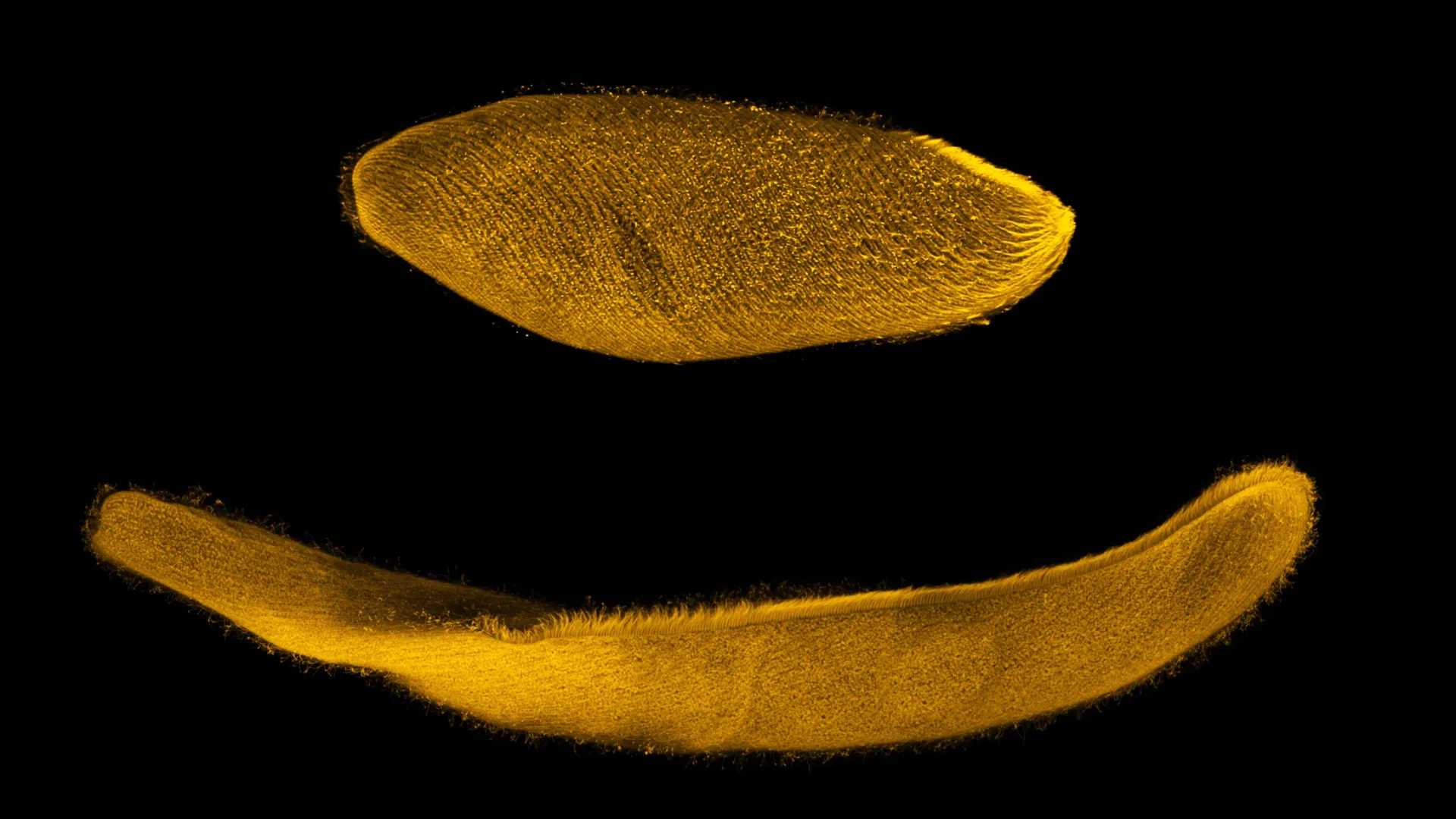
A tiny aquatic organism made of just one cell can compress its body to one quarter of its original length in under five milliseconds, hundreds of times faster than a person can blink. Scientists have now identified the unusual mechanism behind this remarkable movement.
The organism, Spirostomum ambiguum, relies on calcium ions and a specialized protein network arranged like a fishnet. This system allows it to contract far more quickly than human muscle, and researchers say the discovery could eventually help guide the development of faster artificial muscles and synthetic cellular machinery.
A Single Cell With Extraordinary Speed
Spirostomum ambiguum is a giant single-celled ciliate, named for the fringe of hairlike cilia it uses to swim. Among ciliates, it stands out for its ability to contract at roughly 100 body lengths per second and then rapidly repeat the movement. Scientists think this behavior may help the organism escape predators or communicate with other ciliates.
Human muscle fibers can shorten by comparable proportions, but the process takes about 10 times longer. That difference has made Spirostomum especially interesting to researchers who want to understand the machinery that makes its extreme speed possible.
"The difference between what Spirostomum can do and what we can do comes down to what is powering the contraction, and what the machinery behind it looks like," says Mary Elting, associate professor of biophysics at North Carolina State University and co-corresponding author of the work. "If we can understand those processes, it could help us build synthetic systems that mimic the speed and power of this single-celled organism."
A Protein Network That Works Like a Fishnet
Using electron and immunofluorescence microscopy, the research team examined Spirostomum in detail. They found that calcium ions initiate the contraction, while an unusual fishnet-like structure carries out the movement.
Unlike animals, single-celled organisms such as Spirostomum do not have muscle fibers. Instead, they contain fibrous structures called myonemes. These structures are made from the calcium-binding proteins centrin and Sfi1.
In Spirostomum, the myonemes form a fishnet-shaped web around the outside of the organism. Once contraction begins, this network tightens inward and then returns to its original configuration.
"The fishnet geometry is unique because it lets Spirostomum contract uniformly, which protects is internal organelles (single cells' versions of organs) while it moves so quickly," Elting says. "It works because the Sfi1 protein in the myoneme can shift from stiff to flexible. In the presence of calcium ions Sfi1 loses its stiffness and clumps up like a ball of wet spaghetti, which causes the fishnet to pull tight, shrinking the organism."
A Very Different Way to Power Movement
Human muscles use adenosine triphosphate, or ATP, to store and release the energy needed for contraction. Spirostomum appears to rely on a fundamentally different process.
"Comparing the way our muscles contract to the way Spirostomum works is like comparing gas to electric power," Elting says. "ATP undergoes a chemical change and gets 'burned up,' like gasoline, whereas calcium ions act like an electrical current, although we still don't know what produces the voltage that starts the current, or how it gets 'reset' so contraction can happen again."
That ability to reset remains one of the major unanswered questions. The researchers now want to determine more precisely how calcium triggers the contraction and how the organism prepares itself to repeat the process.
"We would expect calcium-triggered reactions to be 'one shot,' but Spirostomum can do it repeatedly," Elting says. "Understanding those aspects of its motion are the keys to building a fast-moving, ATP-independent artificial muscle."
Toward Faster Artificial Muscles
The findings could provide useful clues for engineers seeking to build artificial muscles that move quickly without depending on ATP. By understanding how Spirostomum repeatedly triggers and resets its calcium-driven contraction system, researchers hope to uncover principles that could be adapted for synthetic devices.
The research appears in Proceedings of the National Academy of Sciences and was supported by the National Science Foundation under award numbers 1935260, 2313722, 2313724, 1935262, 1817334, 2313727 and 2313725, and by NIGMS of the National Institutes of Health under award numbers R35GM130327 and R35GM142588.
Co-corresponding authors of the work are Aaron Dinner, professor of chemistry at the University of Chicago; Jerry Honts, the Marshall and Judith Flapan Professor of Biology at Drake University; and Saad Bhamla, associate professor of chemical and biological engineering at the University of Colorado at Boulder.
Other NC State contributors are former Ph.D. student and first author Joseph Lannan, and Research Assistant Professor Peter Thompson. Carlos Floyd and Suriyanarayanan Vaikuntanathan from the University of Chicago; L.X. Xu from the Georgia Institute of Technology; and Connie Yan and Wallace Marshall from the University of California San Francisco also contributed to the work.
Story Source:
Materials provided by North Carolina State University. Original written by Tracey Peake. Note: Content may be edited for style and length.
Journal Reference:
- Joseph Lannan, Carlos Floyd, L. X. Xu, Peter M. Thompson, Connie Yan, Wallace F. Marshall, Suriyanarayanan Vaikuntanathan, Aaron R. Dinner, Jerry E. Honts, Saad Bhamla, Mary Williard Elting. A centrin–Sfi1 myoneme fishnet powers ultrafast calcium-triggered contraction in the giant ciliate Spirostomum ambiguum. Proceedings of the National Academy of Sciences, 2026; 123 (22) DOI: 10.1073/pnas.2601408123
Cite This Page: