
Anak Krakatau blasts ash nearly 10 miles high
- Date:
- September 17, 2026
- Source:
- NASA Earth Observatory
- Summary:
- Anak Krakatau erupted for more than 24 hours in early September, sending volcanic ash up to 50,000 feet into the atmosphere. The ash cloud shut down eight airports, disrupted nearly 3,000 flights, and affected air quality as far away as Jakarta. NASA satellites captured dramatic views of the plume spreading across the region.
- Share:
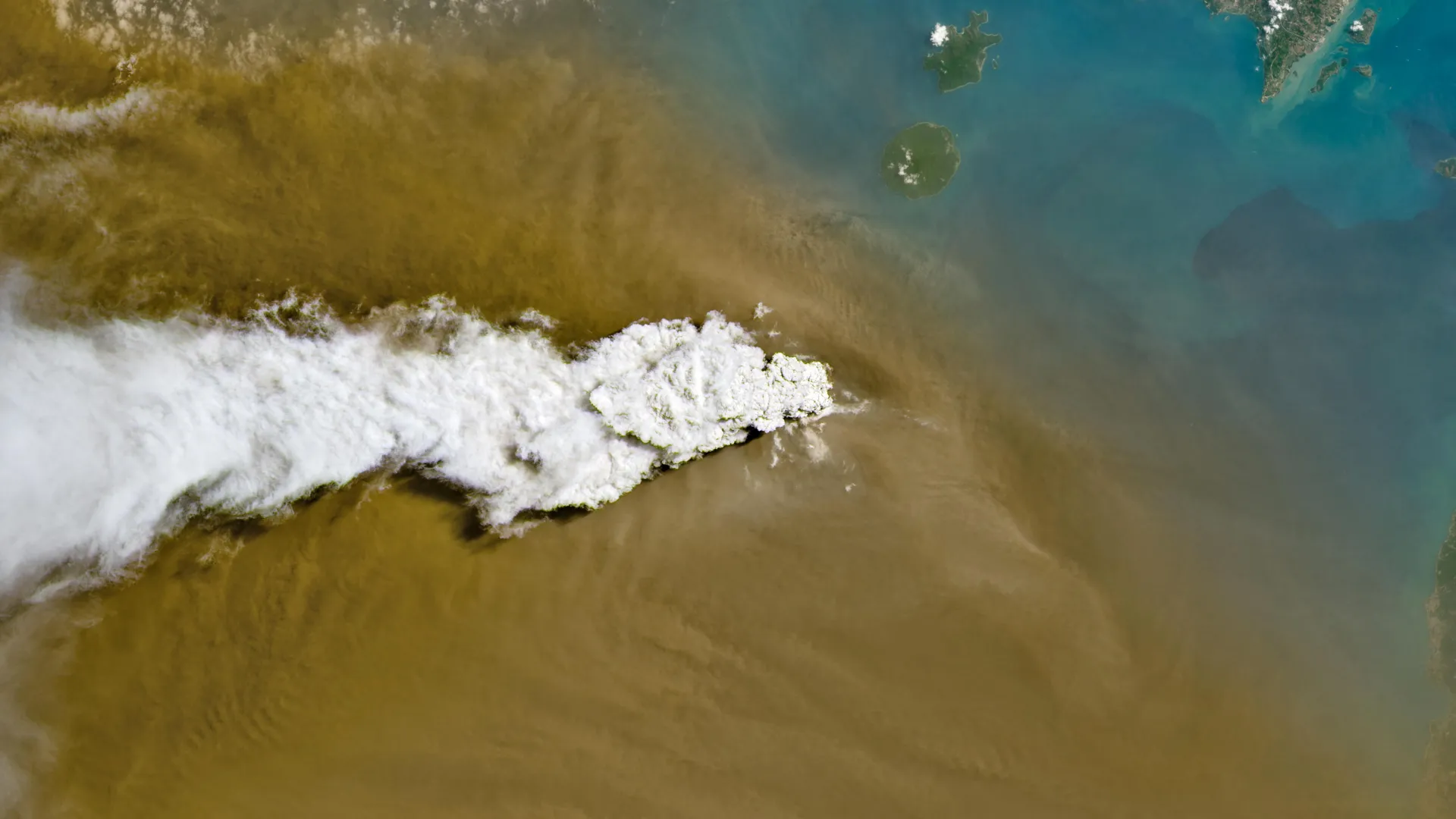
A powerful eruption at Indonesia's Anak Krakatau sent ash high into the atmosphere, disrupting thousands of flights and worsening air quality across parts of the country.
Anak Krakatau is a small but highly active volcano located between the Indonesian islands of Java and Sumatra. Its eruptions are often relatively modest, but the volcano is also capable of producing much more hazardous activity. In early September 2026, Anak Krakatau entered a prolonged explosive phase that lasted for more than 24 hours, sending large amounts of gas and ash into the sky. The eruption disrupted air travel and contributed to poor air quality in several areas, including Jakarta.
Satellites Capture the Eruption From Space
Satellites observed the eruption on September 5 as explosive activity continued at the volcano. One image (above), collected by the OLI (Operational Land Imager) aboard the NASA-USGS Landsat 8 satellite, shows a bright white plume of volcanic gas rising above a darker brown cloud of ash.
A broader view from the VIIRS (Visible Infrared Imaging Radiometer Suite) aboard the Suomi NPP satellite revealed volcanic material spreading across a much wider area.
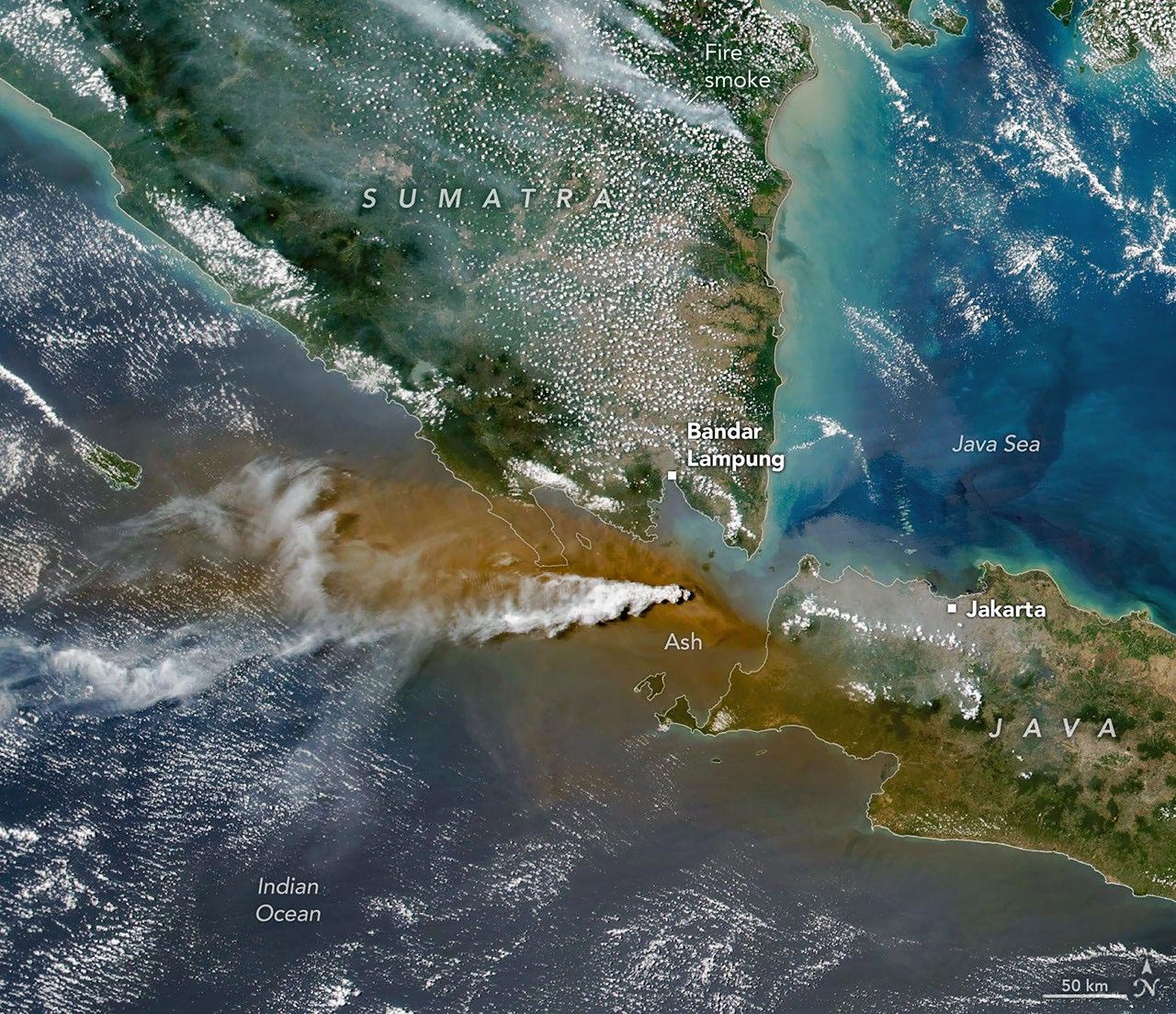
By September 6, Indonesia's meteorological agency reported that ash had climbed to altitudes of up to 6,000 meters (20,000 feet) east of the volcano and as high as 15,000 meters (50,000 feet) to the west.
Ash Cloud Disrupts Thousands of Flights
The high concentration of volcanic ash in the atmosphere forced the temporary closure of eight airports across Java and Sumatra. According to news reports, nearly 3,000 flights into and out of the affected region were disrupted.
Ash also fell over populated areas. The Indonesian Humanitarian Coordination Platform (IHCP) reported that communities east of Anak Krakatau were particularly affected, including Jakarta and other parts of West Java.
Volcanic ash can pose health concerns because it may irritate the respiratory system, eyes, and skin. The IHCP noted that the hazard differs from the smoke produced by peatland fires elsewhere in Indonesia. Volcanic ash and wildfire smoke have different particle properties, travel through the atmosphere in different ways, and require different protective measures.
Anak Krakatau Remains on High Alert
The volcano's sustained explosive activity weakened on September 6, although Anak Krakatau continued to rumble. Its activity shifted back toward a more typical pattern of Strombolian eruptions, which involve periodic bursts of ash and other volcanic material.
Airports had resumed operation by September 8. Even so, Anak Krakatau remained at the second-highest alert level on Indonesia's volcanic warning scale, a status it has held since early July.
NASA Earth Observatory images by Michala Garrison, using Landsat data from the U.S. Geological Survey, and VIIRS data from NASA EOSDIS LANCE, GIBS/Worldview, and the Suomi National Polar-orbiting Partnership.
Story Source:
Materials provided by NASA Earth Observatory. Original written by Lindsey Doermann. Note: Content may be edited for style and length.
Cite This Page: