
Scientists just discovered why Arctic sea ice moves so strangely
A surprisingly simple process, countless ice floes crashing into one another, may explain the Arctic’s mysterious sea ice movements.
- Date:
- September 17, 2026
- Source:
- University of California - Riverside
- Summary:
- Arctic sea ice may move in unexpected ways because individual ice floes are constantly colliding and transferring energy. Researchers found that this simple process can explain several long-standing mysteries about how quickly the ice moves and spreads.
- Share:
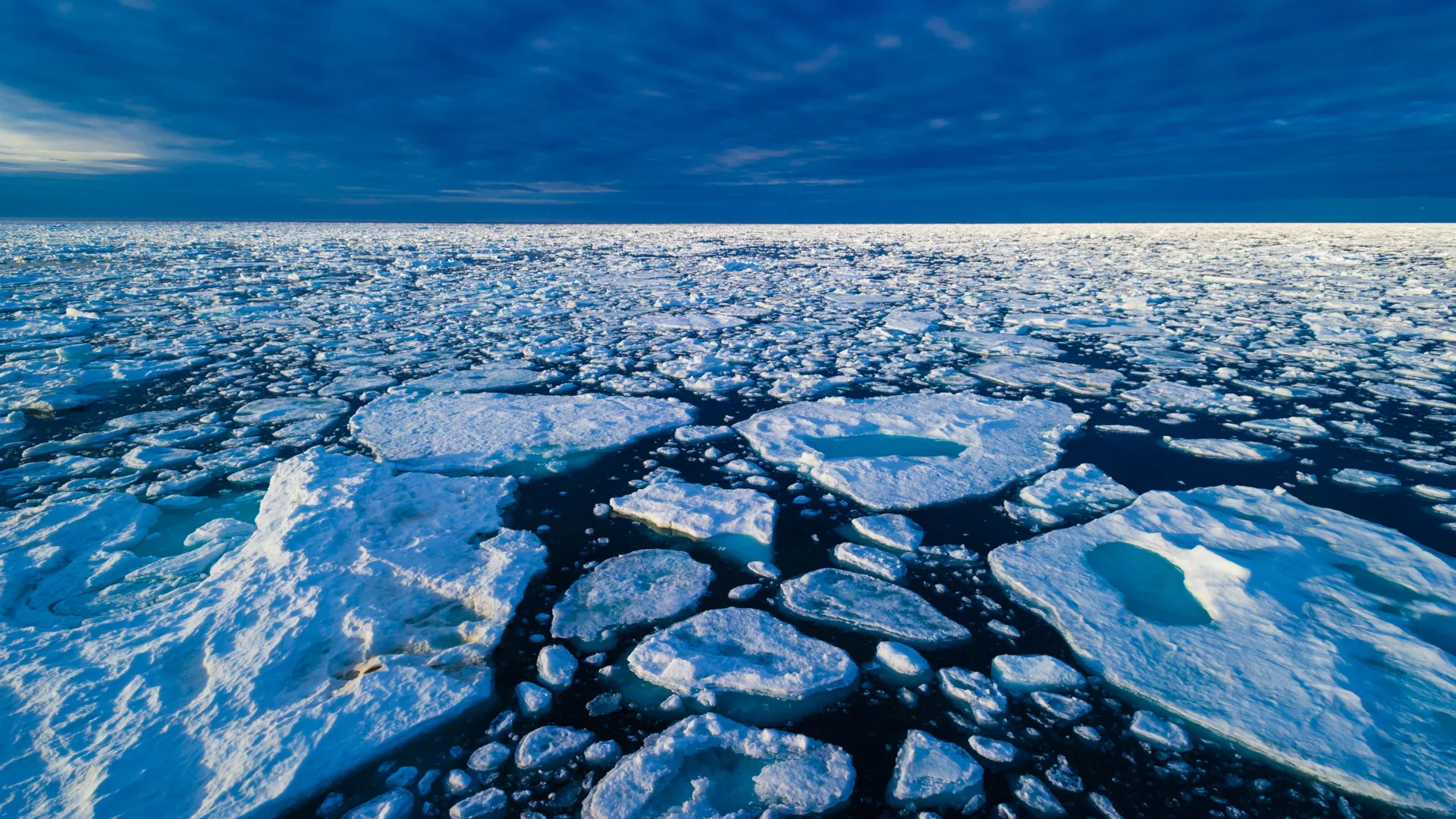
Arctic sea ice does not always move the way wind alone would predict. New research led by UC Riverside suggests that a simple but overlooked process may help explain the difference: individual pieces of ice repeatedly collide with one another.
The findings could eventually help scientists improve forecasts of how sea ice moves across the Arctic as the region continues to warm.
The study, published in Physical Review Letters, was led by Bryan Shaddy, formerly a UC Riverside undergraduate and now at the University of Southern California, along with UCR materials scientist Alex Greaney and Bhargav Rallabandi, associate professor of mechanical engineering at UCR.
Arctic Sea Ice Is Made of Moving Floes
Rather than forming one unbroken sheet, Arctic sea ice is divided into separate slabs known as floes. These pieces can range from just several meters across to several kilometers wide.
Wind pushes the floes over the ocean, causing them to drift and slowly move apart. Although wind is one of the main forces controlling sea ice motion, observations have long shown that it cannot explain everything.
The ice often travels at speeds that simple wind-based models do not predict. It also spreads across the ocean much more slowly than those models suggest.
Scientists have proposed several possible explanations, including unusual wind behavior, ocean eddies, and cracks in the ice. The new research suggests that many of these puzzling patterns can instead be explained by one basic process: collisions between neighboring floes.
"If you get a lot of ice floes together in the same place with some wind, they bump into each other and transfer energy to neighbors," Rallabandi said. "We showed that that's the only ingredient you need to explain these observations."
Simulating a Crowded Field of Ice
To test this idea, the researchers created a computer model that treats floating ice somewhat like grains moving through a silo. The major difference is that these grains are floating on water and being pushed by turbulent winds.
The simulation includes drag from the ocean as well as repeated collisions among the floes.
Researchers then compared the model with real measurements from the Fram Strait, a passage between Greenland and the Norwegian archipelago of Svalbard. Large amounts of Arctic sea ice move through this region on their way toward the Atlantic Ocean.
Using measured local wind and ice conditions, along with just one additional parameter that had little effect on the overall outcome, the model successfully reproduced three observations that had previously been difficult to explain.
It matched how quickly sea ice spreads, the range of speeds at which individual floes move, and the way ice motion changes over periods ranging from hours to days.
Why Collisions Matter So Much
Collisions have a strong effect because Arctic sea ice can become tightly packed.
In dense ice fields, individual floes hit nearby pieces much more often than the wind itself changes. Every collision removes some of the energy supplied by the wind and reduces how far a floe can travel before it strikes another piece of ice.
This repeated jostling helps explain why sea ice does not simply keep accelerating and spreading in response to the wind.
The findings may eventually improve predictions of sea ice transport as Arctic conditions evolve. Both the amount of ocean covered by ice and the size of individual floes influence how often collisions occur. Those collisions, in turn, affect how rapidly the ice field can spread.
The new framework connects these small, local interactions with movement occurring across much larger areas.
A Possible Tool for Climate Models
The study does not determine exactly how future warming will change where Arctic sea ice eventually ends up.
However, Rallabandi said the model could help scientists investigate questions such as whether changing ice conditions might allow floes to spread apart more easily and enter warmer waters, where they could melt faster.
The work could also prove useful for climate modeling.
Global climate models cannot track every one of the vast number of relatively small floes covering the Arctic. Instead, scientists need ways to represent their combined behavior. A physics-based model of how the floes interact could help capture processes that are otherwise too small to follow individually.
For Rallabandi, one of the most important aspects of the study is that a relatively simple physical process can explain complicated motion seen in the real world.
Physics That Extends Beyond Sea Ice
The same principles may apply to systems far beyond the Arctic.
Any situation involving many objects that collide while being pushed by an unpredictable force could behave in a similar way. The researchers point to possible applications in avalanches, landslides, materials science, and particle-filled inks used in 3D printing.
"The model is not restricted to ice," Rallabandi said. "It just needs a noisy source of force and the things that are moving to experience collisions."
Story Source:
Materials provided by University of California - Riverside. Note: Content may be edited for style and length.
Journal Reference:
- Bryan Shaddy, P. Alex Greaney, Bhargav Rallabandi. Anomalous Statistics of Sea Ice Transport are Explained by Collisional Rules. Physical Review Letters, 2026; 137 (11) DOI: 10.1103/g8y2-8ytt
Cite This Page: