
Scientists find breast cancer cells hiding behind protective “shields”
- Date:
- September 6, 2026
- Source:
- Medical Research Council (MRC) Laboratory of Medical Sciences
- Summary:
- Researchers have mapped breast tumors in striking detail and uncovered hidden pockets of dormant cancer cells that may help explain why cancer can return after treatment. Unlike rapidly dividing cells, these quiet cells can essentially hibernate, allowing them to evade chemotherapy and reactivate later. The team found that they are often surrounded by immune cells and connective tissue cells that may act like a protective shield.
- Share:
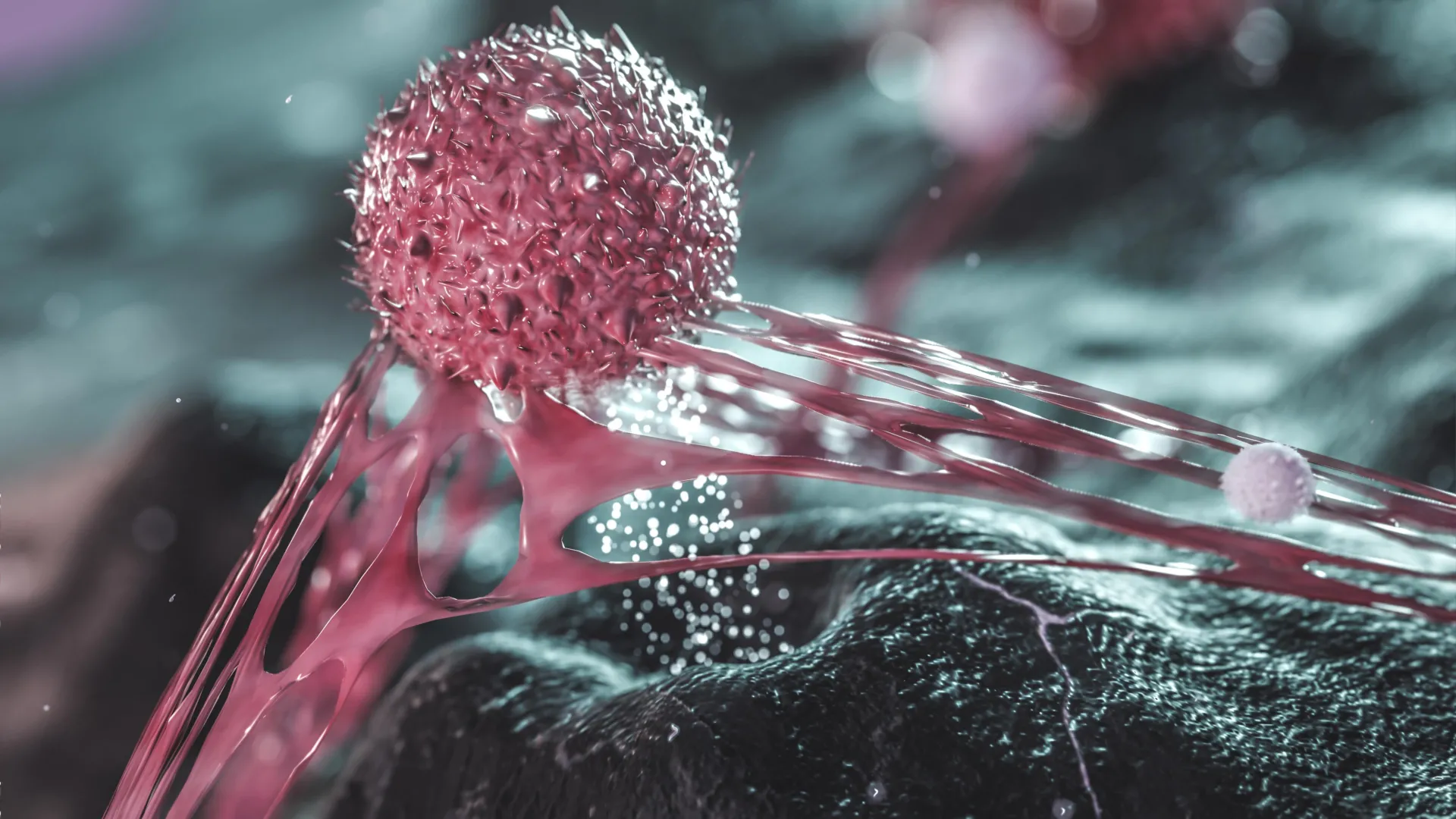
Researchers from the MRC Laboratory of Medical Sciences (LMS), Imperial College London, and UCL Genetics Institute have built a detailed cellular map of breast tumors, revealing separate regions filled with actively dividing cancer cells and others containing dormant cells. Published in Genome Medicine, the findings show that these inactive cancer cells are often surrounded by immune and connective tissue cells that may help protect them from treatment.
The work suggests that future cancer therapies may need to do more than attack fast-growing tumor cells. They may also need to target dormant cancer cells and the local environments that allow them to persist, with the goal of stopping tumor growth while reducing the risk that the disease returns later.
Hidden Cells Inside Breast Tumors
Breast tumors are complex environments made up of many different kinds of cells. Alongside rapidly multiplying cancer cells are immune cells, newly formed blood vessels and a particularly concerning group of cancer cells that remain unusually quiet.
These dormant, or 'quiescent', cells can survive treatment and may later contribute to cancer spreading or returning. Researchers at the LMS, Imperial and UCL wanted to understand where these cells are located in untreated tumors, what distinguishes them and which other cells tend to surround them.
Using publicly available data, the team created detailed maps of breast cancer tumors and found distinct clusters of quiescent cells surrounded by other cells that may serve as a protective barrier.
Why Dormant Cancer Cells Are Dangerous
"Quiescent cancer cells are very dangerous," explains Dr. Alexis Barr, co-lead author and head of the Cell Cycle Control group at the LMS. "These cells can hide from chemotherapy and then remain in this dormant quiescent state in the tumor, and then later reactivate to drive proliferation."
Cancer cells can enter this dormant state in response to stressful conditions inside a growing tumor. As tumors expand rapidly, blood flow and nutrients may not always keep pace. Some cells respond by essentially putting their growth on hold.
Much like a bear hibernating through difficult conditions, these cells can remain inactive until the environment becomes more favorable. That opportunity may come after treatment has ended.
Alexis adds, "If we want to achieve long-term control of peoples' tumors and prevent tumor relapse, we have to focus on these dormant quiescent cancer cells, and have to understand more about them."
Mapping the Tumor Cell by Cell
To investigate these hidden cell populations, Alexis worked with Dr. Maria Secrier's computational biology team at UCL to construct a detailed picture of the tumor and the immune and support cells surrounding it.
The researchers combined single-cell RNA sequencing, which reveals which genes individual cells are using, with spatial transcriptomics, a technique that shows where those cells are positioned and which neighboring cells are nearby.
"We found cells that resemble therapy-resistant cells already residing in the tumor before we give any treatment," says Maria, suggesting that some characteristics associated with treatment resistance may already exist before therapy begins rather than appearing only as a response to treatment.
The researchers saw this pattern in both aggressive forms of breast cancer and slower-developing classes - an unexpected result because quiescence had previously been linked more closely with slower-growing disease.
Protective Neighborhoods Around Dormant Cells
The analysis extended beyond the cancer cells themselves. Researchers also examined the many supporting cell types that become part of the tumor environment.
A consistent pattern emerged. Dormant cancer cells were frequently located close to CXCL10-positive macrophages (a type of immune cell) and myofibroblastic cancer-associated fibroblasts (a type of tumor-supporting cell).
These surrounding cells may have been recruited or altered in ways that help protect the dormant cancer cells. One possibility is that they create a physical or biological barrier that prevents cancer-killing immune cells or treatments from reaching the inactive cells effectively.
"The cancer cells are really encapsulated within these areas of macrophages and fibroblasts that we think act as shields for these dormant cancer cells," said Maria. "But we don't yet know the direction of cause and effect: whether the surrounding cells push cancer cells into dormancy or if the cancer cells attract or alter their surroundings. It's very likely coming from both sides."
Different Tumor Regions May Need Different Treatments
Many chemotherapy drugs work best against cells that are dividing quickly. Dormant cells, however, are not actively multiplying, which can make them much harder to eliminate.
The findings suggest that rapidly growing and dormant parts of the same tumor may respond differently to treatment. Researchers detected increased activity in the complement pathway (a part of the immune system) within dormant cell niches. That raises the possibility that treatments targeting this pathway could make those areas more vulnerable.
The support cells surrounding dormant cancer cells could provide another possible treatment target. However, researchers still need to determine whether these cells actually help maintain dormancy and how important they are to cancer cell survival.
"Different parts of the tumor will likely respond to different drugs," said Maria. "If we understand what drug combinations we can use to target both the proliferative and the dormant areas, potentially that could be more successful than current therapies. This is giving us a first insight into how we can then intervene with different therapeutics that specifically target different areas of the tumor where the cells have adapted and have evolved differently."
Alexis said, "It is clearly important to focus on proliferative cancer cells, but we also need to understand this population of quiescent dormant cancer cells. And that's been less studied."
A Possible Path Toward Longer-Lasting Treatments
The ideas generated by this analysis still need to be tested experimentally. Even so, locating treatment-resistant regions that already exist inside tumors and understanding the cells that support them could eventually help researchers develop more effective combinations of cancer therapies.
By mapping quiescent cells and the environments that surround them, scientists may be able to design treatments that attack both the rapidly growing portions of a tumor and the dormant cells that can survive and later become active again.
This work was primarily funded by a UKRI Future Leaders Fellowship, the Medical Research Council and the Biotechnology and Biological Sciences Research Council.
Story Source:
Materials provided by Medical Research Council (MRC) Laboratory of Medical Sciences. Note: Content may be edited for style and length.
Journal Reference:
- Cenk Celik, William A. Weston, Thais de Moraes-Lacerda, Eloise Withnell, Shi Pan, Tooki Chu, John Labbadia, Alexis R. Barr, Maria Secrier. Spatial ecology of breast cancer reveals co-evolution of proliferative and dormant niches. Genome Medicine, 2026; DOI: 10.1186/s13073-026-01711-0
Cite This Page: