
Dying Sun-like stars may kick themselves through space
- Date:
- July 20, 2026
- Source:
- Caltech
- Summary:
- Dying Sun-like stars may not fade away quietly. As blobs of gas erupt unevenly from their swollen surfaces, each burst gives the star a tiny push in the opposite direction. Thousands of these random kicks could eventually break apart distant stellar pairs or, in rare cases, drive two stars into a violent collision.
- Share:
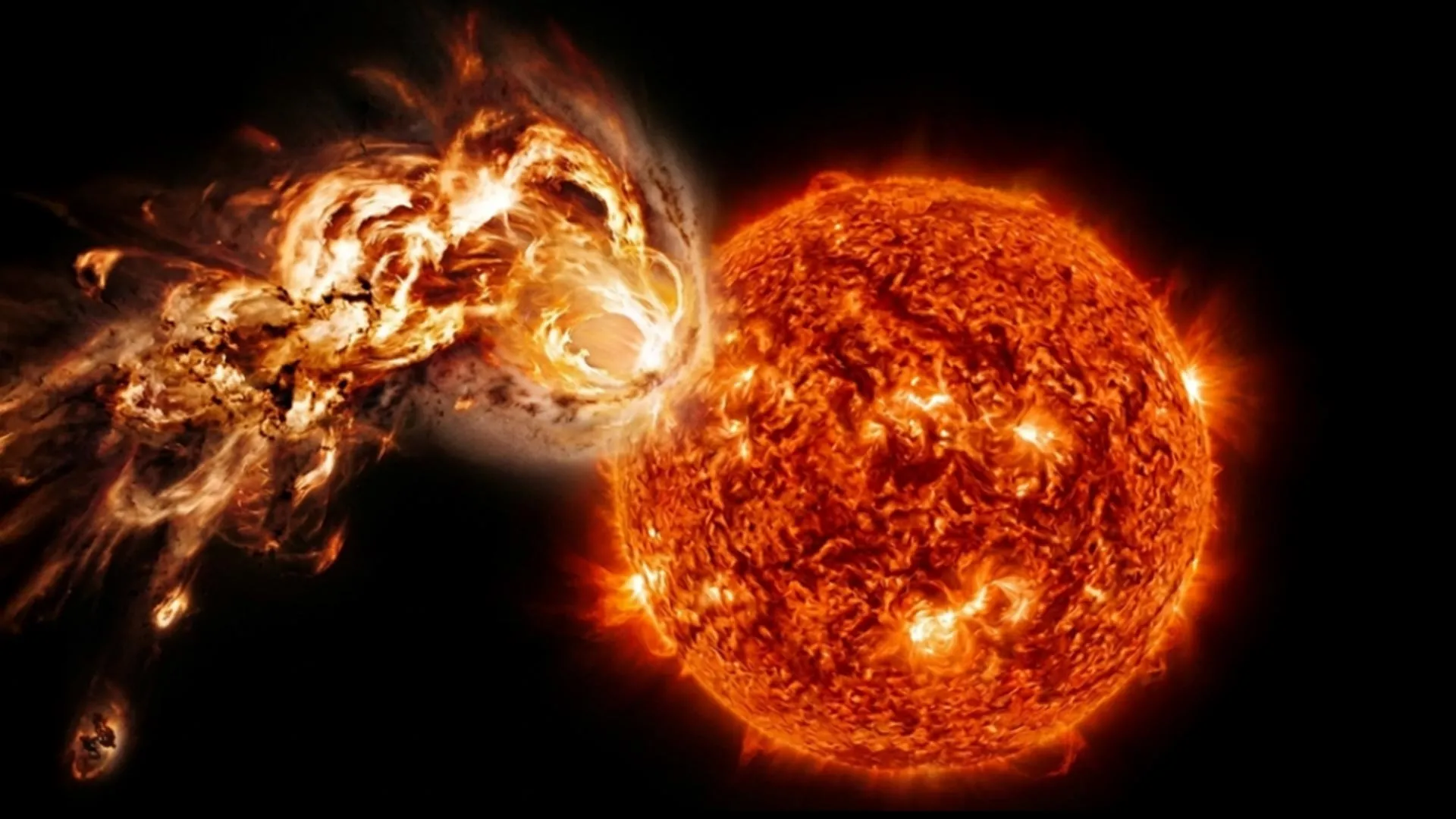
When stars similar to the Sun grow old, they expand into red giants. During this phase, their outer layers churn and gradually drift into space, while the dense cores left behind shrink into white dwarfs. Because this is the fate of most stars, white dwarfs are among the most common stellar remnants in the universe.
A new model from Caltech theoretical astrophysicist Jim Fuller suggests that this transformation may be far less orderly than it appears. His calculations indicate that uneven bursts of escaping material can repeatedly push a dying star in different directions, giving it thousands of small kicks before the white dwarf fully forms.
Chaotic Eruptions Push Dying Stars
"In this model, blobs of matter are chaotically being ejected from the surface of the bloated stars in an asymmetric fashion," Fuller says. "And every time that happens, the star gets a little kick in the opposite direction. Like Newton said, for every action there is an equal and opposite reaction."
Fuller presented the findings at the 248th meeting of the American Astronomical Society in Pasadena. The study has been submitted to the Publications of the Astronomical Society of the Pacific.
According to Fuller's calculations, a star approaching the white dwarf stage may experience roughly 10,000 small kicks over several hundred thousand years. Each individual push would move the star at only a few meters per second. "That's a slow jogging pace for humans," he says.
Thousands of Kicks Add Up
Although the escaping material is launched in random directions, the kicks do not cancel out perfectly. Over time, they produce an overall shift in one direction through a mathematical process known as a random walk.
A simple comparison is repeatedly flipping a coin to decide whether to move one way or another. Even though each step is random, you will eventually end up some distance from where you began. Fuller's model suggests that the combined kicks could leave a dying star moving in a random direction at about 1 kilometer per second.
Some objects in space receive much stronger pushes. When a massive star explodes as a supernova, for example, the blast can launch the stellar remnant in one direction at high speed. Astronomers have long suspected that white dwarfs also receive kicks, but the process is much gentler because these stars do not explode.
Why Wide Binary Stars Break Apart
Evidence for white dwarf kicks comes from research led by Kareem El-Badry, an assistant professor of astronomy at Caltech. He found that widely separated pairs of stars, known as binaries, are less common after one member of the pair becomes a white dwarf.
The new model offers a possible explanation. A net kick of about 1 kilometer per second could disrupt the orbit of a loosely bound stellar pair, causing the two stars to separate.
"If the orbital speed of the binaries is less than the kick speed, the wide binaries will become gravitationally unbound," Fuller explains.
Fuller developed the model using El-Badry's observations along with computer simulations of convection inside aging red giants. Those simulations show that the churning material near the surface can escape unevenly rather than flowing away in a smooth, balanced pattern.
The model is the first to directly connect many randomly directed ejection events with the motion astronomers suspect white dwarfs receive.
"I am pleased to see a physical model that can explain this observation, which has puzzled me for several years," El-Badry says.
Stellar Kicks Could Trigger Collisions
The model also makes a new prediction. In some binary systems, repeated kicks to a dying red giant could alter its orbit enough to send it crashing into its companion. Such a collision could produce an explosion.
Astronomers may eventually be able to search for signs of these violent stellar mergers, providing a way to test whether Fuller's model accurately describes the final stages of Sun-like stars.
The submitted study titled "White Dwarf Kicks via Episodic Mass Ejection from Red Giant Stars" was funded by Caltech.
Story Source:
Materials provided by Caltech. Original written by Whitney Clavin. Note: Content may be edited for style and length.
Cite This Page: