
Spider-like creatures help uncover the surprising origins of fatherhood
- Date:
- July 12, 2026
- Source:
- The Linnean Society of London
- Summary:
- Citizen scientists have helped researchers solve a long-standing mystery about how parental care evolved in harvestmen. Using photos and observations from iNaturalist, scientists more than doubled the known cases of egg-guarding behavior and discovered that maternal and paternal care followed different evolutionary paths. The project, completed in just days with help from public data, shows how citizen science is transforming biological research on a global scale.
- Share:
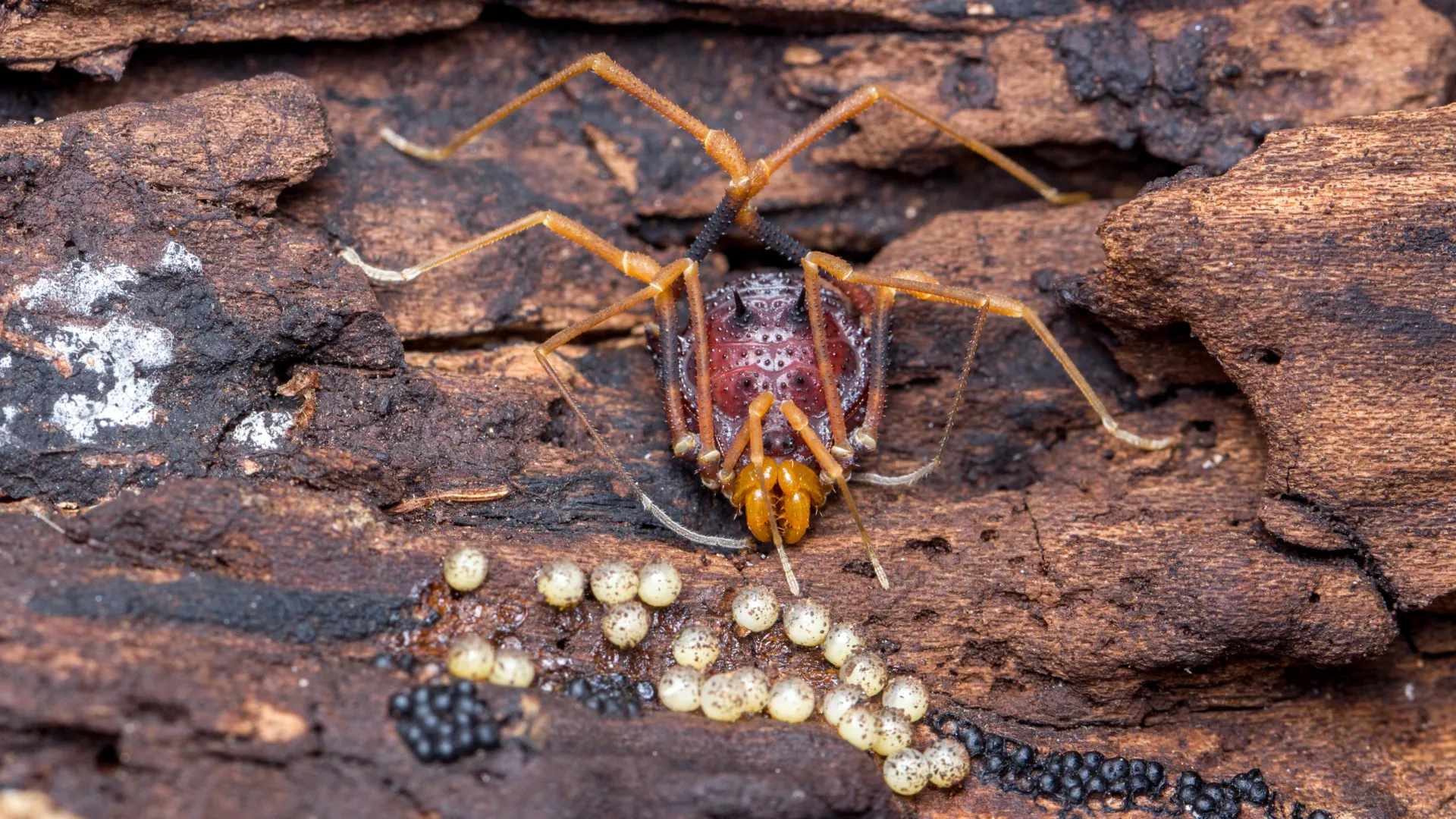
Citizen scientists have helped researchers uncover how parental care evolved in harvestmen, a group of spider like arachnids, by contributing observations through the popular nature platform iNaturalist. The findings, published in the Zoological Journal of the Linnean Society, reveal that parental guarding behavior has appeared, disappeared, and evolved again multiple times over the group's evolutionary history.
By combining nearly 30 years of field research with observations submitted to iNaturalist, an international team led by a University of São Paulo scientist more than doubled the number of documented examples of parental care in harvestmen. The expanded dataset also allowed researchers to reconstruct, for the first time, how both maternal and paternal care evolved within the superfamily Gonyleptoidea.
Citizen science reveals the evolution of parental care
The analysis showed that parental guarding behavior has not followed a simple evolutionary path. Instead, it has emerged repeatedly, been lost in some lineages, and later reappeared.
Researchers found that maternal care evolved only from species that showed no parental care, matching patterns previously observed in insects. Paternal care, however, followed two different evolutionary routes. It arose either directly from species with no parental care or from species in which females already guarded the eggs. This suggests that different evolutionary pressures shaped the development of maternal and paternal care.
The researchers propose that when paternal care evolved from maternal care, it likely reflects a form of sexual selection known as 'enhanced fecundity', in which females favor males that are already caring for eggs.
Why harvestmen are ideal for studying fatherhood
More than 6900 species of harvestmen have been identified, making them one of the most diverse groups of arachnids. Although they account for only about 0.6% of all arthropod diversity, they represent more than half of the independently evolved examples of paternal care known among arthropods, making them an exceptional group for studying the evolution of parenting.
Lead author Glauco Machado explained:
"It's very rare in nature, paternal care, and this behavior evolved many times independently. So, by looking at harvestmen we can explore questions related to the factors that led to the evolution of this behavior. In many species where males care for the offspring alone, the caring activity is a sexually selected behavior, which means that females prefer males that are caring for the eggs."
iNaturalist dramatically expanded the dataset
Citizen science projects allow people without specialized scientific training to contribute valuable observations. Around the world, volunteers have helped monitor bird populations, rediscover lost species, and even uncover ancient writing systems through cave art. Their contributions are becoming an increasingly important source of scientific data.
Machado's team turned to the global iNaturalist platform after hearing a presentation about using citizen science in bird research. The website allows users to upload georeferenced observations of plants and animals from virtually anywhere in the world.
The results demonstrated just how quickly citizen science can accelerate research. From 1936 through 2025, published scientific studies documented parental guarding behavior in only 80 harvestman species. Using iNaturalist, the researchers more than doubled that total, including 62 new records contributed through the platform alone. Machado said the iNaturalist search itself took only two days.
Citizen science speeds research worldwide
According to Machado, iNaturalist's greatest strength is not simply the number of observations it contains but the accessibility of those records for scientists everywhere.
"It's a tremendous source of information that can improve the velocity with which we accumulate biological information. I would never be able to do this by visiting museums around the world. It would be very expensive, very time consuming, but here we conducted the search in only one week."
By eliminating many of the costs associated with museum visits and extensive fieldwork, citizen science platforms are making large scale biological research more accessible, particularly for scientists working in the Global South.
Taxonomists remain essential
Despite the growing value of citizen science, the researchers emphasize that expert taxonomists remain indispensable. Identifying species correctly, determining whether the caregiving individual is male or female, and distinguishing true parental care from similar behaviors such as mate guarding all require specialized expertise.
Machado stressed the continuing importance of taxonomy:
"I think taxonomists' role in modern science is more important than ever. We cannot preserve a species that doesn't have a name. And names are provided by taxonomists. So, it's very important."
Study limitations and future research
The researchers acknowledge that the study has limitations. One of the biggest challenges is sampling bias because animals actively guarding eggs are much easier to notice and photograph than species that provide no parental care.
Even so, the authors argue that studies like this help close major gaps in understanding which species exhibit parental care and which do not. Because more than half of the records analyzed were newly documented, Machado believes citizen science will continue to play an increasingly important role in studies of parental behavior across many different animal groups.
"I think it's a very broad contribution for people that are working with insects, frogs, and all kinds of groups, animal groups, in which we have both maternal care and paternal care."
Story Source:
Materials provided by The Linnean Society of London. Note: Content may be edited for style and length.
Journal Reference:
- Glauco Machado, Bruno A Buzatto, Daniel S Caetano, Edgardo Flores, Solimary García-Hernández, Osvaldo Grob, Laís A Grossel, Hubert Höfer, Adriano B Kury, Héctor Lancheros, Miguel Medrano, Carlos Oyarzún, Jorge Pérez-Schultheiss, Ricardo Pinto-da-Rocha, Luis E Robledo-Ospina, Joaquín Sáenz-Mancheno, Diego Solano-Brenes, Rosannette Quesada-Hidalgo, Emilia Triana, Osvaldo Villarreal. One small step for citizens, one giant leap for science: iNaturalist records boost our understanding of the evolution of parental care in a clade of arachnids. Zoological Journal of the Linnean Society, 2026; 207 (2) DOI: 10.1093/zoolinnean/zlag061
Cite This Page: