
This alien planet never has sunrise or sunset. It may support life
Even exoplanets trapped in eternal day and endless night may have hidden regions where life could stand a chance.
- Date:
- July 9, 2026
- Source:
- University of Pennsylvania
- Summary:
- A planet with one side permanently roasting and the other frozen in endless darkness might still have a chance of supporting life. Researchers found that heat inside a tidally locked exoplanet could circulate in a stable, continuous loop, helping moderate temperatures in certain regions. Their laboratory model suggests these worlds may be more hospitable than previously thought, despite their extreme surface conditions.
- Share:
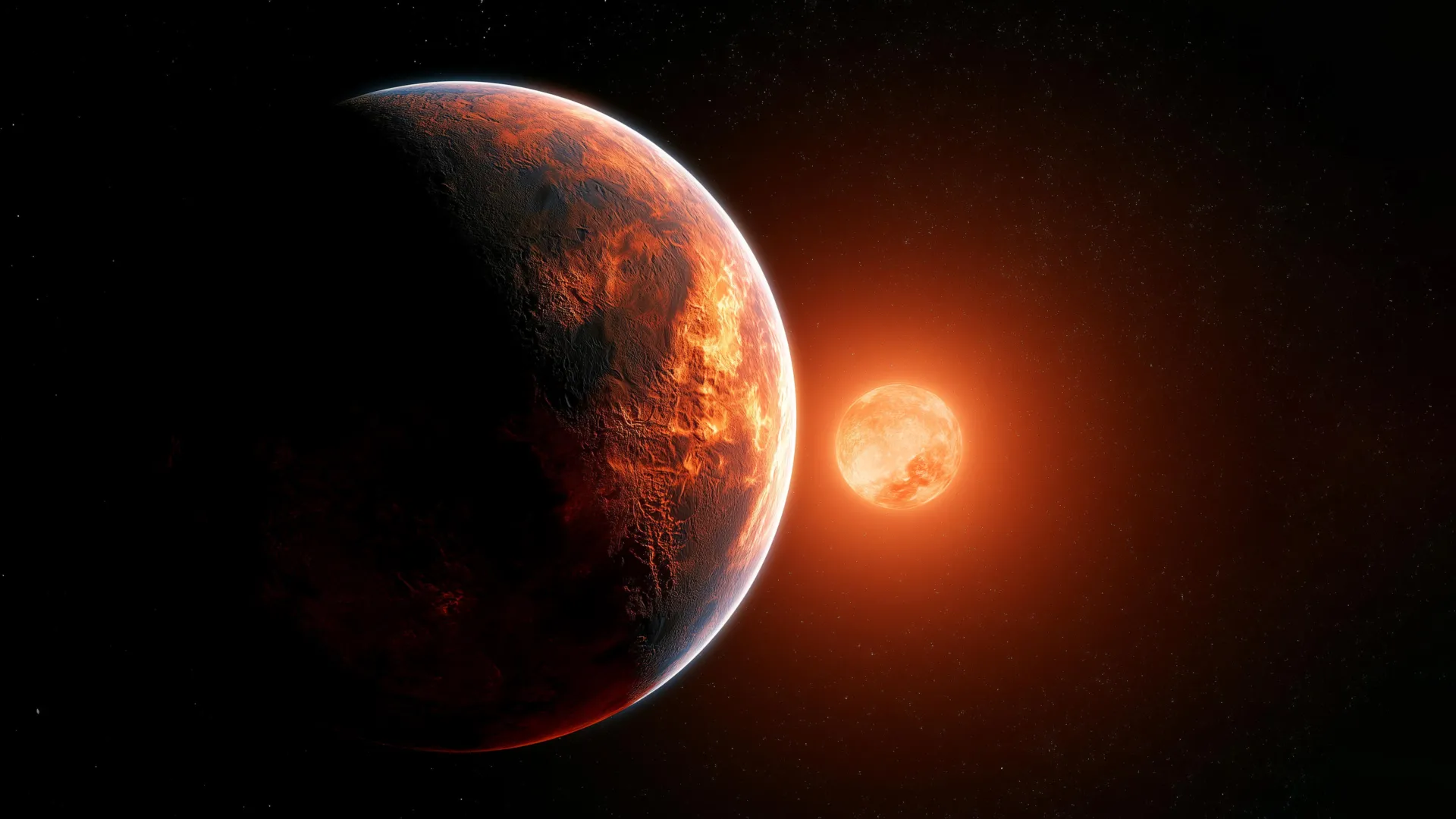
LHS 3844b is an exoplanet just slightly larger than Earth that orbits the red dwarf star LHS 3884, located 48.5 light years from our solar system. Unlike Earth, it is tidally locked, meaning it rotates once on its axis in exactly the same amount of time it takes to orbit its star. As a result, one hemisphere experiences constant, blistering daylight while the other remains in permanent darkness so cold it approaches absolute zero (zero Kelvin).
At first glance, such an extreme environment seems completely inhospitable. Daytime temperatures can reach roughly 1,000 to 2,000 Kelvin, while the night side is so cold that particle motion effectively stops. Yet new research suggests these worlds may not be as hostile to life as they appear.
"Just looking at the extreme temperatures on the day and night sides -- like 1,000-2,000 Kelvin on the day side and absolute zero on the night side -- might lead one to conclude these exoplanets are too harsh for life. But," says Daisuke Noto, a postdoctoral researcher in Hugo Ulloa's Penn GEFLOW Lab at the University of Pennsylvania, "life might find a way."
In a study published in Nature Communications, Noto and collaborators from the Japan Agency for Marine-Earth Science and Technology and Hokkaido University found that "such exoplanets may be more tolerant of sustaining life as 'tidal locking' can contribute to maintaining moderate thermal environments locally by distributing heat flux laterally."
Why Tidally Locked Exoplanets Are So Common
The findings challenge a common assumption about planets that always show the same face to their stars. According to Noto, worlds with permanent day and night are actually much more common than planets like Earth, which experience a regular day and night cycle.
"Many celestial bodies like moons and planets that are very close to their parent stars are what we call tidally locked," he explains. "Meaning, as they spin around on their axes and orbit around their parents, those rates/frequencies match, leading to the phenomena like us only seeing one side of our moon."
This constant orientation creates a dramatic temperature contrast across the planet. Instead of focusing on surface conditions alone, the researchers wanted to understand what happens deep inside the planet, specifically within the mantle, the thick rocky layer between the crust and the core.
Recreating an Alien Planet in the Lab
Rather than relying only on computer simulations, the team built a physical laboratory model to mimic the interior of a tidally locked planet.
"Building an actual exoplanet in the lab wasn't in the budget," Noto jokes.
Instead, the researchers used a tabletop rectangular tank filled with viscous glycerol and tiny thermochromic liquid crystals that change color as temperatures shift. Similar experimental systems have long been used to study how heat moves through slow moving materials, making them useful stand ins for the rocky interiors of planets.
Unlike weather or ocean currents, which are strongly influenced by Earth's rotation and gravity, convection inside a rocky mantle is driven mainly by differences in temperature and density. To reproduce those conditions, the team installed four thermostats around the tank to heat and cool different regions, creating temperature gradients similar to those expected between the permanently illuminated side, the permanently dark side, the surface, and the deep interior of a tidally locked exoplanet.
A Planetary Heat Engine
The experiments revealed a remarkably stable pattern. Hot material consistently rose beneath the day side, flowed across the upper region, cooled as it reached the night side, then sank before returning through the lower mantle. The result was one continuous circulation loop that behaved like a steady planetary heartbeat.
"It's not chaotic like Earth's mantle," Noto says. "It's slow and steady. Predictable. Kind of boring -- but in a good way."
The researchers also observed occasional mushroom shaped plumes rising from the heated base of the tank. Unlike volcanic hotspots on Earth, such as those beneath Hawaii or Iceland, these plumes remained fixed in one location rather than drifting over time.
Measurements of heat transport, known as Nusselt numbers, were comparable to those seen for Earth's mantle. That finding suggests some tidally locked exoplanets could maintain localized geothermal environments that provide conditions favorable for life, particularly in more temperate mid latitudes.
What This Could Mean for Alien Life
The steady circulation pattern may influence more than just surface temperatures. Noto believes it could also affect the movement of a planet's liquid core, potentially generating magnetic fields that differ from Earth's familiar dipole field.
"That's something we couldn't test in this experiment," he says, "but it's an exciting direction for future work."
Looking Beyond Other Worlds
Noto and Ulloa are continuing to develop similar laboratory models to investigate a wide range of geophysical processes. Earlier research from the Penn GEFLOW Lab explored how heat and mass move through confined spaces, providing new insight into the role of fluids in hydrothermal systems.
"We are planning on further extending the experimental methods to delve deeper into different systems on our planet in different contexts, the possibilities are, quite literally, out of this world," says Noto.
Daisuke Noto is a postdoctoral researcher in the School of Arts & Sciences at the University of Pennsylvania.
Hugo Ulloa is an assistant professor in the Department of Earth and Environmental Science in Penn Arts & Sciences.
Other authors include Takehiro Miyagoshi and Takatoshi Yanagisawa of the Japan Agency for Marine-Earth Science and Technology; and Tomomi Terada and Yuji Tasaka of Hokkaido University.
Story Source:
Materials provided by University of Pennsylvania. Note: Content may be edited for style and length.
Journal Reference:
- Daisuke Noto, Takehiro Miyagoshi, Tomomi Terada, Takatoshi Yanagisawa, Yuji Tasaka. Convective dynamics in mantle of tidally-locked exoplanets. Nature Communications, 2025; 16 (1) DOI: 10.1038/s41467-025-62026-z
Cite This Page: