
Earth’s orbital wobble triggered rapid climate chaos during the dinosaur age
Earth’s ancient orbital wobble may have triggered rapid climate chaos during the dinosaur era — and scientists say it could happen again in a warmer future.
- Date:
- May 28, 2026
- Source:
- China University of Geosciences
- Summary:
- New research suggests Earth’s climate can swing wildly on surprisingly short timescales — even during hot, ice-free greenhouse periods. By studying ancient sediments from the Late Cretaceous, scientists uncovered repeating climate shifts tied to tiny changes in Earth’s orbital wobble. These cycles may have repeatedly pushed the planet between humid and arid states every few thousand years.
- Share:
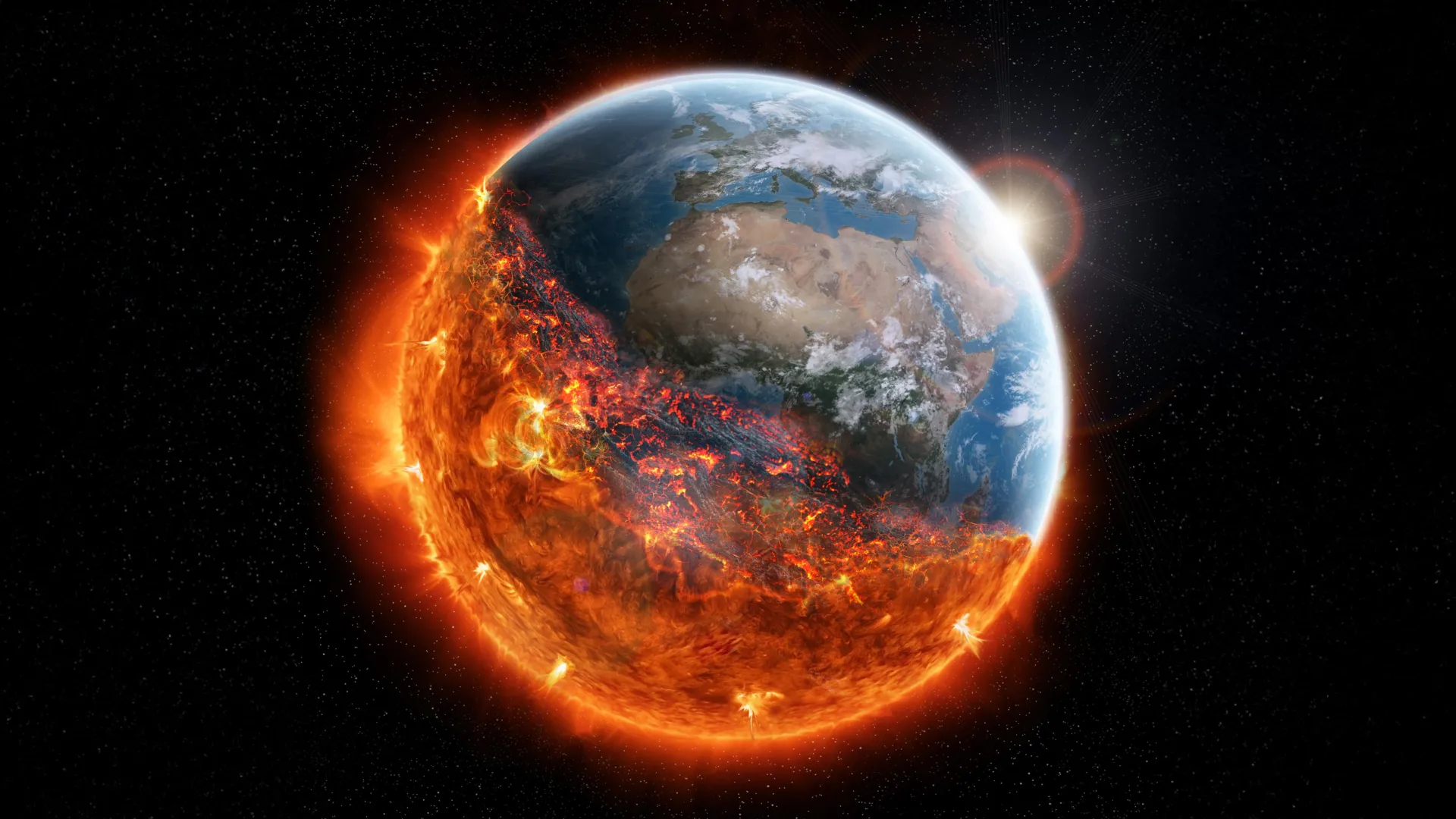
When audiences watched The Day After Tomorrow, they saw a fictional version of sudden and dramatic climate collapse. While the movie exaggerated the speed of those events, scientists know that Earth's climate really can change abruptly. During the last Ice Age, temperatures in Greenland surged by as much as 16°C within just a few decades. Massive waves of icebergs also repeatedly disrupted circulation in the North Atlantic during events known as Dansgaard-Oeschger and Heinrich events.
These kinds of abrupt changes, called millennial-scale climate events, reveal that Earth's climate system can reorganize much faster than would be expected from slow changes in Earth's orbit alone.
For years, researchers believed such rapid climate swings were mainly tied to the growth and collapse of large ice sheets. That left a major mystery unresolved. How could similar rapid climate shifts happen during greenhouse periods in Earth's history when ice sheets barely existed?
A new international study may now provide an answer.
Scientists Link Orbital Wobbles to Rapid Climate Changes
A research team led by Professor Chengshan Wang of the China University of Geosciences (Beijing), working with scientists from Belgium, Austria, and China, found evidence that slow changes in Earth's orbit may have triggered abrupt climate fluctuations even during ice-free greenhouse climates. Their findings were published in Nature Communications.
The researchers analyzed sediment cores from China's Songliao Basin that were deposited around 83 million years ago during the Late Cretaceous period. At that time, Earth was in a greenhouse state with very high atmospheric CO2 levels and virtually no polar ice sheets.
The sediment cores came from the Cretaceous Continental Scientific Drilling Project, an international drilling effort launched in 2006 by Prof. Wang.
How Earth's Precession Cycles Affect Climate
Earth does not rotate perfectly steadily. Its axis slowly wobbles over time like a spinning top, a movement known as axial precession. One full wobble takes roughly 26,000 years.
As this wobble interacts with gradual shifts in Earth's elliptical orbit, it creates two major climatic precession cycles lasting about 19,000 and 23,000 years. These cycles influence how sunlight is distributed between the Northern and Southern Hemispheres during different seasons, making them an important driver of long-term climate patterns.
The effect becomes especially important in tropical regions. Because Earth's axis is tilted relative to its orbit, areas outside the tropics experience one yearly peak in solar radiation near the summer solstice. Tropical regions behave differently. They receive two annual peaks in solar radiation near the equinoxes and two yearly lows near the solstices.
This unique tropical sunlight pattern creates four peaks in seasonal solar contrast each year. Over time, that pattern generates a quarter-precession climate cycle lasting around 5,000 years.
Evidence From the Age of Dinosaurs
The team found strong evidence for these cycles in the ancient sediment record.
Using geochemical data, mineral analysis, and simulations of bioturbation, the researchers discovered repeated humid and arid climate cycles during the Late Cretaceous. These shifts occurred with a regular rhythm of roughly 4,000 to 5,000 years. The strength of these oscillations also varied according to longer 100,000-year orbital cycles connected to changes in Earth's orbital eccentricity.
The results closely matched theoretical predictions for how tropical solar radiation should respond to Earth's orbital geometry.
According to the researchers, this shows that equatorial sunlight changes alone were capable of driving major climate fluctuations. Their spectral analysis also suggested that these 5,000-year cycles could trigger even faster climate oscillations lasting between 1,800 and 4,000 years through nonlinear climate interactions.
Together, the evidence suggests that Earth's climate during the Late Cretaceous greenhouse world was far from stable. Instead, it repeatedly shifted between wetter and drier conditions under the influence of orbital forcing tied to precession cycles.
What This Could Mean for Earth's Future
"During the Late Cretaceous, atmospheric CO2 levels reached about 1,000 parts per million -- comparable to projections for the end of this century," says Prof. Michael Wagreich, a paleoclimatologist at the University of Vienna. "This makes the Cretaceous greenhouse climate a meaningful analogue for understanding Earth's future."
"Because Earth's orbital configuration will remain stable for billions of years, the unveiled close link we identified between astronomical precession and millennial-scale climate cycles implies that high-frequency climate oscillations, like those seen in the Cretaceous, could also emerge in a warmer future -- potentially in ways that are more predictable than previously thought," concludes the study's first author, Zhifeng Zhang.
This work was funded by the Deep Earth Probe and Mineral Resources Exploration -- National Science and Technology Major Project of China (No. 2024ZD1001105), National Natural Science Foundation of China (No. 42272134 to Y.H., 42488201 to C.W., 42502020 to Z.Z., 42172137 to C.M.), National Key Research and Development Program of China (No. 2023YFF0804000 to C.M.), "Deep-time Digital Earth" Science and Technology Leading Talents Team Funds for the Central Universities for the Frontiers Science Center for Deep-time Digital Earth, China University of Geosciences (Beijing) (Fundamental Research Funds for the Central Universities) (No. 2652023001 to C.W.), and the Postdoctoral Fellowship Program of CPSF (No. GZC20241605 to Z.Z.). Q.Y. is a Senior Research Associate of the Fonds de la Recherche Scientifique-FNRS (F.R.S.-FNRS) and acknowledges the support of the F.R.S.-FNRS grant n° T.0246.23. Z.Z. gratefully acknowledges the fellowship from the China Postdoctoral Science Foundation (No. 2025M770431). ACDS thanks the FNRS support WarmAnoxia (grant T.0037.22).
Story Source:
Materials provided by China University of Geosciences. Note: Content may be edited for style and length.
Journal Reference:
- Zhifeng Zhang, Yongjian Huang, Tiantian Wang, Qiuzhen Yin, Anne-Christine Da Silva, Eun Young Lee, Hanfei Yang, Chao Ma, Hai Cheng, André Berger, Chengshan Wang. Precession-induced millennial climate cycles in greenhouse Cretaceous. Nature Communications, 2025; 16 (1) DOI: 10.1038/s41467-025-66219-4
Cite This Page: