
DNA robots could deliver drugs and hunt viruses inside your body
DNA robots could transform medicine and technology—but they’re still just getting started.
- Date:
- March 31, 2026
- Source:
- Journal Center of Harbin Institute of Technology
- Summary:
- DNA robots are emerging as tiny programmable machines that could one day deliver drugs, hunt viruses, and build molecular-scale devices. By borrowing ideas from traditional robotics and combining them with DNA folding techniques, scientists are creating structures that can move and act with precision. These robots can be guided using chemical reactions or external signals like light and magnetic fields.
- Share:
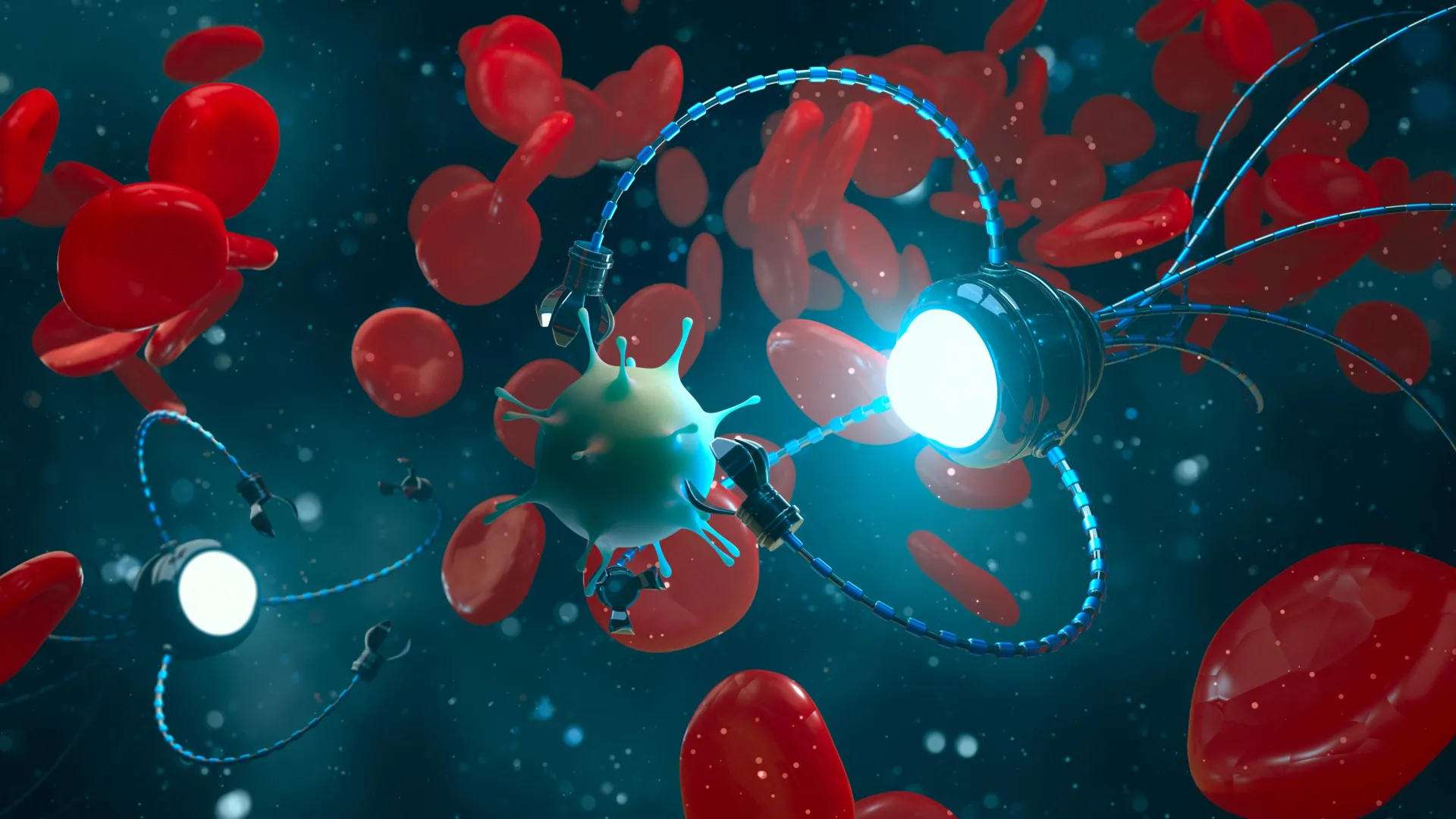
Imagine tiny robots made from DNA moving through the bloodstream, delivering drugs exactly where they are needed and targeting threats such as cancer cells or viruses. These microscopic machines could also assemble ultra-precise data storage systems and computing devices at the nanometer scale. Although the possibilities are remarkable, most DNA robots today remain in early experimental stages and are better understood as proof of concept rather than practical tools.
Researchers are exploring how DNA can be engineered into working machines using creative design approaches. These include building rigid DNA joints, incorporating flexible components, and using folding techniques inspired by origami. By applying principles from larger-scale robotics such as rigid, compliant and origami robots, scientists are adapting familiar mechanical concepts to the nanoscale. This allows DNA-based systems to carry out controlled and repeatable tasks despite their extremely small size.
Controlling Movement in DNA Nanorobots
Guiding the motion of DNA robots in a constantly shifting molecular environment is a major challenge. To address this, scientists have developed control systems that help these machines behave in predictable ways. One important method involves DNA strand displacement, a biochemical process that enables precise programming of movement using specific DNA sequences labeled as "fuel" and "structure."
In addition to biochemical control, external physical signals such as electric fields, magnetic fields, and light can direct how these robots move. Together, these approaches provide a toolkit for fine-tuning the behavior of DNA machines with a high degree of accuracy.
DNA Robots in Medicine and Technology
The potential uses for DNA robots extend well beyond laboratory experiments. In medicine, they could function as "nano-surgeons," locating diseased cells and delivering targeted treatments with precision. Researchers are also exploring whether these machines could capture viruses like SARS-CoV-2, with future systems potentially operating as fully autonomous drug delivery platforms.
DNA robots may also play a role in advanced manufacturing. Acting as programmable templates, they could position nanoparticles with sub-nanometer accuracy. This capability could lead to breakthroughs in molecular computing and highly efficient optical devices that outperform current technologies.
Challenges in Scaling DNA Robotics
Despite rapid progress, several obstacles remain. Moving from large-scale systems to molecular machines introduces challenges such as Brownian motion, which makes precise control more difficult. Many current DNA robot designs are still relatively simple and operate in isolation, limiting their usefulness in complex real-world environments.
There are also gaps in foundational knowledge. Researchers still lack detailed databases describing the mechanical properties of DNA structures, and simulation tools for predicting behavior at this scale are not yet fully developed.
What Needs To Happen Next
To overcome these barriers, scientists emphasize the need for collaboration across disciplines. Proposed solutions include creating standardized DNA "parts libraries," using artificial intelligence to improve design and simulation, and advancing bio-manufacturing methods. Progress in these areas will be essential for scaling DNA robots and integrating them into practical applications in healthcare, manufacturing, and beyond.
"The robots of tomorrow won't just be made of metal and plastic," says the research team. "They will be biological, programmable, and intelligent. They will be the tools that allow us to finally master the molecular world."
Story Source:
Materials provided by Journal Center of Harbin Institute of Technology. Note: Content may be edited for style and length.
Journal Reference:
- Yiquan An, Fan Wu, Yanyu Xiong, Cheng Zhang, Jian S. Dai, Lifeng Zhou. Designer DNA‐Based Machines. SmartBot, 2026; 2 (1) DOI: 10.1002/smb2.70029
Cite This Page: