
New engine uses the freezing cold of space to generate power at night
A new device turns the cold of space into nighttime power — no fuel required.
- Date:
- February 27, 2026
- Source:
- University of California - Davis
- Summary:
- Engineers at UC Davis have built a remarkable device that creates power at night by tapping into something we rarely think about: the vast cold of outer space. Using a special type of Stirling engine, the system links the warmth of the ground to the freezing depths above us, generating mechanical energy simply from the natural temperature difference after sunset.
- Share:
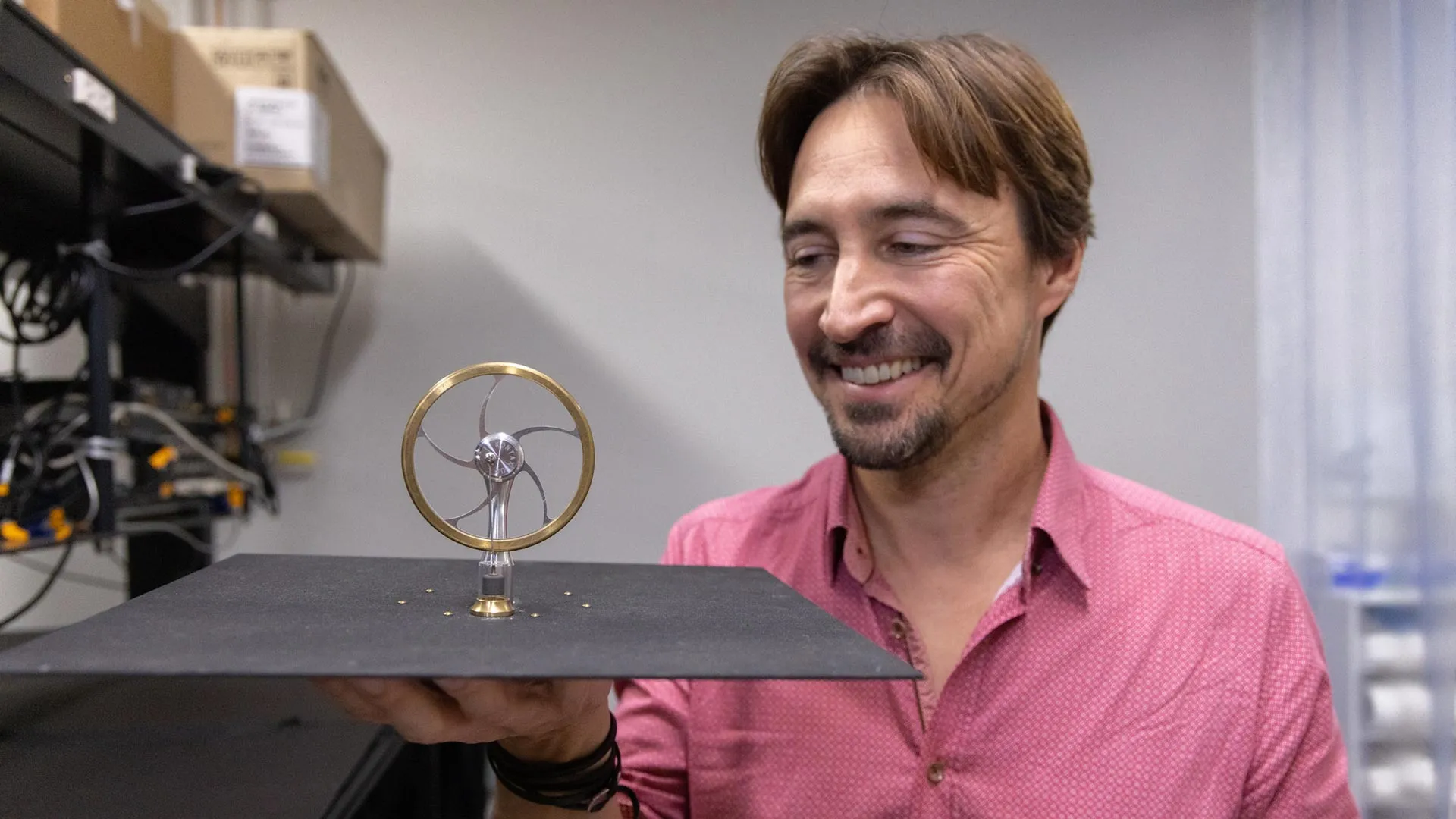
Engineers at the University of California, Davis have created a device that produces mechanical power at night by taking advantage of the temperature difference between the warmth of the Earth and the extreme cold of outer space. The system could eventually help ventilate greenhouses and other buildings without relying on fuel. The research appears in Science Advances.
The device is based on a Stirling engine, a type of machine designed to convert heat into mechanical motion. Unlike internal combustion engines, which require a large temperature gap to operate efficiently, Stirling engines can run on much smaller differences in heat. Jeremy Munday, professor of electrical and computer engineering at UC Davis and co author of the study, explained that the temperature contrast can be as modest as that between a hot cup of coffee and the surrounding air.
"These engines are very efficient when only small temperature differences exist, whereas other types of engines work better with larger temperature differences and can produce more power," Munday said.
In a typical setup, one side of a Stirling engine is kept warm while the other side is cooled. The temperature contrast drives a piston, which in turn produces mechanical energy.
"If you just set it on the table, it's not going to produce any power on its own because all sides are the same temperature," Munday said.
Using Deep Space as a Cold Reservoir
Usually, a temperature difference is created by heating one side of the engine with a fuel source. Instead of burning fuel, Munday and graduate student researcher Tristan Deppe explored whether the cold side could be linked to something far colder and much more distant: deep space.
"It doesn't actually have to touch space physically, it can just interact radiatively with space," Munday said. On a clear, cool night, heat naturally radiates away from your body toward the sky, which makes your head feel colder. The team aimed to use that same effect.
Their design places a simple Stirling engine (essentially a piston driving a flywheel) on top of a panel that acts as a heat radiating antenna. The entire system sits outdoors at night. The ground provides warmth to one side of the engine, while the panel releases heat upward, effectively connecting the other side to the cold of space.
Nighttime Experiments Show Promising Results
After a year of testing at night, the researchers found that the compact device could generate at least 400 milliwatts of mechanical power per square meter. In demonstrations, the engine directly powered a small fan. It was also connected to a small electric motor to produce electrical current.
These results show that meaningful amounts of energy can be captured from the night sky. According to Munday, the approach works best in regions with low humidity and consistently clear skies. In the future, the technology could help ventilate greenhouses or residential buildings without conventional energy sources.
UC Davis has filed a provisional patent related to the invention.
Story Source:
Materials provided by University of California - Davis. Note: Content may be edited for style and length.
Journal Reference:
- Tristan J. Deppe, Jeremy N. Munday. Mechanical power generation using Earth’s ambient radiation. Science Advances, 2025; 11 (46) DOI: 10.1126/sciadv.adw6833
Cite This Page: